
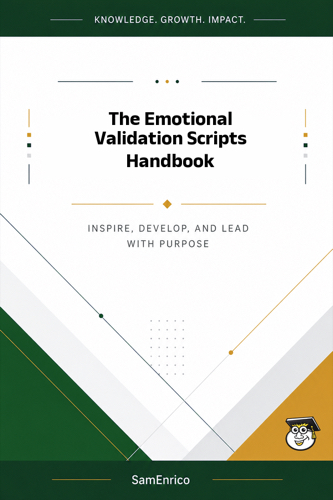
The Emotional Validation Scripts Handbook eBook
Provides phrase templates for validating anger, sa
Provides phrase templates for validating anger, sadness, fear, and joy.
Formats
Free sample
Chapter 1: The Listening Paradox...--–- It happens in almost every important conversation you have ever had. Someone you care about — a partner, a friend, a child, a colleague — sits across from you with pain or frustration visible on their face. They begin to speak. You feel a familiar pull in your chest. You want to help.
You want to fix it. You want to say the right thing that will make them feel better. And so you open your mouth, and you offer a solution. You give advice. You explain why it is not that bad.
You tell them what worked for you. And then, something strange happens. They do not feel better. They feel worse. They shut down.
They say, “You don’t understand.” They stop talking. And you are left wondering what you did wrong.This is the listening paradox. The harder you try to help, the more alone the other person feels. The more solutions you offer, the more certain they become that you are not really hearing them. Your desire to fix their problem has become the very thing that destroys your connection with them.
And you are not alone in this. Almost every human being does exactly the same thing.The problem is not that you do not care. The problem is not that you are selfish or unskilled or emotionally unintelligent. The problem is that human beings are wired to solve problems. Our brains are prediction engines.
We see a problem, and we immediately begin searching for a solution. This is how we survived as a species. When our ancestors saw a predator, they did not sit around validating each other’s fear. They ran. They solved.
They acted. That same neural circuitry is alive and well in you right now. When someone you love is in distress, your brain treats their emotion as a problem to be eliminated. And the fastest way to eliminate a problem is to offer a solution.But here is the truth that changes everything: most of the time, the other person is not asking for a solution. They are asking to be heard.
They are asking for their emotional experience to be acknowledged as real, valid, and understandable. They are asking for you to sit with them inside their feeling, not to pull them out of it. And until you give them that — until they feel truly heard — no solution you offer will ever be accepted. In fact, your solutions will feel like rejections. They will feel like you are saying, “Your feeling is inconvenient.
Let’s get rid of it.” And that is the opposite of what they need.This chapter is the foundation for everything that follows in this handbook. If you understand nothing else, understand this: validation comes before solutions. Always. In every emotional situation, with every person, across every context. Validation is not a technique you use to make someone feel better so you can then solve their problem.
Validation is the solution. It is the medicine itself. When a person feels deeply heard, their nervous system calms down. Their defenses lower. Their brain becomes capable of problem-solving again.
And often, after being validated, they will solve their own problem without any advice from you at all.The entire premise of this book rests on this single paradox: the fastest way to help someone solve their problem is to stop trying to solve their problem. Instead, you must learn to listen differently. You must learn to respond rather than react. And you must master the art of saying, “I hear you,” in a way that actually means something.The Neuroscience of Feeling Heard Before we go any further, let us look at what actually happens inside the human brain when someone feels validated versus when someone receives premature advice. This is not abstract psychology.
This is biology. And understanding the biology will make it easier to override your natural instincts.When a person is emotionally distressed — whether from anger, sadness, fear, or shame — their brain activates the amygdala. The amygdala is the brain’s threat detection system. It scans the environment for danger. When it finds danger, it triggers the sympathetic nervous system, releasing cortisol and adrenaline.
The person’s heart rate increases. Their breathing becomes shallow. Their attention narrows. Their body prepares to fight, flee, or freeze. In this state, the prefrontal cortex — the part of the brain responsible for logical reasoning, impulse control, and long-term planning — goes offline.
This is why people in emotional distress say things they regret, make impulsive decisions, and cannot “think straight.” Their thinking brain has been hijacked by their survival brain.Now, here is the critical insight. When someone offers a solution to a distressed person — even a good solution, even a kind solution — the brain often interprets that as further threat. Why? Because the solution implies that the current state is unacceptable. The distressed person’s brain hears, “You should not be feeling this way.
Your feeling is a problem that needs fixing.” And that message, however well-intentioned, confirms the person’s worst fear: that their emotion is wrong, bad, or shameful. The amygdala does not calm down. It stays activated. The person remains in survival mode.Validation works differently. When someone says, “It makes sense that you feel this way,” or “I hear how hard this is for you,” or even simply “That sounds terrible,” the brain receives a different message.
The message is: “Your feeling is real. Your feeling is acceptable. You are not alone in this feeling.” This message triggers the release of oxytocin — the bonding hormone — and activates the parasympathetic nervous system. The heart rate slows. Breathing deepens.
The prefrontal cortex comes back online. The person can think again. And only then, after the nervous system has regulated, is the brain capable of receiving solutions.This is not a theory. This is measurable neuroscience. Studies using functional MRI have shown that labeling emotions reduces amygdala activity.
Research on social support has demonstrated that perceived empathy lowers cortisol levels. The data is clear: validation is a biological intervention. It changes the chemistry of the brain. And without it, problem-solving is not just ineffective — it is counterproductive.The Difference Between Reaction and Response Now that you understand the biology, let us talk about behavior. Most people react to emotional distress.
Few people respond to it. The difference between a reaction and a response is the difference between automaticity and intentionality. And it is the single most important skill you will learn in this book.A reaction is automatic. It is fast. It comes from the older, more primitive parts of your brain.
When someone is upset, your reaction might be any of the following: offering a solution, sharing your own similar experience, minimizing the problem, explaining why it is not that bad, giving advice, asking clarifying questions too early, or changing the subject. None of these are malicious. All of them are natural. And all of them, in the absence of prior validation, will likely make the other person feel unheard.A response is intentional. It is slower.
It requires you to pause, to notice your own internal state, and to choose your words deliberately. A response might…
This is the end of the free sample. Get the eBook to keep going. Buy now
About this book
Details
- Author
- Mccullough Corinna
- Publisher
- SamEnrico
- Language
- English
- Genre
- Non-Fiction, Self-Help, Scripting
- Released
- 2026-06-06
- Pages (approx.)
- 131
- Available as
- eBook, Audiobook

Read better in the ZLOADR app
Your eBooks on your phone or tablet. Sign in with your SamEnrico account and start reading.
More by Mccullough Corinna
 TM and High Blood PressureMccullough Corinna$11.99
 Appetite Regulation SuggestionMccullough Corinna$11.99
 PCOS Cinnamon Blood Sugar GuideMccullough Corinna$11.99
 Peterson Laci Pregnancy Due Date RealityMccullough Corinna$11.99
 The Hollow Ones: Gilgamesh’s Forgotten WarMccullough Corinna$11.99
 Corning Glass PatentsMccullough Corinna$12.99
 Domain Leasing for Geo TLDsMccullough Corinna$12.99
 How to Become a Spray-machine LoaderMccullough Corinna$11.99
 Peritoneal Fluid AnalysisMccullough Corinna$11.99
 Understanding Pelvic LipomatosisMccullough Corinna$17.99
You may also like
 Hong Kong Handover 1997Dunn Johnnie$11.99
 Zumba For Postnatal Recovery CourseNeal Christian$11.99
 Zumba for BeginnersLadner Nikia$11.99
 YouTube Comment Mining GuideHumes Pandora$12.99
 Worry Box MeditationCarlin Rudy$11.99
 Workplace Stress MeditationNguyen Lynn$11.99
 Workplace Stress and Sleep RepairHawley Ivory$11.99
 Workplace Perfectionism CureDelaney Jeffry$11.99
 Workplace Injustice Anger GuideWallen Isabelle$11.99
 Work Addiction and Burnout LinkGreenwood Ester$11.99
 Women in Yoga and WellnessBeattie Galina$11.99
 Women in Stand Up ComedyChun Evangeline$11.99