
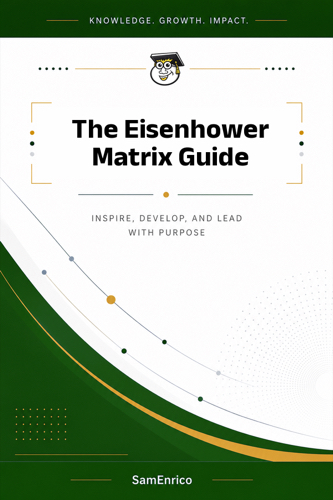
The Eisenhower Matrix Guide eBook
Master the urgent important matrix to stop firefig
by Busby Ardith
Master the urgent important matrix to stop firefighting and focus on what truly matters.
Formats
Free sample
Chapter 1: The Busyness Epidemic–- Sarah’s Tuesday began like any other. At 7:30 AM, she opened her laptop to find three emails marked “urgent.” By 9:30, she had been pulled into a crisis meeting about a client who might leave. She skipped lunch to draft a response. Between 2 PM and 5 PM, she answered 47 Slack messages, attended two more “quick syncs” that ran forty-five minutes each, and replied to fourteen emails while sitting in a conference room. At 6:47 PM, she closed her laptop, looked at her original to-do list—which contained exactly zero completed items—and felt a familiar wave of exhaustion mixed with shame.She had been busy.
She had not been effective.This chapter is about the difference between those two words. It is about why most professionals confuse activity with achievement, and why that confusion is not your fault. Before we can fix your time management, we must first understand why your brain fights every attempt to fix it. And before we introduce the Eisenhower Matrix—the tool that will change how you work—we must first diagnose the condition that makes you need it.The Addiction You Didn’t Know You Had Let us name the problem. You are likely addicted to urgency.
Not in the clinical sense of withdrawal seizures, but in the psychological sense that your brain has learned to crave the small dopamine hits that come from clearing a “crisis.” This is not a character flaw. It is a neurochemical reality.The human brain evolved to prioritize immediate threats over important opportunities. This made excellent sense on the savanna, where ignoring a rustle in the grass could mean becoming a lion’s lunch. But in the modern knowledge workplace, this same circuitry works against you. Your brain cannot tell the difference between a genuinely urgent client crisis and an email that someone marked “high priority” to make themselves feel important.
To your amygdala—the brain’s threat-detection center—both look like rustling grass.Here is what happens inside your skull when you see a notification: Your amygdala activates your sympathetic nervous system, releasing cortisol and adrenaline. Your heart rate increases. Your pupils dilate. Blood flows away from your prefrontal cortex—the part of your brain responsible for long-term planning and strategic thinking—and toward your muscles. You are literally becoming dumber in the moment you feel most productive.Then comes the reward.
When you clear that notification, answer that email, or resolve that “crisis,” your brain releases dopamine. This feels good. So good, in fact, that your brain learns to seek out the trigger that preceded the reward. You become conditioned to crave interruptions. You become addicted to the small, satisfying click of marking something “done”—even if that something was trivial.This is the Urgency Trap: completing urgent but unimportant tasks feels productive, feels rewarding, and feels like progress.
But at the end of the day, you have moved nothing forward that actually matters.Why Your Workplace Is Designed to Keep You Stuck If urgency addiction were only an internal problem, you could solve it with willpower. But your workplace is actively working against you. The modern office has been optimized for reactivity, not results.Consider the open office. According to research cited in Chris Bailey’s The Productivity Project, open-plan offices increase interruptions by 67 percent. Every time a colleague taps you on the shoulder or stops by your desk, your brain must disengage from whatever you were doing, process the interruption, respond, and then attempt to reorient.
This “context switching” costs an average of twenty-three minutes per interruption. If you are interrupted five times per day, you have lost nearly two hours—not of work time, but of thinking time.Now consider your communication tools. Email, Slack, Teams, and their cousins were designed for asynchronous communication—meaning you send a message and the other person responds when convenient. But somewhere along the way, every organization began treating these tools as synchronous. The expectation is that you will respond immediately.
A message marked “urgent” creates social pressure. A message left unanswered for an hour feels like a personal failure.The result is a workplace culture that rewards responsiveness over strategic work. The person who answers emails fastest is praised as “on top of things.” The person who spends four hours in deep concentration on a quarterly plan is invisible. The hero who extinguishes a fire gets the promotion. The person who prevented the fire in the first place gets nothing.This is not an accident.
This is the Firefighting Culture, and it is the single greatest barrier to meaningful productivity.The Three Costs of Constant Firefighting Living in a state of perpetual urgency is not merely unpleasant. It is expensive. Research across neuroscience, psychology, and organizational behavior has identified three major costs of chronic firefighting.The Creativity Cost Your brain has two major networks. The Task-Positive Network activates when you are focused on a specific goal—writing an email, solving a problem, following a recipe. The Default Mode Network activates when you are at rest—showering, walking, daydreaming.
Here is the crucial fact: The Default Mode Network is where creative insight happens. It is where disparate ideas connect. It is where you have your best ideas.Chronic urgency keeps your Task-Positive Network engaged constantly. Your Default Mode Network never gets a turn. This is why the answer to a stubborn problem often comes to you in the shower or on a walk—not while you are staring at the screen, fighting another fire.
By eliminating rest, urgency eliminates your capacity for breakthrough thinking.The Health Cost Sustained cortisol elevation—the hallmark of chronic urgency—has been linked to sleep disruption, weakened immune function, impaired memory, and decision fatigue. The firefighters among us are not heroes; they are patients in waiting. The body was not designed to sustain crisis mode indefinitely. When you live in Quadrant I, you are borrowing against your future health.The Relationship Cost Every hour spent fighting a manufactured fire is an hour stolen from your family, your friends, and yourself. This is not a matter of “work-life balance” rhetoric.
It is arithmetic. If you have two hours of genuine quality time with your children each evening, and you spend one of those hours answering “urgent” emails, you have reduced your presence by 50 percent. Your children will not remember the emails you answered. They will remember the parent who was distracted.The Self-Assessment You Must Take Honestly Before we proceed to any solution, you must know where you stand. The following fifteen-question diagnostic—the Urgency Addiction Score—will establish your baseline.
Answer each question as honestly as possible. There is no benefit to cheating; only the truth can set you free.Section A: Reactivity Patterns (1-5)When you see a notification, do you feel a physical pull to check it immediately? (1=Never, 5=Always)Do you check email or messaging apps before starting your most important work of the day? (1=Never, 5=Always)Do you feel anxious when you have not checked your inbox for more than an hour? (1=Never, 5=Always)Do you often find yourself working on tasks that others assigned to you rather than tasks you chose?
(1=Never, 5=Always)Do you feel “lazy” when you have no immediate crises to handle? (1=Never, 5=Always)Section B: Deep Work Availability (6-10)Can…
This is the end of the free sample. Get the eBook to keep going. Buy now
About this book
Details
- Author
- Busby Ardith
- Publisher
- SamEnrico
- Language
- English
- Genre
- Non-Fiction, Self-Help
- Released
- 2026-06-07
- Pages (approx.)
- 147
- Available as
- eBook, Audiobook

Read better in the ZLOADR app
Your eBooks on your phone or tablet. Sign in with your SamEnrico account and start reading.
More by Busby Ardith
 Bosnian War Family StoryBusby Ardith$11.99
 Self Esteem for Interfaith CouplesBusby Ardith$11.99
 Remote Team Expense GuideBusby Ardith$11.99
 Positive Emotion CultivationBusby Ardith$11.99
 Inside Antwerp VaultBusby Ardith$11.99
 Sober Curious Exploration GuideBusby Ardith$11.99
 The Stockholm Forgery: The Art Heist That Turned DeadlyBusby Ardith$11.99
 The Golden Voices of the Nile: Opera and Majesty in Ancient KemetBusby Ardith$11.99
 How to Produce Hair Care KitsBusby Ardith$11.99
 Mastering The Art of IndiaBusby Ardith$11.99
 A Collector's Handbook to the Dkw Meisterklasse F2Busby Ardith$11.99
 ISO 26000 Social ResponsibilityBusby Ardith$12.99
You may also like
 Hong Kong Handover 1997Dunn Johnnie$11.99
 Zumba For Postnatal Recovery CourseNeal Christian$11.99
 Zumba for BeginnersLadner Nikia$11.99
 YouTube Comment Mining GuideHumes Pandora$12.99
 Worry Box MeditationCarlin Rudy$11.99
 Workplace Stress MeditationNguyen Lynn$11.99
 Workplace Stress and Sleep RepairHawley Ivory$11.99
 Workplace Perfectionism CureDelaney Jeffry$11.99
 Workplace Injustice Anger GuideWallen Isabelle$11.99
 Work Addiction and Burnout LinkGreenwood Ester$11.99
 Women in Yoga and WellnessBeattie Galina$11.99
 Women in Stand Up ComedyChun Evangeline$11.99