
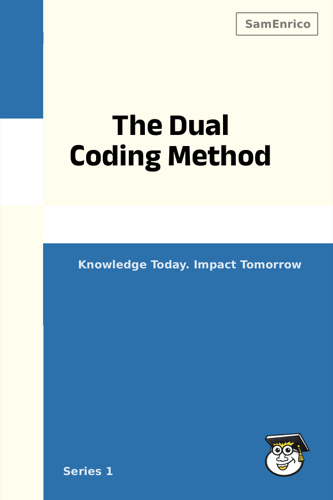
The Dual Coding Method Audiobook
Combine words and visuals to strengthen memory pat
Combine words and visuals to strengthen memory pathways.
Formats
Free sample
Chapter 1: The Two-For-One Brain...--–- Try this simple experiment before reading another sentence. Close your eyes. Picture the bedroom you slept in when you were ten years old. Notice the color of the walls. Where was the bed?
Was there a window, and if so, what did it look out onto? Could you reach out in your imagination and touch the texture of the carpet or the wood of the dresser? Most people can do this with startling clarity, summoning details they have not consciously thought about in decades.Now, without looking back, what was the third word of the previous paragraph?If you are like most people, the first task was effortless and the second was surprisingly difficult. You may remember the gist of that sentence—something about a bedroom—but the exact sequence of words is already fading. This simple contrast reveals something profound about how your brain is wired.
Your visual-spatial memory is ancient, powerful, and automatic. Your verbatim verbal memory is recent, fragile, and sequential. One evolved over hundreds of millions of years. The other is a cultural invention barely a few thousand years old.This book is about teaching these two systems to talk to one another.The Deep Structure of Human Memory In 1971, a Canadian psychologist named Allan Paivio proposed a theory that was radical for its time. While most researchers assumed that human memory operated like a single computer—processing information in one unified stream—Paivio argued for something else entirely.
He believed that the brain contains two separate but interconnected subsystems for processing information. He called this Dual Coding Theory.The first subsystem he called the verbal system. This system processes language in all its forms: written words, spoken sentences, numbers, mathematical symbols, and logical propositions. Paivio named the basic units of this system logogens—from the Greek logos meaning "word" or "reason." Logogens are sequential. They process information one piece at a time, in a linear chain.
They handle syntax, grammar, and abstract relationships. And they are relatively slow.The second subsystem he called the non-verbal system. This system processes everything else: mental images, spatial relationships, sounds, smells, textures, tastes, and even bodily sensations like balance and movement. Paivio named the basic units of this system imagens—from the Latin imago meaning "image" or "likeness." Imagens are holistic. They process entire scenes at once, in parallel.
They handle pattern recognition, emotional valence, and spatial navigation. And they are extraordinarily fast.Here is what makes Dual Coding Theory…
This is the end of the free sample. Get the Audiobook to keep going. Buy now
About this book
Details
- Author
- Hoover Ailene
- Publisher
- SamEnrico
- Language
- English
- Genre
- Non-Fiction, Self-Help, Learning
- Released
- 2026-06-07
- Pages (approx.)
- 140
- Available as
- eBook, Audiobook

Listen in the VoxFlicks app
Audiobooks and audio dramas wherever you go. Sign in with your SamEnrico account and press play.
More by Hoover Ailene
 Walking Meditation in the OfficeHoover Ailene$11.99
 Dream Poetry MethodHoover Ailene$11.99
 Zinc Immunity GuideHoover Ailene$11.99
 Political Conversation GuideHoover Ailene$11.99
 Pet Cremation DecisionsHoover Ailene$11.99
 Major System for Memorizing DigitsHoover Ailene$11.99
 Vision Board Action PlanHoover Ailene$11.99
 The Day the Internet Stood Still: The 2016 Dyn Cyberattack ExposedHoover Ailene$11.99
 The Alchemist and the Astronomer: A Timbuktu Love StoryHoover Ailene$11.99
 How to Start a Apple Growing Business (Beginners Guide)Hoover Ailene$11.99
 How to Produce Vacuum AccessoriesHoover Ailene$11.99
 Cooperative Value Chain FinanceHoover Ailene$12.99
You may also like
 Weekly Lessons LearnedThatcher Charline$11.99
 The SMART Criteria ExplainedToledo Theresia$11.99
 The Feynman Technique GuideHobbs Hong$11.99
 The Elaboration TechniqueLeclair Darline$11.99
 Lifelong Learning MemorySellers Florencia$11.99
 Slow Wave Sleep for FactsKinder Farah$11.99
 Pre Learning Sleep BenefitsCordova Codi$11.99
 Learning Speed AnchorShort Oren$11.99
 Handwritten vs Typed NotesLadner Leann$11.99
 The Beginner's Mistake GuideBlakely Manie$11.99
 Reading Hour Morning PlanAllen Julian$11.99
 Lesson Learned WeeklySnipes Sudie$11.99