
Non-FictionSelf-HelpPeer Communication
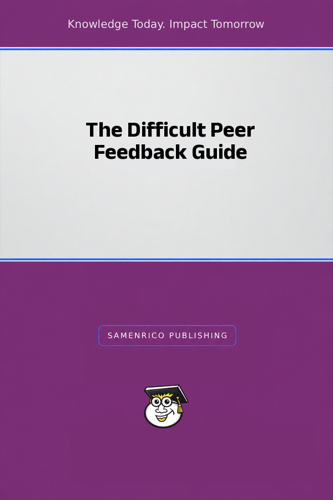
The Difficult Peer Feedback Guide eBook
How to give constructive criticism to coworkers wi
How to give constructive criticism to coworkers without hierarchy.
Formats
Free sample
Chapter 1: The Silence Tax--–- The email arrived at 9:47 AM on a Tuesday. Sarah, a senior product manager at a mid-sized tech company, had been copied on a thread about the Q3 launch. Buried in the chain was a message from her peer, Mark, that read: "Per my last email, I'll need the final numbers by EOD. This is the third time I've asked." The words were technically professional. But everyone on the thread felt the subtext: You are failing me.
Sarah's stomach dropped. She wanted to reply, to defend herself, to point out that Mark had changed the deadline twice without telling her. Instead, she closed the laptop and walked to the kitchen. She told a colleague, "Can you believe this guy?" The colleague nodded sympathetically. Neither of them ever spoke to Mark about the issue.
The launch happened, barely, with two bugs that could have been caught if Sarah and Mark had been able to talk directly. Six months later, Mark left the company. In his exit interview, he said he never felt trusted by his peers. Sarah, in her own review, cited "poor cross-functional communication" as a persistent obstacle. Neither of them was wrong.
Neither of them had spoken up. The silence cost the company an estimated $87,000 in rework and delayed feature releases. No one ever found out why.This is not an outlier. This is the daily, invisible tax that teams pay when peers cannot tell each other the truth.Welcome to the Silence Tax—the accumulated cost of every withheld observation, every swallowed critique, every moment you chose comfort over candor with someone who has the same job title as you. This book is not about how to give feedback to your boss.
It is not about how to manage a difficult subordinate. It is about the hardest, most common, and most neglected form of communication in modern work: peer-to-peer feedback without hierarchy.If you have ever bitten your tongue in a meeting, vented to your spouse about a coworker, watched a project drift into disaster because no one wanted to be "the bad guy," or received a passive-aggressive Slack message instead of a direct conversation—this chapter will show you why that happens, what it costs you, and why the discomfort you feel is not a sign of weakness but a design flaw in how we think about feedback.The Paradox of Peers Let us start with a simple experiment. Imagine your boss says to you: "Your presentation lacked structure." How do you feel? Probably a bit defensive, maybe anxious, but also—if you have a decent boss—you recognize this as part of their job. You might grumble, but you understand the transaction: they have authority, they are accountable for your output, and feedback is part of that contract.Now imagine a peer—someone at your exact level, with the same title, same salary band, same lack of authority over you—says the exact same words: "Your presentation lacked structure." What happens inside you?
For most people, the reaction is not mild defensiveness. It is hot. It feels like an attack. A status challenge. A violation of the unspoken code that says peers should be allies, not judges.This is the Power Paradox of peer feedback: the same words carry radically different meaning depending entirely on the perceived authority of the speaker.
Why?Because hierarchy provides contextual safety. When a boss critiques you, your brain understands the rules. The boss has the right to evaluate you. The boss's feedback, however uncomfortable, is part of a legitimate power structure. You may not like it, but you are not confused by it.When a peer critiques you, your brain has no pre-existing script.
The peer has not earned the right to evaluate you through any formal mechanism. So your brain does something else: it interprets the feedback as a status challenge. This is not a conscious choice. It is a neurological reflex, forged over millions of years of evolution in which status challenges within a tribe could mean loss of resources, mating opportunities, or even exile.And exile, to the ancient parts of your brain, still feels like death.The Neuroscience of "Who the Hell Are You?"To understand why peer feedback feels so threatening, we need to spend a few minutes inside your skull. This is the only chapter that will offer a deep neuroscience dive—we will call it the Neuroscience Box—and afterward, we will simply refer to "the threat response." But for now, stay with me.Your brain has an ancient alarm system centered on a small, almond-shaped cluster of neurons called the amygdala.
The amygdala does not think. It detects. Its job is to scan your environment for threats—predators, falling rocks, hostile tribe members—and to activate your sympathetic nervous system (fight, flight, freeze, or fawn) before your conscious mind even knows what is happening.The crucial fact for our purposes: the amygdala cannot distinguish between a physical threat (a tiger) and a social threat (a peer questioning your competence). To your amygdala, they are the same. Both trigger a cascade of cortisol and adrenaline.
Both narrow your cognitive field of view. Both prepare your body for combat or escape.This is called amygdala hijack, a term popularized by emotional intelligence researcher Daniel Goleman. When hijacked, your prefrontal cortex—the rational, planning, language-processing part of your brain—literally goes offline. Blood flow redirects to your limbs. Your hearing sharpens, but your ability to process complex language degrades.
This is why, when someone gives you unexpected peer feedback, you might suddenly forget the perfectly reasonable response you had rehearsed. You might stammer, get angry, or go silent. You are not weak. You are neurologically compromised.Now here is the cruel irony: the person giving you peer feedback is also experiencing amygdala activation. They, too, are flooded with threat response.
They, too, are likely to stumble, over-explain, or accidentally sound accusatory. Two people, both in threat response, trying to have a conversation about a sensitive topic, without the mediating structure of hierarchy.This is why most peer feedback conversations go badly. It is not because people are bad or cowardly. It is because the brain is not designed for this interaction. The entire book you are holding is, in essence, a user manual for bypassing your own amygdala and helping others bypass theirs.The Three Identity Triggers Even after the amygdala calms down, peer feedback remains difficult because it threatens three core identities that are particularly vulnerable in lateral relationships.
These are adapted from the work of Stone and Heen, who wrote the brilliant Thanks for the Feedback, but with a specific lens for peers.Identity Trigger #1: Competence"Are they saying I'm bad at my job?"When a boss questions your competence, you can attribute it to their need to manage performance. When a peer questions your competence, the implication is different: they think they are better than you. Because you and your peer occupy the same role, any critique of your work is implicitly a claim about relative standing. This is why peers so often respond to feedback with counter-critique: "Oh yeah? Well, you did X last week." They are not being…
This is the end of the free sample. Get the eBook to keep going. Buy now
About this book
Details
- Author
- Kunkel Xavier
- Publisher
- SamEnrico
- Language
- English
- Genre
- Non-Fiction, Self-Help, Peer Communication
- Released
- 2026-06-10
- Pages (approx.)
- 152
- Available as
- eBook, Audiobook

Read better in the ZLOADR app
Your eBooks on your phone or tablet. Sign in with your SamEnrico account and start reading.
More by Kunkel Xavier
 Burnout In Nonprofit Sector CourseKunkel Xavier$11.99
 Port Wine Stain Birthmark GuideKunkel Xavier$11.99
 Cukor Women DirectorKunkel Xavier$11.99
 Grandparent Sleep ConsistencyKunkel Xavier$11.99
 The Phantom of Yankee Stadium: The Secret Blueprint That Built a DynastyKunkel Xavier$11.99
 How to Become a Distribution SupervisorKunkel Xavier$11.99
 Understanding Mesenteric IschemiaKunkel Xavier$17.99
 US Corporate Transparency ActKunkel Xavier$12.99
 SWOT Analysis Prompt EngineeringKunkel Xavier$12.99
 System Automation DeveloperKunkel Xavier$11.99
You may also like
 Hong Kong Handover 1997Dunn Johnnie$11.99
 Zumba For Postnatal Recovery CourseNeal Christian$11.99
 Zumba for BeginnersLadner Nikia$11.99
 YouTube Comment Mining GuideHumes Pandora$12.99
 Worry Box MeditationCarlin Rudy$11.99
 Workplace Stress MeditationNguyen Lynn$11.99
 Workplace Stress and Sleep RepairHawley Ivory$11.99
 Workplace Perfectionism CureDelaney Jeffry$11.99
 Workplace Injustice Anger GuideWallen Isabelle$11.99
 Work Addiction and Burnout LinkGreenwood Ester$11.99
 Women in Yoga and WellnessBeattie Galina$11.99
 Women in Stand Up ComedyChun Evangeline$11.99