
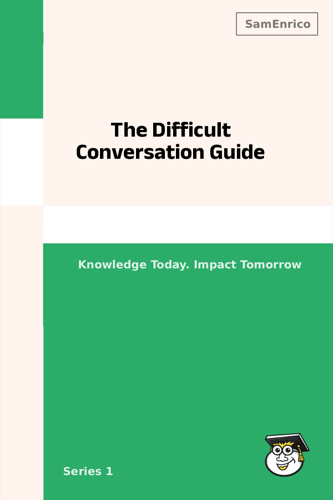
Non-FictionSelf-HelpCommunication
The Difficult Conversation Guide eBook
Prepare for high stakes talks with scripts, mindse
Prepare for high stakes talks with scripts, mindset shifts, and emotional regulation tools.
Formats
Free sample
Chapter 1: The Ambush Inside–- You are driving home after a long day. The radio is playing something forgettable. You are not thinking about anything in particular. Then your phone buzzes. A text from your boss: “We need to talk about the Henderson project.
Tomorrow, 9 a.m.”Your stomach drops. Your shoulders tense. Your mouth goes dry.You have not even read the second sentence yet. You do not know what the conversation will be about. It could be good news.
It could be neutral. But your body has already decided: something is wrong.This is the ambush inside. It happens to everyone. It happens to CEOs and first-year associates. It happens to parents and partners and friends.
The moment a conversation feels high stakes, your own biology turns against you. Not because you are weak. Not because you lack social skills. Because your brain is doing exactly what evolution programmed it to do: treat a social threat like a physical one.The problem is that what worked on the savanna—running from a predator, fighting a rival, freezing in the tall grass—does not work in a conference room or across a dinner table. In fact, those same instincts are the primary reason difficult conversations go badly.
Not because you said the wrong thing. But because your body hijacked your mouth before your mind had a chance to speak.This chapter is about understanding that ambush. Not to eliminate it—you cannot rewire millions of years of evolution in a single chapter. But to recognize it, name it, and catch it before it fully disables you. Because once you can see the ambush coming, you have a fighting chance to step around it.The Three Ingredients of a Crucial Conversation Not every conversation is difficult.
You do not need a script for deciding where to order lunch. You do not need emotional regulation tools for confirming a meeting time. A conversation becomes “crucial”—the kind that makes your heart race and your palms sweat—when three specific conditions collide.First, high stakes. Something important is on the line. A job.
A relationship. Your reputation. A child’s well-being. Money. Respect.
The stakes do not have to be life-or-death. They just have to matter to you. And the more something matters, the more your brain treats its potential loss as a threat.Second, strong emotions. You feel something. Fear.
Anger. Shame. Anxiety. Hurt. Perhaps a mix of several at once.
These emotions are not the problem—they are information. The problem is what happens to your cognitive functioning when emotions run high. You do not think clearly when you are afraid. You do not listen well when you are angry. You do not solve problems creatively when you are ashamed.Third, differing opinions.
You see the situation one way. The other person sees it differently. Maybe they think you missed the deadline. Maybe they think you were rude. Maybe they want one direction for the project and you want another.
The gap between your view and theirs is where the friction lives. If you agreed on what happened, what it meant, and what to do about it, the conversation would be easy. The difficulty comes from the gap.When you have all three—high stakes, strong emotions, and differing opinions—you are in a crucial conversation. And crucial conversations have a nasty habit of going wrong. Not because people are bad communicators.
Because their brains are doing exactly what evolution designed them to do.The Amygdala Hijack: Your Brain's False Fire Alarm Deep inside your brain, tucked behind your ears, sits a small almond-shaped cluster of neurons called the amygdala. Its job is simple: scan the environment for threats. It does this constantly, unconsciously, in milliseconds. The amygdala does not reason. It does not wait for evidence.
It reacts.Millions of years ago, this was a superb design. A rustle in the bushes could be the wind—or it could be a saber-toothed cat. The amygdala did not wait to find out. It triggered a cascade of stress hormones—adrenaline and cortisol—that flooded your body, readying you to fight, flee, or freeze. The people whose amygdalas reacted first lived longer.
The people who stopped to think got eaten.Your amygdala is still doing the same job today. It just has different targets. A critical email. A tense silence. A boss who says “we need to talk.” Your amygdala cannot tell the difference between a predator and a performance review.
It treats both as existential threats.This is the amygdala hijack. The term was coined by psychologist Daniel Goleman, and it describes what happens when the amygdala bypasses your prefrontal cortex—the part of your brain responsible for logic, planning, empathy, and self-control—and takes direct control of your behavior.The symptoms are unmistakable. Your heart pounds. Your breathing becomes shallow. Your throat tightens.
Your hearing narrows—you literally stop hearing as well because blood is being redirected to your limbs for fighting or running. Your peripheral vision shrinks. Your mouth dries up. You might feel heat in your chest or face. Your stomach might clench.And crucially: your ability to think clearly collapses.
You cannot find the right words. You forget what you planned to say. You blurt something you immediately regret. Or you say nothing at all, your mind going blank.Here is what most people get wrong about the amygdala hijack. They think it is an all-or-nothing event—either you are hijacked or you are fine.
In reality, the hijack happens on a spectrum. There is early activation—the first few seconds when your heart rate starts to rise and you feel a flicker of tension. And there is full flooding—tunnel vision, inability to form sentences, a sense of watching yourself from outside your body.The distinction matters enormously because it tells you what to do next. If you catch the hijack in the early activation stage—the first two or three seconds—you can pause, breathe, and redirect. If you are already fully flooded, no amount of “just calm down” will work.
You need different tools entirely. (Those tools are waiting for you in Chapter 6.)For now, the most important skill is simply recognizing the hijack as it begins. Most people do not notice they are being hijacked until after they have already said something damaging. They are driving home thinking, “Why did I say that? That is not even how I feel.” The hijack happened so fast that their conscious mind never got a vote.So let us practice the recognition now.
Think of a recent difficult conversation that went badly. Not a catastrophe—just one where you left thinking you could have handled it better. As you replay that memory, scan your body. Did your chest tighten? Did your shoulders rise?
Did your voice change—get louder or quieter? Those were the physical signatures of your amygdala doing its job. It saw a threat. It reacted. You did not notice until later.The goal is not to eliminate the hijack.
The goal is to shrink the gap between the hijack starting and you noticing it. From thirty seconds to ten. From ten to…
This is the end of the free sample. Get the eBook to keep going. Buy now
About this book
Details
- Author
- Emanuel Christiane
- Publisher
- SamEnrico
- Language
- English
- Genre
- Non-Fiction, Self-Help, Communication
- Released
- 2026-06-07
- Pages (approx.)
- 139
- Available as
- eBook, Audiobook

Read better in the ZLOADR app
Your eBooks on your phone or tablet. Sign in with your SamEnrico account and start reading.
More by Emanuel Christiane
 Saying No at Work GuideEmanuel Christiane$11.99
 Banking Job Loss RecoveryEmanuel Christiane$11.99
 Carson Nature Poetry Prose GuideEmanuel Christiane$11.99
 West Side Story JetsEmanuel Christiane$11.99
 Ideation Brainstorm MethodsEmanuel Christiane$11.99
 Remote Onboarding CommunicationEmanuel Christiane$11.99
 Creative Risk Taking GuideEmanuel Christiane$11.99
 The Visionary and the Void: How Ridley Scott Defied Hollywood's OddsEmanuel Christiane$11.99
 The Silent Rebellion: The Women Who Defied the Olympics (1928)Emanuel Christiane$11.99
 A Collector's Handbook to the Sunbeam Imp SportEmanuel Christiane$11.99
 How to Produce Other FurnitureEmanuel Christiane$11.99
 How to Produce Communication EquipmentEmanuel Christiane$11.99
You may also like
 Hong Kong Handover 1997Dunn Johnnie$11.99
 Zumba For Postnatal Recovery CourseNeal Christian$11.99
 Zumba for BeginnersLadner Nikia$11.99
 YouTube Comment Mining GuideHumes Pandora$12.99
 Worry Box MeditationCarlin Rudy$11.99
 Workplace Stress MeditationNguyen Lynn$11.99
 Workplace Stress and Sleep RepairHawley Ivory$11.99
 Workplace Perfectionism CureDelaney Jeffry$11.99
 Workplace Injustice Anger GuideWallen Isabelle$11.99
 Work Addiction and Burnout LinkGreenwood Ester$11.99
 Women in Yoga and WellnessBeattie Galina$11.99
 Women in Stand Up ComedyChun Evangeline$11.99