
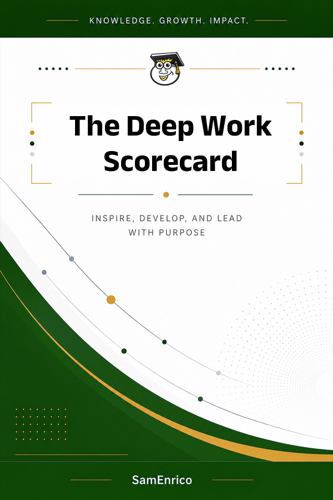
Non-FictionBusiness BriefMetrics
The Deep Work Scorecard eBook
Measure your focused hours and cognitive output.
Measure your focused hours and cognitive output.
Formats
Free sample
Chapter 1: The Attention Audit--–- You are about to discover something uncomfortable. By the time you finish reading this sentence, the average knowledge worker will have already considered switching tasks at least once. Not because they are lazy. Not because they lack ambition. Because their brain has been trained—systematically, relentlessly, by an economy that profits from their fragmentation—to crave the next ping, the next badge, the next dopamine-spiked notification.This is not a moral failing.
It is a design flaw in modern work. And you cannot fix what you refuse to measure.The 40-Hour Lie Let us begin with a simple question: How many hours did you work last week?If you are like most professionals reading this book, you answered with a number between 40 and 60. Perhaps you felt a small surge of pride. Perhaps you felt exhaustion. Perhaps you felt nothing at all, because the number has become meaningless—a badge of busyness that no longer correlates with actual output.Here is the truth those numbers hide: You were present for 40 to 60 hours.
You focused for far less.Research conducted across multiple knowledge work industries reveals a consistent and startling pattern. The average office worker experiences approximately two hours and forty-eight minutes of truly productive, focused work per day. The remaining five to seven hours are consumed by task-switching, email triage, meetings, recovery from interruptions, and what researchers call "pseudo-work"—the appearance of productivity without meaningful output.Let us be precise about what we mean. When we say "truly productive, focused work," we mean uninterrupted cognitive effort directed at a single, challenging task that moves a meaningful needle. Writing a proposal.
Analyzing a data set. Coding a new feature. Designing a strategy. Learning a difficult skill. These are the activities that create value, build careers, and produce the outputs that organizations actually pay for.Everything else is what this book will call shallow work.
We will define it once here, and refer back to this definition throughout: Shallow work consists of non-cognitively demanding, logistically-oriented tasks that are easily replicable and rarely create lasting value. Email triage. Meeting scheduling. Expense reporting. Status updates.
Social media management. Reading news alerts. Reorganizing files. Attending meetings without clear agendas. These tasks feel productive because they produce immediate closure—the satisfying dopamine hit of sending a message or checking a box.
But they rarely move meaningful needles.You have likely felt this gap. You have ended a ten-hour day exhausted, yet unable to name a single significant thing you accomplished. You have looked at your calendar, seen it packed with back-to-back meetings, and realized at 5 PM that you never touched your actual priority work. You have told yourself, "Tomorrow will be different," only to repeat the same cycle.Tomorrow will not be different. Not unless you measure what is actually happening.The 47-Second Ceiling Let us make this uncomfortable in a specific, quantifiable way.Researchers studying computer programmers, financial analysts, writers, and designers have identified a consistent metric: the average knowledge worker stays on a single screen for approximately forty-seven seconds before switching tasks.
Forty-seven seconds. Not minutes. Seconds.Consider what that means. In the time it has taken you to read the first few paragraphs of this chapter, the average worker would have switched tasks three or four times. They would have glanced at their email inbox.
They would have checked a Slack notification. They would have looked at their phone. They would have opened a browser tab for something entirely unrelated. They would have done all of this without consciously deciding to do so—because task-switching has become an automatic, addictive habit, wired into the basal ganglia through thousands of repetitions.This is not speculation. Functional magnetic resonance imaging studies of task-switching show that the brain releases small amounts of dopamine when shifting attention to a new stimulus.
Each ping, each badge, each notification acts as a variable-reward slot machine: you do not know what email just arrived, so checking it offers the possibility of something interesting, important, or validating. That possibility triggers a dopamine release. The dopamine reinforces the checking behavior. The behavior becomes automatic. The automatic behavior becomes identity.You are not weak.
You are being exploited by an attention economy designed to fragment you.The cost of this fragmentation is staggering. Researchers estimate that it takes an average of twenty-three minutes to fully return to a complex task after an interruption. Twenty-three minutes. Not to "get back to work"—to reach the same depth of cognitive engagement you had before the interruption. If you are interrupted every forty-seven seconds, you never reach depth at all.
You spend your entire day in what neuroscientists call "continuous partial attention": a state of shallow, reactive, low-quality cognitive processing that feels like work but produces minimal value.The Fragmentation Index We cannot fix what we refuse to measure. So let us measure.The Fragmentation Index is the first of eleven metrics in the Deep Work Scorecard. It answers a simple question: How destroyed is your workday by interruptions?Here is the formula:Fragmentation Index = Total hours at work ÷ Uninterrupted focus blocks But we must be careful. This initial version of the book mistakenly assumed that an "uninterrupted focus block" meant ninety minutes. That assumption works for some people but fails for many others.
A person who has trained for years to focus can sustain ninety-minute blocks. A person who currently switches tasks every forty-seven seconds cannot. Demanding a ninety-minute block from a severely fragmented worker is like demanding a four-plate deadlift from someone who has never entered a gym.So we will define the Fragmentation Index progressively.For the first week of using this Scorecard, an "uninterrupted focus block" means any continuous period of single-task focus that exceeds your current personal average block length. If you currently switch tasks every forty-seven seconds, a three-minute block counts. If you currently sustain ten minutes before distraction, a fifteen-minute block counts.
The metric tracks improvement, not perfection.For the second week, increase your target block length by twenty percent. For the third week, another twenty percent. By week twelve, you will be targeting ninety-minute blocks—but only if you have followed the progressive overload protocol in Chapter 8. Do not jump ahead. Do not demand more of your brain than it can currently deliver.A healthy Fragmentation Index for a beginner is 4:1—four hours of work time containing at least one uninterrupted block that exceeds your current baseline.
A destructive score is 8:0—eight hours of work time containing no uninterrupted blocks at all. Most knowledge workers start at 8:0 or worse.Your goal over the next twelve weeks is to move from 8:0 to 4:1 to 2:1 to, eventually, 1:1—one uninterrupted block of appropriate length for every hour of work time. That is the level at which deep work becomes sustainable as a daily practice rather than a rare event.The Three-Day Attention Audit You cannot calculate your Fragmentation Index without data. This chapter includes a three-day Attention Audit worksheet. You will complete it tomorrow, the day after, and the day after that.
You will not skip it. You will not estimate from memory. Memory lies. Memory smooths over the uncomfortable truth of fragmentation.Here is the protocol:For three consecutive…
This is the end of the free sample. Get the eBook to keep going. Buy now
About this book
Details
- Author
- Tan Nicolette
- Publisher
- SamEnrico
- Language
- English
- Genre
- Non-Fiction, Business Brief, Metrics
- Released
- 2026-06-06
- Pages (approx.)
- 138
- Available as
- eBook, Audiobook

Read better in the ZLOADR app
Your eBooks on your phone or tablet. Sign in with your SamEnrico account and start reading.
More by Tan Nicolette
 Stress and Allergies GuideTan Nicolette$11.99
 Affirmations for HSPsTan Nicolette$11.99
 Swing at SunsetTan Nicolette$11.99
 Flow in CookingTan Nicolette$11.99
 Kayak River Floating GuideTan Nicolette$11.99
 Martial Artist's HypnosisTan Nicolette$11.99
 ABCDE for Project ManagersTan Nicolette$11.99
 Whale Sharks: Largest FishTan Nicolette$11.99
 The Wolfpack Strikes: U-Boats and the Atlantic Shadow War (1940-1943)Tan Nicolette$11.99
 The Golden Girls of Algiers: How African Athletes Defied Colonialism on the World StageTan Nicolette$11.99
 Youth Cooperative Formation GuideTan Nicolette$12.99
 Chinese Supplier Exclusivity PlaybookTan Nicolette$12.99
You may also like
 Hong Kong Handover 1997Dunn Johnnie$11.99
 Zumba For Postnatal Recovery CourseNeal Christian$11.99
 Zumba for BeginnersLadner Nikia$11.99
 YouTube Comment Mining GuideHumes Pandora$12.99
 Worry Box MeditationCarlin Rudy$11.99
 Workplace Stress MeditationNguyen Lynn$11.99
 Workplace Stress and Sleep RepairHawley Ivory$11.99
 Workplace Perfectionism CureDelaney Jeffry$11.99
 Workplace Injustice Anger GuideWallen Isabelle$11.99
 Work Addiction and Burnout LinkGreenwood Ester$11.99
 Women in Yoga and WellnessBeattie Galina$11.99
 Women in Stand Up ComedyChun Evangeline$11.99