
Non-FictionSelf-HelpProductivity
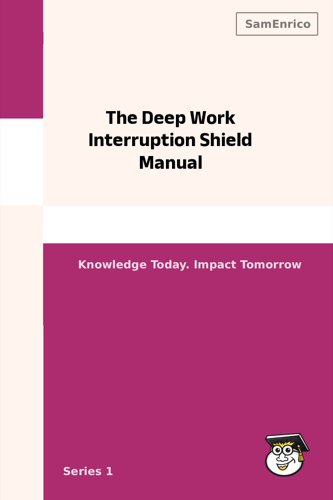
The Deep Work Interruption Shield Manual eBook
Build a personal barrier against constant workplac
by Parks Ian
Build a personal barrier against constant workplace disruptions using proven cognitive control techniques.
Formats
Free sample
Chapter 1: The Open Door Tax--–- Sarah had been at her desk since 7:30 AM. It was now 5:47 PM, and she had just realized she had not made a single dent in the project that was due Friday. Her calendar showed ten hours of logged time. Her actual output: three emails, a rearranged spreadsheet, and a headache. She had answered forty-two Slack messages, attended two unscheduled “quick syncs” that ran forty-five minutes each, and replied to an email chain about a meeting that could have been a bullet point.
When her manager asked what she accomplished, she felt a familiar wave of shame. She had been busy all day. But she had not done anything that mattered.This is not a story about laziness. It is not a story about poor time management or a lack of discipline. Sarah is smart, motivated, and genuinely wants to do good work.
She is also a prisoner of the most common and least examined productivity killer in the modern workplace: the myth of the open door.The myth says that constant availability is a virtue. It says that a good colleague responds quickly, that a valuable team member is always reachable, and that the person who answers every message first is the one who cares the most. This myth has been sold to us so thoroughly that we have stopped questioning it. We wear our responsiveness like a badge of honor. We apologize when we do not reply within minutes.
We have built entire workplace cultures around the assumption that interruption is collaboration and that availability is accountability.The myth is wrong. And it is costing you weeks of your life every year.The Invention of Shallow Work Before we can build a shield against interruptions, we must understand what we are protecting. The most useful framework comes from Cal Newport, a computer science professor who spent years studying the habits of high-performing professionals in fields ranging from theoretical physics to creative writing. Newport drew a sharp line between two types of work: shallow and deep.Shallow work is the work of logistics. It includes answering emails, updating spreadsheets, moving tasks from one column to another in a project management tool, attending status meetings, rearranging files, and responding to messages that ask for information you already have.
Shallow work is often necessary. A company cannot function without some amount of coordination. But shallow work has a defining characteristic: it does not create new value. It merely moves existing value from one place to another.Deep work is the work of creation. It is writing a proposal that changes a client’s mind, debugging a complex system, designing a marketing strategy, analyzing data to find a pattern no one has seen before, or drafting the section of a report that requires original thinking.
Deep work is cognitively demanding. It requires sustained, uninterrupted attention. And it is the only type of work that actually moves the needle. Newport’s research found that deep workers consistently produced more value in four focused hours than shallow workers produced in ten fragmented ones.The tragedy of the modern office is that we have inverted the ratio. Most knowledge workers spend 60 to 80 percent of their day on shallow work, squeezing deep work into the few minutes between meetings or the last exhausted hour of the afternoon.
We treat deep work as the exception and shallow work as the rule. Then we wonder why we feel perpetually behind.The Hidden Cost of a Quick Question The myth of the open door makes this inversion worse by actively destroying our capacity for deep work. The mechanism is context switching, and its cost is far higher than most people realize.When you are engaged in deep work, your brain builds a temporary neural structure specific to the task at hand. This structure includes the relevant facts, the current state of the problem, the next step you plan to take, and the half-formed ideas that have not yet crystallized. This structure is fragile.
It exists in your working memory, which is a limited resource. Think of it as a house of cards that you have carefully assembled.An interruption—a Slack message, a tap on the shoulder, an email notification—collapses that structure. Your brain must reallocate resources to the new stimulus. By the time you have dealt with the interruption, the original neural structure has degraded. Rebuilding it takes time.
Research from the University of California, Irvine, found that after a typical interruption, it takes an average of twenty-three minutes and fifteen seconds to return to the same level of focus. That is not the time to resume working. That is the time to get back to the same depth of cognitive engagement you had before the interruption.Let us do the math. Suppose you have a four-hour deep work block scheduled for the morning. If you receive one interruption at the ninety-minute mark, you lose roughly twenty-three minutes to recovery.
But that is not the full cost. The interruption also fragments the block into two smaller chunks, each of which requires its own ramp-up time. In practice, a single interruption in a ninety-minute block reduces productive output by 40 percent. Two interruptions reduce it by 60 percent. Three interruptions, and the block is effectively worthless.Now multiply that across a week.
The average knowledge worker experiences fifty-six interruptions per day, according to a study by Gloria Mark at UC Irvine. Fifty-six. That means the typical worker spends nearly four hours every day just recovering from interruptions. Four hours. That is twenty hours a week.
That is one thousand hours a year. That is twenty-five forty-hour workweeks spent entirely on the cognitive equivalent of restarting your computer.The open door is not a policy of collaboration. It is a tax. And you are paying it every single day.Case Study: The Fragmented Engineer Consider James, a senior software engineer at a mid-sized technology company. James was highly skilled, with a decade of experience and a reputation for solving difficult problems.
But over the course of a year, his productivity had declined by nearly half. He was working longer hours but shipping less code. His manager was concerned. James was frustrated. Neither could figure out what had gone wrong.We asked James to track his interruptions for three days.
The results were staggering. On day one, he was interrupted thirty-seven times. Twenty-two of those interruptions came from Slack. Nine came from email notifications. Six came from colleagues stopping by his desk.
His average recovery time was twenty-one minutes. His total time lost to recovery was nearly thirteen hours across three days. He was losing an entire workday every three days to the cost of getting back on track.But the deeper problem was what the interruptions prevented. James had been trying to refactor a critical piece of the company’s payment processing system—a task that required sustained, uninterrupted concentration to understand the existing code, map the dependencies, and design a cleaner architecture. He had attempted to start this task nine times over the course of two weeks.
Each time, an interruption arrived within the first forty-five minutes. Each time, the neural house of cards collapsed. After nine…
This is the end of the free sample. Get the eBook to keep going. Buy now
About this book
Details
- Author
- Parks Ian
- Publisher
- SamEnrico
- Language
- English
- Genre
- Non-Fiction, Self-Help, Productivity
- Released
- 2026-06-10
- Pages (approx.)
- 141
- Available as
- eBook, Audiobook

Read better in the ZLOADR app
Your eBooks on your phone or tablet. Sign in with your SamEnrico account and start reading.
More by Parks Ian
 Religious Identity ShiftParks Ian$11.99
 Imposter Syndrome Daily Reset GuideParks Ian$11.99
 Laura Bush First LadyParks Ian$11.99
 Working Memory and IQ LinkParks Ian$11.99
 Low Carb For DiabeticsParks Ian$11.99
 Financial Stress Couple AngerParks Ian$11.99
 The Gilded Betrayal: How a Queen’s Secret Divorce Shattered an EmpireParks Ian$11.99
 The Voice of the Continent: How SuperSport Revolutionized African Sports BroadcastingParks Ian$11.99
 Understanding ErythromelalgiaParks Ian$11.99
 How to Produce Sink LegsParks Ian$11.99
 A Collector's Handbook to the Buick Aug-50Parks Ian$11.99
 Trademark Renewal in WIPOParks Ian$12.99
You may also like
 Hong Kong Handover 1997Dunn Johnnie$11.99
 Zumba For Postnatal Recovery CourseNeal Christian$11.99
 Zumba for BeginnersLadner Nikia$11.99
 YouTube Comment Mining GuideHumes Pandora$12.99
 Worry Box MeditationCarlin Rudy$11.99
 Workplace Stress MeditationNguyen Lynn$11.99
 Workplace Stress and Sleep RepairHawley Ivory$11.99
 Workplace Perfectionism CureDelaney Jeffry$11.99
 Workplace Injustice Anger GuideWallen Isabelle$11.99
 Work Addiction and Burnout LinkGreenwood Ester$11.99
 Women in Yoga and WellnessBeattie Galina$11.99
 Women in Stand Up ComedyChun Evangeline$11.99