
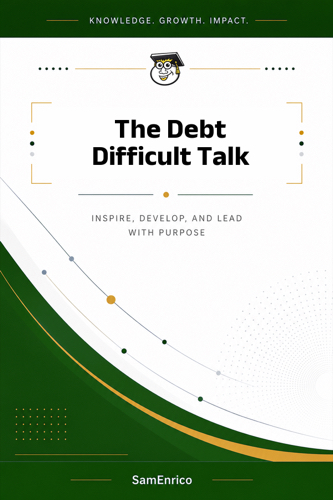
The Debt Difficult Talk eBook
Discuss financial struggles with a partner or fami
by Sanborn Cris
Discuss financial struggles with a partner or family member.
Formats
Free sample
Chapter 1: The $64,000 Question...--–- The envelope arrived on a Tuesday. Beige, windowed, return address from a bank she didn't recognize. Maria slid it under a stack of junk mail without opening it—the seventeenth unopened envelope in six months. Her husband, Tom, sat three feet away, scrolling his phone, having no idea that their credit card debt had quietly ballooned to $47,000. Neither of them had said a word about money in eleven months.
Not because they didn't care. Because they were terrified.This is how financial distress actually lives in most households: not as screaming fights or slammed doors, but as a thick, suffocating silence. The kind that settles into the space between two people who love each other but cannot bring themselves to say, "I'm scared." Maria and Tom are not bad people. They are not lazy, or selfish, or financially illiterate. They are two adults who never learned how to have a single conversation that might save their marriage—and their credit score—because no one ever taught them.That silence is the real enemy of this book.
Not the debt itself. Not the interest rates. Not the past-due notices. The silence.Money remains the last taboo in intimate relationships. We can talk about sex, politics, religion, and even death with relative ease compared to the simple question: "How much do you owe?" A 2023 survey by the National Endowment for Financial Education found that 41% of adults have lied to their partner about money—hiding debt, concealing purchases, or pretending to have more savings than they do.
Forty-one percent. Nearly half of all relationships are built on a foundation of quiet financial deception. And here is the cruelest part: most of those lies are not born of malice. They are born of shame.The Shame Trap Shame is the most destructive emotion in personal finance, and it operates differently from guilt. Guilt says, "I did something bad." Shame says, "I am bad." When you hide a credit card statement, you are not protecting your partner from bad news.
You are protecting yourself from the confirmation of what you secretly believe: that you are fundamentally broken when it comes to money.This book introduces a framework called the Shame-to-Strategy Continuum. Imagine a line. On the far left is Shame: hiding, lying, avoiding, pretending. On the far right is Strategy: joint problem-solving, transparency, shared planning. Most couples never move past the left side of the continuum.
They remain stuck in shame, believing that if they just ignore the problem long enough, it might disappear—or at least not blow up until after the holidays.The problem with shame is that it demands secrecy, and secrecy makes everything worse. When you hide a $200 purchase, you feel shame. The shame makes you hide the next purchase. The hiding creates distance. The distance breeds resentment.
The resentment explodes over something small—a $20 pizza, a forgotten receipt—and suddenly you are fighting about pepperoni while what you are really fighting about is $47,000 in credit card debt and eleven months of silence.The Tire Comparison Here is a metaphor that will appear throughout this book, because it explains almost everything about how financial distress destroys relationships. Think about the tires on your car. They wear down gradually, invisibly, mile by mile. You do not notice the tread getting thinner. You do not feel the slow degradation.
And then one day, on the highway, at 70 miles per hour, a tire blows out. The explosion seems sudden. It seems catastrophic. It seems like it came out of nowhere.But it didn't. The blowout was the final event in a long, predictable process of wear.
The problem was not the blowout. The problem was the thousands of miles of invisible erosion that preceded it.Financial distress works exactly the same way. Couples do not typically divorce over a single $20,000 debt. They divorce over the slow, invisible erosion of trust, intimacy, and safety that happens while neither person is willing to say, "I'm scared about the money." By the time the blowout comes—a missed mortgage payment, a collector's call, a partner discovering a secret credit card—the relationship has already been damaged beyond easy repair. The blowout is just the moment when the damage becomes visible.This book is not primarily about debt reduction.
There are hundreds of books that will teach you how to negotiate with creditors, consolidate loans, or file for bankruptcy. This book is about something more fundamental: how to have the conversation that stops the invisible erosion before the blowout happens. You can fix a blown tire. It is much harder to fix a marriage that has been quietly dying for years.The Three Warning Signs You Are Already in the Red Zone Most couples do not realize they are in financial distress until the blowout. But the erosion leaves signs.
You just have to know what to look for.Warning Sign One: The Mail Pile. You have a specific place where unopened bills go to die. Maybe it is a kitchen drawer. Maybe it is a pile on the desk. Maybe it is a digital folder labeled "To Do" that you never open.
The specific location does not matter. What matters is that you have stopped opening envelopes because you are afraid of what you will find. The mail pile is not a organizational problem. It is a shame containment system.Warning Sign Two: The Subject Change. When your partner says, "How are we doing on money?" you deflect.
You say, "Fine," or "The usual," or "I'll look at it this weekend." You change the subject to the kids, the weather, or what to watch on Netflix. You are not trying to deceive. You are trying to avoid the feeling of your stomach dropping through the floor. But avoidance is a form of deception, and your partner knows it.Warning Sign Three: Defensive Spending. You buy something small—a coffee, a treat, a $14 item at Target—and you immediately feel the need to justify it.
"It was on sale." "I had a gift card." "It's for the house." The defensiveness is not about the $14. It is about the accumulated weight of every previous purchase you felt you had to hide. You are not defending the coffee. You are defending your right to exist without shame.If you recognize any of these signs in your relationship, you are already in the red zone. The erosion is happening.
The good news is that you caught it before the blowout. The better news is that you are holding a book that will give you the exact words, systems, and protocols to stop the erosion and start moving from shame to strategy.Why Most Couples Never Have the Talk Here is what stops people from having the difficult money conversation. It is not laziness. It is not a lack of love. It is a very specific, very predictable set of fears that this book is designed to dismantle, one chapter at a time.Fear One: "If I tell the truth, they will leave." This is the most common fear, and it is almost always wrong.
What drives partners away is not the debt itself. It is the secrecy. A 2022 study from Kansas State University…
This is the end of the free sample. Get the eBook to keep going. Buy now
About this book
Details
- Author
- Sanborn Cris
- Publisher
- SamEnrico
- Language
- English
- Genre
- Non-Fiction, Self-Help, Finance
- Released
- 2026-06-08
- Pages (approx.)
- 119
- Available as
- eBook, Audiobook

Read better in the ZLOADR app
Your eBooks on your phone or tablet. Sign in with your SamEnrico account and start reading.
More by Sanborn Cris
 Strategic Alliance MappingSanborn Cris$11.99
 Rapid Cycling Bipolar HandbookSanborn Cris$11.99
 The Set Point Theory GuideSanborn Cris$11.99
 Improv for PerfectionistsSanborn Cris$11.99
 Self Esteem and Credit StealingSanborn Cris$11.99
 Public Speaking for Graduate StudentsSanborn Cris$11.99
 Joy of Small ThingsSanborn Cris$11.99
 The Forgotten Siege: Changde's Bloodied Winter (1943)Sanborn Cris$11.99
 The Fox and the Bear: Rommel vs. Montgomery in North Africa (1940-1943)Sanborn Cris$11.99
 How to Become a Mat-machine OperatorSanborn Cris$11.99
 How to Produce Outdoor Grill CartsSanborn Cris$11.99
 Oral Promise That Became a ContractSanborn Cris$12.99
You may also like
 Hong Kong Handover 1997Dunn Johnnie$11.99
 Zumba For Postnatal Recovery CourseNeal Christian$11.99
 Zumba for BeginnersLadner Nikia$11.99
 YouTube Comment Mining GuideHumes Pandora$12.99
 Worry Box MeditationCarlin Rudy$11.99
 Workplace Stress MeditationNguyen Lynn$11.99
 Workplace Stress and Sleep RepairHawley Ivory$11.99
 Workplace Perfectionism CureDelaney Jeffry$11.99
 Workplace Injustice Anger GuideWallen Isabelle$11.99
 Work Addiction and Burnout LinkGreenwood Ester$11.99
 Women in Yoga and WellnessBeattie Galina$11.99
 Women in Stand Up ComedyChun Evangeline$11.99