
Non-FictionInformativeEducational
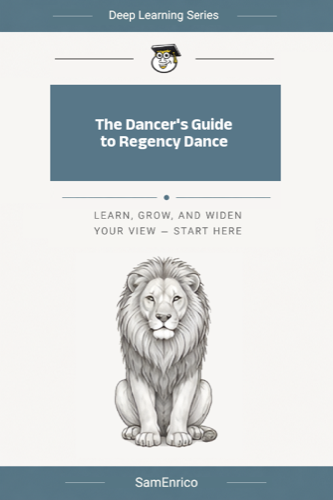
The Dancer's Guide to Regency Dance
This publication, published by SamEnrico, covers T
This publication, published by SamEnrico, covers The Dancer's Guide to Regency Dance
Formats
About this book
Free sample
Chapter 1: The Bounce Before Bridgerton...--–- Every year, millions of viewers watch Colin Bridgerton sweep Penelope Featherington across a candlelit ballroom in a dance so slow, so stately, so breathlessly romantic that it has launched a thousand fantasies. There is only one problem: that dance never happened. Not once. Not anywhere in England between 1790 and 1825. The Regency era did not dance like that.
The truth is far more surprising, far more athletic, and far more joyful. The truth is that Regency dancers bounced.This chapter dismantles the single greatest misconception about the era—a misconception so pervasive that even award-winning period films perpetuate it—and replaces it with a foundation that will transform everything you think you know about historical dance. If you have come to this book expecting to learn slow, measured, dignified movements suitable for a museum display, you are about to be delightfully disabused. What Regency dancers actually did was skip, slide, leap, and spin with an energy that would leave most modern fitness classes breathless. And understanding why tells us something profound not only about dance, but about an entire society on the brink of modernity.The Great Misconception: Where Slow Dances Came From Let us begin by identifying the enemy, because it is not malice but misunderstanding.
The "slow, stately Regency dance" that appears in film after film—from the beloved 1995 Pride and Prejudice to more recent productions—is not Regency at all. It is Victorian. Specifically, it is the English Country Dance as filtered through the late Victorian revival movement of the late nineteenth century, a revival that fundamentally altered tempo, posture, and aesthetic.The Victorian era (1837–1901) prized restraint, moral uprightness, and controlled emotion. Its dances reflected these values. The Victorian ballroom was a place of formalized courtship under strict chaperonage, where bodies were kept at prescribed distances and movements were clean, precise, and—above all—slow.
When Cecil Sharp and the English Folk Dance Society began reviving "traditional" English dances in the early 1900s, they drew heavily on Victorian interpretations and, more significantly, on the memories of elderly Victorian dancers whose tempos…
This is the end of the free sample. Get the eBook to keep going. Buy now
Contents
- Chapter 1
- Chapter 2
- Chapter 3
- Chapter 4
- Chapter 5
- Chapter 6
- Chapter 7
- Chapter 8
- Chapter 9
- Chapter 10
- Chapter 11
- Chapter 12
Details
- Author
- Chandler Natalie
- Publisher
- SamEnrico
- Language
- English
- Genre
- Non-Fiction, Informative, Educational
- Released
- 2026-05-11
- Pages (approx.)
- 140
- Available as
- eBook, Audiobook

Read better in the ZLOADR app
Your eBooks on your phone or tablet. Sign in with your SamEnrico account and start reading.
More by Chandler Natalie
 Relationship Status Envy GuideChandler Natalie$11.99
 The Perfectionist Parent LegacyChandler Natalie$11.99
 Wedding Comparison CultureChandler Natalie$11.99
 Teen Digital Detox GuideChandler Natalie$11.99
 The COVID Vaccine ComparisonChandler Natalie$11.99
 Twitch Watching Addiction GuideChandler Natalie$11.99
 Benzo Withdrawal HellChandler Natalie$11.99
 Grit Mistakes GuideChandler Natalie$11.99
 Imposter Syndrome And BurnoutChandler Natalie$11.99
 The Last Empress: A Dynasty’s Fall and a Family’s FightChandler Natalie$11.99
 The Oxford Enlighteners: Scholars Who Shaped the Modern MindChandler Natalie$11.99
 The Midnight Tunnels of Alcatraz: The Untold Breakout of 1962Chandler Natalie$11.99
You may also like
 Hong Kong Handover 1997Dunn Johnnie$11.99
 Zumba For Postnatal Recovery CourseNeal Christian$11.99
 Zumba for BeginnersLadner Nikia$11.99
 YouTube Comment Mining GuideHumes Pandora$12.99
 Worry Box MeditationCarlin Rudy$11.99
 Workplace Stress MeditationNguyen Lynn$11.99
 Workplace Stress and Sleep RepairHawley Ivory$11.99
 Workplace Perfectionism CureDelaney Jeffry$11.99
 Workplace Injustice Anger GuideWallen Isabelle$11.99
 Work Addiction and Burnout LinkGreenwood Ester$11.99
 Women in Yoga and WellnessBeattie Galina$11.99
 Women in Stand Up ComedyChun Evangeline$11.99