
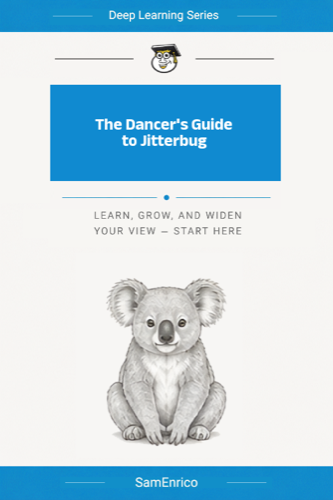
Non-FictionInformativeEducational
The Dancer's Guide to Jitterbug eBook
This publication, published by SamEnrico, covers T
This publication, published by SamEnrico, covers The Dancer's Guide to Jitterbug
Formats
Free sample
Chapter 1: The Beat That Built America...--“Jitterbug” – say the word aloud. Feel how it bounces off your tongue: JIT-ter-bug. The very sound is playful, syncopated, energetic. It suggests something small and restless, something that cannot stay still. And that, as you will discover, is precisely the point.This opening chapter is not a dry preface or a mechanical list of objectives.
It is an invitation. An invitation to understand not just a dance but a cultural earthquake that began in a sprawling ballroom in Harlem and never really stopped shaking. Before you place your hand on a partner’s shoulder or take your first rock step, you need to know what Jitterbug actually is – and, just as importantly, what it is not.Let us begin with a confession: “Jitterbug” is a messy, contradictory, wonderful word. It is a term that has meant different things to different generations. To your grandparents, it might have meant the wild, acrobatic dancing they saw in newsreels from the 1940s.
To Dick Clark’s teenage audience on American Bandstand, it meant the “Bop” – a high-energy version of swing danced to early rock and roll. To a swing dance enthusiast today, it might mean something else entirely. This book embraces that messiness because the dance itself was never neat or codified. Jitterbug was born on crowded dance floors, not in formal studios, and it carries the fingerprints of everyone who ever threw themselves into its rhythm.The Great Confusion: What Jitterbug Is (and Isn't)Here is the most important clarification you will read in this entire book: While the original Savoy-era Jitterbug (1920s–1930s) was predominantly 8‑count Lindy Hop, the term “Jitterbug” as used in this book refers primarily to the 6‑count Single Step Swing that became dominant on American Bandstand and in social dance studios from the 1950s onward.Why does this matter? Because if you walk into a swing dance event and tell someone you dance “Jitterbug,” they might assume you mean Lindy Hop with its flashy aerials and eight-count patterns.
But if you have learned the material in this book, you will be dancing a 6‑count pattern – rock step, step, step, rock step, step, step – that is more accessible, more forgiving at faster tempos, and historically the version most Americans actually danced when they “jitterbugged” at their high school prom or at a sock hop.The confusion is understandable. The history is genuinely tangled. So let us untangle it together.A Family Tree of Swing Dances Think of Jitterbug as a large, welcoming family. At the head of the table sits Lindy Hop – the original 8‑count swing dance born at the Savoy Ballroom in Harlem. Lindy Hop is athletic, improvisational, and built around the “swingout,” a move that sends partners away from each other and then snaps them back together like a rubber band.Sitting next to Lindy Hop is East Coast Swing – a 6‑count simplification of Lindy that was codified by dance studios in the 1940s and 1950s to teach the masses.
East Coast Swing is what most Americans learned in Arthur Murray studios. It is the Jitterbug’s polite, well-behaved cousin.Jive is the British and international version – faster, more upright, and eventually adopted as a competitive ballroom dance. Charleston (1920s) and Shag (1930s Carolinas) are older relatives with distinctive footwork that influenced everything that followed. Balboa is the close-embrace cousin, danced to extremely fast music in crowded ballrooms where there was no room for big kicks or turns.And then there is Single Step Swing – the true subject of this book. Single Step Swing uses a 6‑count pattern with single steps rather than triple steps.
It is danced to music between 150 and 215 beats per minute. It does not require the athleticism of Lindy Hop or the closed-embrace intimacy of Balboa. It is the most social, most forgiving, most universally accessible version of swing dancing. And for most of American history, when people said “Jitterbug,” this is what they meant.Where Did the Word Come From?The etymology of “jitterbug” is almost as colorful as the dance itself. Most historians trace the term to the 1930s, when “jitter” was slang for alcohol withdrawal tremors.
Someone with the “jitters” was nervous, shaky, unable to hold still. The suffix “-bug” was added affectionately – like “ladybug” or “lightning bug” – to describe someone who was afflicted with uncontrollable movement.But the word truly entered the American lexicon through Cab Calloway, the legendary bandleader and scat singer. In 1934, Calloway recorded a song titled “Call of the Jitter Bug.” The lyrics described a fictional ailment that struck dancers who moved too fast and too wildly. “The jitter bug,” Calloway sang, “is a funny little dance.” The name stuck. Soon, anyone dancing to the new swing music was called a “jitterbug.” The dance itself became the Jitterbug.There is a beautiful irony here.
“Jitterbug” began as a mildly derogatory term – a joke about nervous tremors. But dancers embraced it. They wore the name like a badge of honor. To be a jitterbug was to be so moved by the music that you could not help but shake. That is the spirit this book hopes to cultivate.How This Book Is Different Before you proceed to Chapter 2, you deserve to know why this guide exists.
There are many books about swing dancing. Some are purely historical. Others are step-by-step manuals without any cultural context. Still others are overly academic, written for scholars rather than dancers.The Dancer’s Guide to Jitterbug does something different. It assumes that you want three things:To understand where the dance came from.
You will not learn Jitterbug properly without knowing the people who invented it – the Black dancers of Harlem’s Savoy Ballroom, the working-class teenagers who transformed it on American Bandstand, and the Detroit innovators who evolved it into the “Jit.”To actually learn the steps. This book is practical. Chapters 4 through 9 contain detailed, illustrated instructions for the Jitterbug Stroll, basic footwork, connection technique, and more than a dozen social moves. Each move is broken down with countable steps, weight-shift notation, and troubleshooting tips.To join a community. Jitterbug is not a solo activity.
The final chapters of this book help you find local dances, understand floorcraft etiquette, choose appropriate footwear, and overcome the perfectly normal fear of dancing with strangers.Every chapter balances history with instruction. You will never read two hundred years of background without learning something you can practice immediately. And you will never be taught a move without understanding its cultural context.The 6‑Count Core: Your First Glimpse Because this is a practical book, let us look briefly at the foundational pattern – the one you will practice obsessively until it becomes automatic.The 6‑Count Single Step Pattern (also called “Single Step Swing” or “Six-Count Jitterbug”):Counts 1-2: Rock step (step back with your left foot, then replace weight onto your right)Counts 3-4: Step, step (step to the side with your left, then step to the side with your right)Counts 5-6: Rock step (step back with your left foot, then replace weight onto your right)That is the entire pattern. Six counts. Three weight changes (rock step, step-step, rock step).
If you are a follower, you simply reverse the roles – rock step with your right foot first.Do not worry…
This is the end of the free sample. Get the eBook to keep going. Buy now
About this book
Details
- Author
- Mccullough Yetta
- Publisher
- SamEnrico
- Language
- English
- Genre
- Non-Fiction, Informative, Educational
- Released
- 2026-05-08
- Pages (approx.)
- 145
- Available as
- eBook, Audiobook

Read better in the ZLOADR app
Your eBooks on your phone or tablet. Sign in with your SamEnrico account and start reading.
More by Mccullough Yetta
 Diamond Vault Legend HistoryMccullough Yetta$11.99
 Imposter Syndrome for Product ManagersMccullough Yetta$11.99
 Contingent Beneficiary GuideMccullough Yetta$11.99
 Sustainable Therapy Training Supervisors GuideMccullough Yetta$11.99
 Learner Driver Patience GuideMccullough Yetta$11.99
 Peg System Memory WorkbookMccullough Yetta$11.99
 Nicotine Depression Link GuideMccullough Yetta$11.99
 Period Flu Remedies GuideMccullough Yetta$11.99
 Vitamin D Deficiency RLSMccullough Yetta$11.99
 The Last Telegram: The Untold Story of the Titanic’s Final HoursMccullough Yetta$11.99
 The Hermit King's Gambit: Yi Sun-sin and the Turtle Ships of MyeongnyangMccullough Yetta$11.99
 The Stone Spies: Gothic Architects of the DivineMccullough Yetta$11.99
You may also like
 Hong Kong Handover 1997Dunn Johnnie$11.99
 Zumba For Postnatal Recovery CourseNeal Christian$11.99
 Zumba for BeginnersLadner Nikia$11.99
 YouTube Comment Mining GuideHumes Pandora$12.99
 Worry Box MeditationCarlin Rudy$11.99
 Workplace Stress MeditationNguyen Lynn$11.99
 Workplace Stress and Sleep RepairHawley Ivory$11.99
 Workplace Perfectionism CureDelaney Jeffry$11.99
 Workplace Injustice Anger GuideWallen Isabelle$11.99
 Work Addiction and Burnout LinkGreenwood Ester$11.99
 Women in Yoga and WellnessBeattie Galina$11.99
 Women in Stand Up ComedyChun Evangeline$11.99