
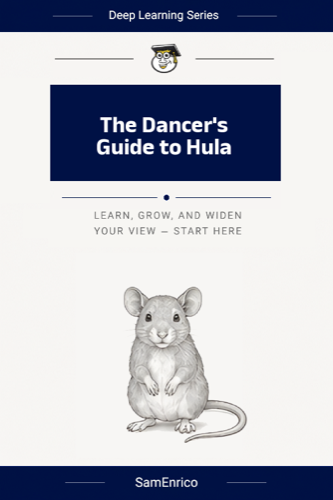
Non-FictionInformativeEducational
The Dancer's Guide to Hula
This publication, published by SamEnrico, covers T
by Coates Cher
This publication, published by SamEnrico, covers The Dancer's Guide to Hula
Formats
About this book
Free sample
Chapter 1: The Living Archive...--Every human culture has its way of remembering. Some build stone monuments. Others write books or record voices. The Hawaiian people built a different kind of archive—one made of muscle, breath, and memory. They called it hula.If you have opened this book expecting a simple dance manual—a collection of steps to be memorized and performed—you have come to the right place but for the wrong reason.
This book will indeed teach you how to move your feet, shape your hands, and sway your hips. But before any of that, it must teach you something far more important: that hula is not a thing you do. It is a world you enter.Consider what happens when a Western dancer learns ballet. She learns positions: first, second, third. She learns vocabulary: plié, relevé, arabesque.
These are mechanical descriptions of where the body goes. But when a Hawaiian dancer learns hula, she learns that her left hand tracing a wave is not simply an arm moving through space. It is the ocean itself. Her hips rotating are not a stylistic flourish. They are the earth turning, the seasons cycling, the generations unfolding.This is the first and most essential truth of hula: it is a living archive.The Difference Between Dancing and Remembering To understand why hula is unlike any Western dance form, we must first understand what Hawaiʻi lost—and what it fought to keep.Before Western contact in 1778, when Captain James Cook arrived at Kealakekua Bay, the Hawaiian islands maintained a sophisticated oral tradition spanning more than a thousand years of recorded history.
There were no books. No written language in the Western sense. Every piece of knowledge—genealogies tracing back to the gods, navigational charts of the Pacific, medical treatments using native plants, agricultural calendars tied to the stars, and legal precedents governing land and water rights—was preserved in two forms: chant and dance.The chant was called mele. The dance was called hula.Together, they formed a dual system of cultural preservation. The mele provided the text: the precise words, the encoded metaphors…
This is the end of the free sample. Get the eBook to keep going. Buy now
Contents
- Chapter 1
- Chapter 2
- Chapter 3
- Chapter 4
- Chapter 5
- Chapter 6
- Chapter 7
- Chapter 8
- Chapter 9
- Chapter 10
- Chapter 11
- Chapter 12
Details
- Author
- Coates Cher
- Publisher
- SamEnrico
- Language
- English
- Genre
- Non-Fiction, Informative, Educational
- Released
- 2026-05-11
- Pages (approx.)
- 149
- Available as
- eBook, Audiobook

Read better in the ZLOADR app
Your eBooks on your phone or tablet. Sign in with your SamEnrico account and start reading.
More by Coates Cher
 Bipolar Sleep Regulation PrimerCoates Cher$11.99
 Bipolar Disorder Support In Poor NationsCoates Cher$11.99
 Gacy's Last MealCoates Cher$11.99
 Dream Recall MethodsCoates Cher$11.99
 FCPA False Statements CasesCoates Cher$11.99
 Pattern Recognition for CoachesCoates Cher$11.99
 Nighttime Stretching ProtocolCoates Cher$11.99
 Imposter Syndrome for First Gen StudentsCoates Cher$11.99
 Kim Jong IlCoates Cher$11.99
 Phantom of the Freeway: The I-5 Killer's Trail of BloodCoates Cher$11.99
 Ragnarok's Unseen Architect: The Forgotten Role of GullinkambiCoates Cher$11.99
 The Marble Mirage: How a Lost Roman Sculptor Outwitted the GodsCoates Cher$11.99
You may also like
 Hong Kong Handover 1997Dunn Johnnie$11.99
 Zumba For Postnatal Recovery CourseNeal Christian$11.99
 Zumba for BeginnersLadner Nikia$11.99
 YouTube Comment Mining GuideHumes Pandora$12.99
 Worry Box MeditationCarlin Rudy$11.99
 Workplace Stress MeditationNguyen Lynn$11.99
 Workplace Stress and Sleep RepairHawley Ivory$11.99
 Workplace Perfectionism CureDelaney Jeffry$11.99
 Workplace Injustice Anger GuideWallen Isabelle$11.99
 Work Addiction and Burnout LinkGreenwood Ester$11.99
 Women in Yoga and WellnessBeattie Galina$11.99
 Women in Stand Up ComedyChun Evangeline$11.99