
Non-FictionInformativeEducational
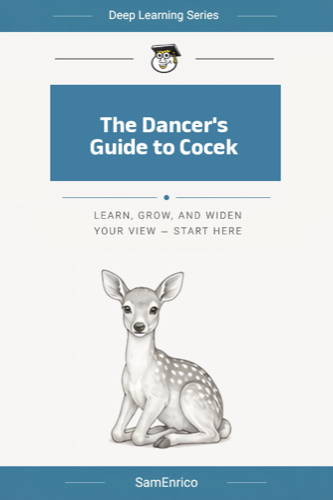
The Dancer's Guide to Cocek
This publication, published by SamEnrico, covers T
This publication, published by SamEnrico, covers The Dancer's Guide to Cocek
Formats
About this book
Free sample
Chapter 1: The Forgotten Guardians...–- The first thing you must understand about Čoček is that it was never supposed to survive. This is not a court dance preserved in royal manuscripts. It is not a folkloric reconstruction staged by a national tourism board. Čoček is the dance of people who have been chased, enslaved, marginalized, and misnamed for a thousand years, and the fact that you can learn its basic step today is nothing short of a miracle of human stubbornness. Before your foot ever slides across the floor, before you count your first 9/8 rhythm, before you tie a single coin to your hip, you need to know who carried this dance through fire and who is still carrying it now.
Without that knowledge, you are not dancing Čoček. You are merely moving your body while Balkan music plays. And those two things are not the same.The year is 1826. In Istanbul, the Sultan has just committed an act of cultural violence that will echo across the Balkans for two centuries. Mahmud II has disbanded the Janissary Corps, the elite Ottoman infantry, and with them, he has destroyed the Mehteran—the military brass bands that had thundered through Ottoman territories since the fourteenth century.
The musicians scatter. They flee to the provinces, to the villages, to the edges of the empire. They carry with them instruments that had never been heard outside the palace: the zurna (a piercing shawm), the davul (a deep double-headed drum), and eventually, the brass instruments that would define a new sound. These displaced musicians land in the towns and countryside of what is now Bulgaria, North Macedonia, Serbia, Kosovo, and northern Greece. And they are welcomed—not by the wealthy, not by the powerful, but by the Romani people.The Romani communities of the Balkans had already been living at the crossroads of empires for four hundred years.
They had arrived in Europe from northwestern India around the fourteenth century, bringing with them a musical tradition that emphasized improvisation, emotional intensity, and a deep relationship between rhythm and the human body. By…
This is the end of the free sample. Get the eBook to keep going. Buy now
Contents
- Chapter 1
- Chapter 2
- Chapter 3
- Chapter 4
- Chapter 5
- Chapter 6
- Chapter 7
- Chapter 8
- Chapter 9
- Chapter 10
- Chapter 11
- Chapter 12
Details
- Author
- Morley Mathilde
- Publisher
- SamEnrico
- Language
- English
- Genre
- Non-Fiction, Informative, Educational
- Released
- 2026-05-25
- Pages (approx.)
- 140
- Available as
- eBook, Audiobook

Read better in the ZLOADR app
Your eBooks on your phone or tablet. Sign in with your SamEnrico account and start reading.
More by Morley Mathilde
 Year Review VisualizationMorley Mathilde$11.99
 Teacher Classroom ListeningMorley Mathilde$11.99
 Contract Abstraction Prompt VersioningMorley Mathilde$11.99
 Indigenous Forgiveness Rituals GuideMorley Mathilde$11.99
 Diarrhea in ChildrenMorley Mathilde$11.99
 Role Transition Imposter GuideMorley Mathilde$11.99
 The Catholic League CrusadeMorley Mathilde$11.99
 Parent Outsourcing GuideMorley Mathilde$11.99
 Remote Work Isolation FixesMorley Mathilde$11.99
 The Blood Eagle: Odin’s Forgotten CurseMorley Mathilde$11.99
 The Ballpoint Breakthrough: How a Disruptive Pen Changed the WorldMorley Mathilde$11.99
 Feast of the Northmen: The Viking Banquets That Built KingdomsMorley Mathilde$11.99
You may also like
 Hong Kong Handover 1997Dunn Johnnie$11.99
 Zumba For Postnatal Recovery CourseNeal Christian$11.99
 Zumba for BeginnersLadner Nikia$11.99
 YouTube Comment Mining GuideHumes Pandora$12.99
 Worry Box MeditationCarlin Rudy$11.99
 Workplace Stress MeditationNguyen Lynn$11.99
 Workplace Stress and Sleep RepairHawley Ivory$11.99
 Workplace Perfectionism CureDelaney Jeffry$11.99
 Workplace Injustice Anger GuideWallen Isabelle$11.99
 Work Addiction and Burnout LinkGreenwood Ester$11.99
 Women in Yoga and WellnessBeattie Galina$11.99
 Women in Stand Up ComedyChun Evangeline$11.99