
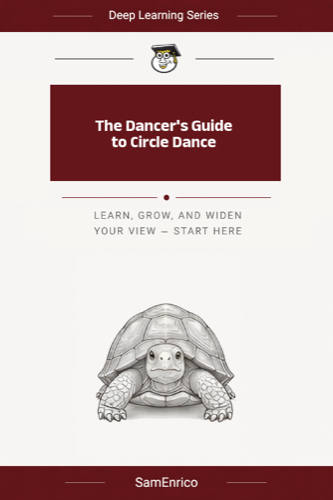
Non-FictionInformativeEducational
The Dancer's Guide to Circle Dance
This publication, published by SamEnrico, covers T
by Weeks Jamar
This publication, published by SamEnrico, covers The Dancer's Guide to Circle Dance
Formats
About this book
Free sample
Chapter 1: The Shape We Already Know...--Before you ever heard the words “circle dance,” before you stepped onto a wooden floor in a workshop or linked arms at a wedding reception, your body already understood one essential truth: humans move better together when we move in a ring. This is not poetry. It is neurology, anthropology, and simple physics. A circle is the only formation in which every participant has an equal view of every other participant. No one is in the back.
No one is at the front. There is no head of the table, no end of the line, no corner of the room where visibility fails. When you stand in a circle, you are simultaneously a performer and an audience of one—for every other person in that ring. That mutual visibility triggers something ancient in the human brain. Prisoners in circle-based rehabilitation programs show lower recidivism than those in traditional rows.
Therapy groups seated in circles report higher trust metrics than those seated in lines. And dancers in a closed circle consistently rate their experience as more “connected” and “safe” than dancers in open lines. This is not magic. This is geometry applied to the nervous system. But geometry alone does not make a dance.
You need to know what kind of circle you are forming, how to hold the person next to you without harming them, and when to let the circle change shape. This chapter gives you those tools. By the end, you will see every circle dance differently—not as a chaotic ring of flailing arms, but as a precise, beautiful, and forgiving conversation between bodies.The Five Faces of the Circle Before you take a single step, you must learn to see what kind of container you are standing inside. Most books describe three or four circle formations. You will learn five, because the fifth solves a contradiction that has confused dancers for decades.
Let us name them clearly.Open Circle is what you use when someone is teaching. The circle is not fully closed. Hands may be free, resting at sides, or…
This is the end of the free sample. Get the eBook to keep going. Buy now
Contents
- Chapter 1
- Chapter 2
- Chapter 3
- Chapter 4
- Chapter 5
- Chapter 6
- Chapter 7
- Chapter 8
- Chapter 9
- Chapter 10
- Chapter 11
- Chapter 12
Details
- Author
- Weeks Jamar
- Publisher
- SamEnrico
- Language
- English
- Genre
- Non-Fiction, Informative, Educational
- Released
- 2026-05-08
- Pages (approx.)
- 122
- Available as
- eBook, Audiobook

Read better in the ZLOADR app
Your eBooks on your phone or tablet. Sign in with your SamEnrico account and start reading.
More by Weeks Jamar
 Sacaltar Indigenous Prayer ManualWeeks Jamar$11.99
 Mistake Apology OvercorrectionWeeks Jamar$11.99
 Journalist Breaking News StressWeeks Jamar$11.99
 The French Religious WarsWeeks Jamar$11.99
 Summer Break SchedulingWeeks Jamar$11.99
 Problem Solving VisualizationWeeks Jamar$11.99
 Constipation MythsWeeks Jamar$11.99
 Layoff Survival Emotional GuideWeeks Jamar$11.99
 Active Listening in SalesWeeks Jamar$11.99
 The Golden Court of the Nubian Pharaohs: Splendor and Sovereignty Along the NileWeeks Jamar$11.99
 The Alchemist’s Cure: Ibn Sina and the Birth of Pharmacology in the Islamic Golden AgeWeeks Jamar$11.99
 The Velvet Underground and the Exploding Plastic RevolutionWeeks Jamar$11.99
You may also like
 Hong Kong Handover 1997Dunn Johnnie$11.99
 Zumba For Postnatal Recovery CourseNeal Christian$11.99
 Zumba for BeginnersLadner Nikia$11.99
 YouTube Comment Mining GuideHumes Pandora$12.99
 Worry Box MeditationCarlin Rudy$11.99
 Workplace Stress MeditationNguyen Lynn$11.99
 Workplace Stress and Sleep RepairHawley Ivory$11.99
 Workplace Perfectionism CureDelaney Jeffry$11.99
 Workplace Injustice Anger GuideWallen Isabelle$11.99
 Work Addiction and Burnout LinkGreenwood Ester$11.99
 Women in Yoga and WellnessBeattie Galina$11.99
 Women in Stand Up ComedyChun Evangeline$11.99