
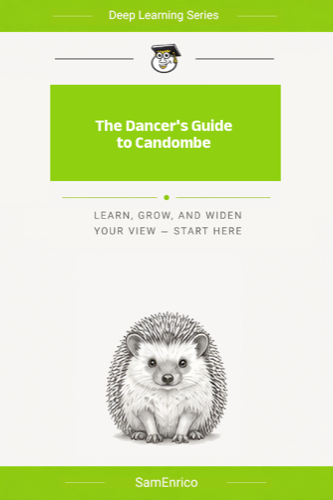
Non-FictionInformativeEducational
The Dancer's Guide to Candombe eBook
This publication, published by SamEnrico, covers T
by Chapa Hien
This publication, published by SamEnrico, covers The Dancer's Guide to Candombe
Formats
Free sample
Chapter 1: The Kongo Legacy--The drum does not forget. Before there was Montevideo, before there was slavery, before there was the Americas at all, there was the Kongo Kingdom—a vast and sophisticated civilization that stretched across Central Africa, from the Atlantic coast deep into the interior. The men and women who would one day create Candombe did not know they were creating anything. They were simply living, drumming, and dancing as their ancestors had done for centuries. They could not have imagined that their movements would cross an ocean, survive centuries of brutality, and eventually become the heartbeat of a nation on the other side of the world.
But that is precisely what happened. This chapter is the story of that journey—not a dry recitation of dates and names, but an excavation of the living memory that still pulses through every Candombe step. To dance Candombe is to inherit that memory. And to inherit it, you must first understand where it came from.The Kongo Kingdom Before the Boats At its height in the fifteenth and sixteenth centuries, the Kongo Kingdom was one of the most powerful and organized states in West Central Africa. It stretched across what is now northern Angola, the western Democratic Republic of Congo, the Republic of Congo, and Gabon.
Its capital, Mbanza Kongo, was a city of tens of thousands of people, with a centralized government, a royal court, a system of provincial governors, and a sophisticated spiritual and artistic culture. The Kongo people were farmers, fishermen, traders, and artisans. They spoke Kikongo, a language rich in nuance and metaphor. And they drummed.The drums of the Kongo were not entertainment. They were communication.
Different drums carried different voices: the ngoma was the large, deep drum played at royal ceremonies and community gatherings; the ditumba was the medium drum used for dance events; the mukoku was the small, high-pitched drum that provided accents and flourishes. This three-drum configuration—large, medium, small—would survive the Middle Passage and become the piano, repique, and chico of Candombe. The names would change. The relationship would not.Kongo dances were similarly structured. There was no separation between musician and dancer in the Western sense.
Drummers watched dancers; dancers responded to drummers. A skilled dancer could "speak" through footwork, and a skilled drummer could "answer" through rhythm. This conversation was not abstract. It carried specific meanings: a particular foot pattern might indicate that the harvest had been good; a particular drum phrase might call the community to gather for a dispute resolution. Dance was language.
Rhythm was law.The posture of Kongo dancing was low to the ground, with bent knees, a tucked pelvis, and a spine that remained long but not rigid. This posture served multiple purposes. It allowed the dancer to move in confined spaces—important in crowded villages and forest clearings. It connected the dancer to the earth, which in Kongo cosmology was not inert matter but a living force, home to ancestors and spirits. And it conserved energy, allowing dancers to move for hours without exhaustion.
Today, that same posture remains the foundation of Candombe. If you stand upright while dancing, you are not dancing Candombe. You are doing something else. The drum will tell you.The Spiritual World of the Kongo To understand Candombe's relationship to the sacred, we must understand what the Kongo people believed—and what they did not believe. The Kongo spiritual world was complex, but its core was relatively simple.
There was a supreme creator god, Nzambi, who was distant, uninvolved in daily affairs. There were ancestors, the bakulu, who remained present and active, able to intervene in the lives of the living. And there was a life force, ntu, that flowed through everything—people, animals, trees, rivers, stones. The goal of most Kongo rituals was to maintain balance, to honor the ancestors, and to ensure the proper flow of ntu.Crucially, the Kongo did not have "possession trance" in the way that the Yoruba people of West Africa did. A Kongo dancer was not mounted by a deity.
A Kongo dancer did not lose consciousness or speak in a divine voice. Instead, the dancer entered a state of focused attention, a heightened awareness of the body and the rhythm. This is a critical distinction because it directly shapes what Candombe is—and what it is not. Candombe has no trance. No deity descends into the dancer's body.
The dancer remains fully present, fully aware, fully in control. The "ecstasy" of Candombe is not an altered state but a deepened one. You do not lose yourself. You find yourself, more fully than in ordinary life.This Kongo worldview would survive the Middle Passage because it was portable. It did not require temples, priests, or sacred texts.
It required only bodies, drums, and the willingness to remember. The ancestors could be honored anywhere. The ntu flowed everywhere. And the dance could be performed anywhere—even in the hold of a slave ship, even in a colonial barracoon, even in a Montevideo basement lit by a single candle. That is the secret of Candombe's survival.
It required nothing that could be taken away.The Middle Passage: The Drums Go Silent Between 1600 and 1850, approximately 200,000 enslaved Africans were transported to the Río de la Plata region—present-day Uruguay and Argentina. This was a fraction of the 4.8 million sent to Brazil, but it was a fraction with a peculiar characteristic: the captives came from a narrower geographic range than almost any other destination in the Americas. The slave ships that docked in Montevideo drew overwhelmingly from the Kongo and Angola regions. Unlike the heterogeneous populations of Cuba (Yoruba, Fon, Congo) or Brazil (Yoruba, Fon, Kongo, Angola, Mozambique), Uruguay's enslaved population was unusually homogeneous. A Yoruba speaker in Montevideo had no one to talk to.
A Kongo speaker had a community.The Middle Passage itself—the brutal, weeks-long voyage across the Atlantic—was designed to break bodies and spirits. Captives were packed into holds so low that they could not stand. They were chained at the ankles, often in pairs, so that the movement of one dragged the movement of the other. They were brought on deck for "dancing" several times a week—forced exercise to preserve their market value. Enslavers believed that muscle atrophy reduced sale prices, so they compelled their human cargo to jump, shuffle, and move.
The dancing was supervised, sometimes whipped, and always humiliating.But within that forced movement, something unexpected happened. The captives danced their own steps. They could not lift their feet because of the chains, so they developed a dragging, shuffling movement—the arrastre that would become the signature of Candombe. They could not stand upright because of the low decks, so they developed a bent-knee posture. They could not drum because drums were confiscated or destroyed, so they drummed on the deck with their palms, on each other's backs, on their own thighs.
They could not perform the full ngoma ceremonies, so they condensed them, simplified them, hid them inside the allowed movements.The drum went silent. But the memory of the drum did not.Disembarkation: Montevideo's Slave Market The first enslaved Africans arrived in Montevideo in 1726, the…
This is the end of the free sample. Get the eBook to keep going. Buy now
About this book
Details
- Author
- Chapa Hien
- Publisher
- SamEnrico
- Language
- English
- Genre
- Non-Fiction, Informative, Educational
- Released
- 2026-05-23
- Pages (approx.)
- 109
- Available as
- eBook, Audiobook

Read better in the ZLOADR app
Your eBooks on your phone or tablet. Sign in with your SamEnrico account and start reading.
More by Chapa Hien
 The Breath And Sensation IsolationChapa Hien$11.99
 Force Majeure Clause AbstractionChapa Hien$11.99
 Sleep Induction JourneyChapa Hien$11.99
 Earth Elder Ceremonial TeachingsChapa Hien$11.99
 Crime Scene Investigator GuideChapa Hien$11.99
 Postpartum Emotion DBTChapa Hien$11.99
 Kenya Youth Enterprise Grant GuideChapa Hien$11.99
 Sibling Incest HealingChapa Hien$11.99
 The Unseen Empire: How a Quiet Tech Giant Outmaneuvered Silicon ValleyChapa Hien$11.99
 The Jakarta Siege: 48 Hours That Shook the WorldChapa Hien$11.99
 Into the Heart of Nyiragongo: The Firewalkers of the CongoChapa Hien$11.99
 Remote Work Productivity SystemsChapa Hien$11.99
You may also like
 Hong Kong Handover 1997Dunn Johnnie$11.99
 Zumba For Postnatal Recovery CourseNeal Christian$11.99
 Zumba for BeginnersLadner Nikia$11.99
 YouTube Comment Mining GuideHumes Pandora$12.99
 Worry Box MeditationCarlin Rudy$11.99
 Workplace Stress MeditationNguyen Lynn$11.99
 Workplace Stress and Sleep RepairHawley Ivory$11.99
 Workplace Perfectionism CureDelaney Jeffry$11.99
 Workplace Injustice Anger GuideWallen Isabelle$11.99
 Work Addiction and Burnout LinkGreenwood Ester$11.99
 Women in Yoga and WellnessBeattie Galina$11.99
 Women in Stand Up ComedyChun Evangeline$11.99