
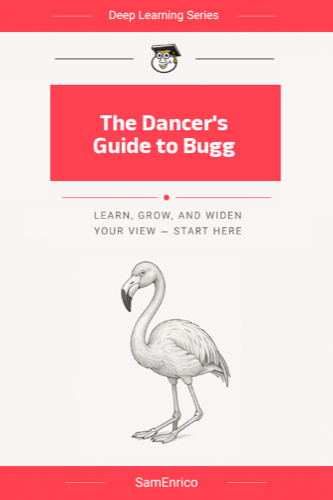
The Dancer's Guide to Bugg
This publication, published by SamEnrico, covers T
by Lyles Aretha
This publication, published by SamEnrico, covers The Dancer's Guide to Bugg
Formats
About this book
Free sample
Chapter 1: The Forgotten Floor--– You have felt it before. The moment when a fast song with a driving backbeat fills the room, and your body wants to move, but your mind freezes. You watch other couples glide across the floor with an ease that seems almost supernatural. Their feet seem to know something yours do not. Their connection looks effortless.
And somewhere in the back of your mind, you wonder if dancing is a language you were simply never taught.This book exists because that language is not only learnable—it is already inside you, waiting for the right grammar to unlock it. The dance is called Bugg, and despite what you may assume, it is not a forgotten relic or a hyper-specialized subgenre for vintage enthusiasts. Bugg is the most accessible, forgiving, and joyfully rhythmic partnered dance you have never heard of. And by the time you finish this chapter, you will understand not only what Bugg is, but why it has stayed hidden in plain sight for decades—and why now is the perfect moment to bring it back.The Birth of a Dance You Didn't Know You Knew Every dance form emerges from a specific collision of music, culture, and physical necessity. Bugg is no exception.
Its origins trace directly to the dance halls of post-World War II America, roughly 1946 through 1955, in the years just before rock and roll exploded into mainstream consciousness. But to understand Bugg, you must first understand what it is not.In the popular imagination, the swing era of the 1930s and early 1940s represents the golden age of partnered jazz dance. Lindy Hop, with its athletic aerials, upright posture, and exuberant bounce, dominated ballrooms like the Savoy in Harlem. But by the late 1940s, something had shifted. Big band swing was giving way to smaller ensembles.
The music was becoming leaner, meaner, and more rhythmically insistent. Boogie woogie piano, with its repetitive left-hand bass patterns and percussive right-hand accents, demanded a different physical response from dancers. The smooth, gliding look of swing began to feel out of step with the music's grittier…
This is the end of the free sample. Get the eBook to keep going. Buy now
Contents
- Chapter 1
- Chapter 2
- Chapter 3
- Chapter 4
- Chapter 5
- Chapter 6
- Chapter 7
- Chapter 8
- Chapter 9
- Chapter 10
- Chapter 11
- Chapter 12
Details
- Author
- Lyles Aretha
- Publisher
- SamEnrico
- Language
- English
- Genre
- Non-Fiction, Informative, Educational
- Released
- 2026-05-08
- Pages (approx.)
- 142
- Available as
- eBook, Audiobook

Read better in the ZLOADR app
Your eBooks on your phone or tablet. Sign in with your SamEnrico account and start reading.
More by Lyles Aretha
 Personal Goal PalaceLyles Aretha$11.99
 ICU Nurse Stress HandbookLyles Aretha$11.99
 Waterfall Release VisualizationLyles Aretha$11.99
 Teacher Emotion RegulationLyles Aretha$11.99
 Psychologist Burnout PreventionLyles Aretha$11.99
 Diver's Midnight Zone LogLyles Aretha$11.99
 The Breath Temperature PracticeLyles Aretha$11.99
 Affirmations For Bedtime WorryLyles Aretha$11.99
 Egyptian Cosmology GuideLyles Aretha$11.99
 The Shadow Vice Presidency: The Untold Story of Gerald Ford’s 29 HoursLyles Aretha$11.99
 The Last Charge of the Zulu Spears: Isandlwana's Fall and the Rise of the Martini-HenryLyles Aretha$11.99
 The First Mapmakers: Decoding the Grand Canyon's Prehistoric SecretsLyles Aretha$11.99