
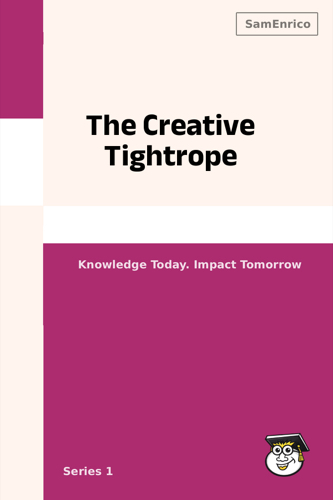
The Creative Tightrope eBook
Balancing on the edge of limitation to find creati
Balancing on the edge of limitation to find creative flow.
Formats
Free sample
Chapter 1: The Heavy Pole...--–- The cursor blinks. That small, vertical line on a white screen has stopped more creative careers than failure ever has. It is not the difficulty of writing that paralyzes you. It is the absence of difficulty. The blank page offers infinite possibilities—every word, every structure, every tone, every ending—and that infinity is not liberating.
It is suffocating. You sit down to create, expecting freedom to be the gateway to flow. Instead, you find yourself checking email, reorganizing your desk, or suddenly needing to research the migratory patterns of monarch butterflies. Anything except the work. This is not a personal failing.
This is a neurological fact. The human brain was not designed for infinite possibility. It was designed for survival within constraints. When faced with too many choices, the brain does not soar. It shuts down.This is the paradox that sits at the heart of every creative act.
We have been taught that creativity requires open space, empty calendars, and absolute autonomy. That constraints are the enemy. That the genius needs to be unchained. The opposite is true. The most prolific and innovative creators in history did not work despite their limitations.
They worked because of them. The painter given three colors, not sixty. The writer given a tight deadline, not an open-ended sabbatical. The musician confined to a specific scale or a damaged instrument. These are not obstacles to be removed.
They are the very mechanisms that trigger the creative engine.The Myth of Unlimited Freedom Let us name the lie immediately. The lie is this: if you could just remove all the barriers—if you had unlimited time, unlimited money, unlimited resources, and no one telling you what to do—you would finally create your masterpiece. This fantasy appears in countless interviews, artist statements, and late-night conversations. "If only I didn't have this day job." "If only I had a studio of my own." "If only I could take six months off." The implication is always the same: freedom is the missing ingredient. Remove the constraints, and the creativity will flow.The evidence suggests the opposite.
In a landmark study conducted at the University of Chicago, researchers gave two groups of writers the same creative assignment. One group was told to write a poem with no restrictions. The other group was told to write a poem that followed a specific structure: fourteen lines, ten syllables per line, a particular rhyme scheme. The constrained group produced poems that were rated significantly more creative by independent judges. They also finished faster and reported less anxiety about the process.
The unconstrained group—given the illusion of total freedom—produced work that was meandering, unfocused, and often incomplete.This finding has been replicated across domains. In visual art, students given a limited palette of three colors produce more innovative work than students given unlimited access to every shade. In product design, teams given a strict budget and timeline generate more inventive solutions than teams given unlimited resources. In music, composers working within a specific scale or rhythmic constraint produce more distinctive compositions than those given complete freedom. The pattern is unmistakable: constraints do not inhibit creativity.
They catalyze it.Why does this happen? The answer lies in how the human brain processes choice. When faced with too many options, the brain enters a state of what psychologists call "decision paralysis." The prefrontal cortex—the part of the brain responsible for planning and decision-making—becomes overwhelmed. It cannot evaluate every possible option, so it evaluates none. The result is not liberation.
It is a kind of cognitive freezing. You stare at the blank page not because you have nothing to say, but because you have too much to say and no mechanism for choosing.The paradox of choice, first documented by psychologist Barry Schwartz, describes exactly this phenomenon. Schwartz found that when people were offered a small selection of options—six jams, for example—they were far more likely to make a purchase than when offered twenty-four jams. The larger selection attracted attention but paralyzed action. Creativity operates on the same principle.
The infinite sandbox is not a playground. It is a trap.The Neurological Truth: What Your Brain Actually Needs The motivational machinery of the human brain operates on a simple principle: reward follows specificity. When the brain encounters a clear, achievable challenge with known parameters, it releases dopamine. That dopamine produces focus, energy, and the pleasant sense of forward momentum. When the brain encounters an open-ended, ambiguous task with no clear parameters, it does not release dopamine.
It releases cortisol—the stress hormone—followed by a shutdown response. The brain is not lazy. It is efficient. It conserves energy for problems that have a solution path. An infinite sandbox has no solution path.
Therefore, the brain conserves energy by disengaging.This is why the blank page feels so terrible. It is not a sign that you lack talent or discipline. It is a sign that your brain is functioning exactly as it evolved to function. The absence of constraints is not a creative invitation. It is a neurological off switch.Steven Kotler, in his research on high-performance individuals, identified four cognitive abilities that form a ladder: Motivation, Learning, Creativity, and Flow.
You cannot reach Learning without first engaging Motivation. You cannot reach Creativity without first engaging Learning. And you cannot reach Flow—that state of effortless immersion where time disappears and the work seems to create itself—without first engaging Creativity. But the first rung of the ladder, Motivation, requires a specific trigger: a clear, achievable, and personally meaningful challenge with a known set of constraints. Without that trigger, the ladder remains on the ground.
You stare at it, wanting to climb, but your feet will not move.That is not weakness. That is neuroscience.The practical implication is profound. If you are struggling to start a creative project, the solution is not to remove more constraints. The solution is to add them. The problem is almost never that your box is too small.
The problem is that your box is too large. You have too much time, too many materials, too many options, too many possible directions. The answer is not more freedom. The answer is a smaller cage.The Tightrope: A New Metaphor for Creativity Consider the tightrope walker. She stands on a thin wire stretched high above the ground.
In her hands, she holds a long pole—twenty to forty pounds of steel or aluminum. The pole is heavy. It is awkward. It requires strength and endurance just to hold it in place. At first glance, the pole seems like an additional burden.
Why would anyone add forty pounds to an already precarious act?The answer is physics. A system with a lower center of gravity is more stable. The pole provides that lower center of gravity. It also increases rotational inertia—resistance to tipping. When the walker begins to lean too far to the left, the heavy pole does not immediately follow.
It resists the movement, buying the walker precious milliseconds to correct the imbalance. The weight that seems like a burden is actually the walker's primary safety mechanism.…
This is the end of the free sample. Get the eBook to keep going. Buy now
About this book
Details
- Author
- Houghton Jayne
- Publisher
- SamEnrico
- Language
- English
- Genre
- Non-Fiction, Self-Help, Balance
- Released
- 2026-06-07
- Pages (approx.)
- 121
- Available as
- eBook, Audiobook

Read better in the ZLOADR app
Your eBooks on your phone or tablet. Sign in with your SamEnrico account and start reading.
More by Houghton Jayne
 Anxiety as Energy PracticeHoughton Jayne$11.99
 MallforAfrica Exit PlaybookHoughton Jayne$11.99
 Divorce Financial Recovery PlanHoughton Jayne$11.99
 The Dutch Revolt IconoclasmHoughton Jayne$11.99
 The Golden Roads of Punt: Africa's Forgotten Maritime EmpireHoughton Jayne$11.99
 How to Start a Chemist Business (Beginners Guide)Houghton Jayne$11.99
 JEE Organic Chemistry SimplifiedHoughton Jayne$12.99
 Executive Assistant VA SearchHoughton Jayne$12.99
 Alaskan Malamute BreedingHoughton Jayne$11.99
 Understanding Pie TorcidoHoughton Jayne$17.99
You may also like
 Hong Kong Handover 1997Dunn Johnnie$11.99
 Zumba For Postnatal Recovery CourseNeal Christian$11.99
 Zumba for BeginnersLadner Nikia$11.99
 YouTube Comment Mining GuideHumes Pandora$12.99
 Worry Box MeditationCarlin Rudy$11.99
 Workplace Stress MeditationNguyen Lynn$11.99
 Workplace Stress and Sleep RepairHawley Ivory$11.99
 Workplace Perfectionism CureDelaney Jeffry$11.99
 Workplace Injustice Anger GuideWallen Isabelle$11.99
 Work Addiction and Burnout LinkGreenwood Ester$11.99
 Women in Yoga and WellnessBeattie Galina$11.99
 Women in Stand Up ComedyChun Evangeline$11.99