
Non-FictionSelf-HelpResourcefulness
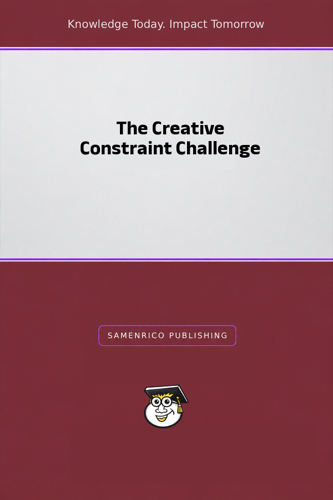
The Creative Constraint Challenge eBook
Uses artificial limits like time or budget to spar
Uses artificial limits like time or budget to spark team resourcefulness.
Formats
Free sample
Chapter 1: The Abundance Trap...--–- In 1997, a small team of engineers at Apple gathered in a nondescript building in Cupertino. They had been given an impossible task, a ridiculous deadline, and a budget that would barely cover coffee for the month. Their mission was to create a portable music player that could hold "a thousand songs in your pocket." At the time, the average MP3 player held about a dozen songs, cost a fortune, and drained batteries faster than a child drains a juice box. Every industry expert said it couldn't be done. Every rational analysis concluded they needed more time, more money, and more people.
They had none of those things.Three years later, they released the i Pod. It didn't just succeed—it transformed music, then phones, then the entire consumer electronics industry.Now consider a different story.At the exact same time, a Silicon Valley startup called General Music (later renamed General Magic) had assembled what journalists called "the dream team of the digital age." They had unlimited funding from major investors including Apple, Sony, and AT&T. They had a stunning roster of engineers who would go on to invent the smartphone, the touchscreen, USB, emoji, and the modern operating system. They had no deadlines they couldn't extend, no budget they couldn't increase, and no shortage of brilliant ideas.They spent millions. They built dozens of prototypes.
They held endless strategy meetings in beautiful offices. And after seven years of unlimited resources and zero marketable products, they filed for bankruptcy.The dream team had dreamed themselves into oblivion.The Paradox That Changes Everything These two stories are not anomalies. They reveal a fundamental truth about the human brain that most managers, leaders, and creative professionals get exactly backward. We instinctively believe that more resources lead to better creativity. More money, more time, more people, more options, more freedom—surely these are the ingredients of breakthrough thinking.
Surely creativity requires abundance.The research says otherwise. In study after study, across industries and disciplines, the evidence is overwhelming: constraints boost creativity. Limits liberate. Abundance—the very thing we chase—often produces the worst work of our careers.This chapter will show you why. More importantly, it will show you how to stop falling into the Abundance Trap and start using deliberate scarcity as your most powerful creative weapon.The General Magic Funeral: A Case Study in Unlimited Failure Let me tell you the full story of General Magic, because it contains every mistake you and your team are probably making right now.The company was founded in 1990 by a group of Apple veterans who had helped create the original Macintosh.
These were not average technologists. These were the rock stars of Silicon Valley—people like Bill Atkinson (creator of the Mac's graphical user interface), Andy Hertzfeld (architect of the Mac operating system), and later Tony Fadell (who would go on to lead the i Pod team and then found Nest). They raised millions from the most sophisticated investors in the world. Their offices in Mountain View were beautiful. Their cafeteria was legendary.
Their ambition was breathtaking: they would build a handheld device that could communicate wirelessly, send messages, make calls, and run apps. In 1990. Before the web. Before cell phones were common. Before any of the infrastructure existed.The problem was that they had no constraints that couldn't be waived.
Every deadline came with an extension. Every budget request was approved. Every new feature suggestion was added to the ever-growing list. The team had complete freedom—and complete freedom, as you're about to learn, is a creativity killer.After four years of development, they finally produced a device called the General Magic Pocket Crystal. It weighed nearly a pound, cost over $800, had a battery life of about two hours, and struggled to perform even basic functions.
A handful shipped. Almost none sold. The company limped along for another three years before finally shutting down.Here's what makes this story heartbreaking: the same engineers who failed at General Magic went on to create the i Phone, the Android operating system, and the entire mobile computing revolution. They had the talent. They had the ideas.
They had everything except the one thing that forces ideas to become reality: a hard, unyielding constraint that cannot be negotiated away.Why Your Brain Actually Performs Worse With More Options The psychological mechanism behind the Abundance Trap is well understood, even if most managers have never heard of it. It's called "choice overload," and it was first demonstrated in a famous experiment by researchers Sheena Iyengar and Mark Lepper.In this study, shoppers at a gourmet food market were presented with a tasting booth for jam. One group of shoppers saw a display with 24 different flavors. The other group saw a display with just 6 flavors. Here's what happened: the 24-flavor booth attracted more attention—more people stopped to look.
But the 6-flavor booth produced far more purchases. In fact, shoppers who saw the larger selection were ten times less likely to buy anything at all. They were paralyzed by abundance.The same thing happens in your brain when you face unlimited options, unlimited time, or unlimited budget. The prefrontal cortex—the part of your brain responsible for decision-making and creative problem-solving—gets overwhelmed. When it sees too many pathways, it defaults to one of two responses: either it shuts down completely (procrastination), or it reaches for the most familiar, low-effort pattern (doing what you've always done).This is why a blank page is so terrifying to writers.
Not because there's nothing to say, but because there's everything to say. The infinite possibility of the empty page creates anxiety, not inspiration. Every professional writer learns this lesson eventually: you need a cage. The cage can be a word count, a deadline, a specific structure, or a ridiculous constraint like "write a novel using only 50 distinct words." The cage doesn't trap your creativity—it gives your brain a track to run on.The Research Is Unanimous: Constraints Create Breakthroughs The evidence for constraint-based creativity extends far beyond jam studies and failed startups. Consider these findings:In a study of corporate R&D teams, researchers found that teams with stricter budget and timeline constraints produced more patents and more commercially successful products than teams with abundant resources.
The constrained teams were forced to prioritize ruthlessly, which meant they spent their energy on what actually mattered instead of polishing things that didn't.In a study of creative writing students, those given specific formal constraints (rhyme schemes, syllable counts, genre restrictions) produced work that independent judges rated as more creative than work produced by students given no constraints. The constrained writers complained more during the process—and produced better results.In a study of design firms, projects with the tightest client budgets and shortest timelines consistently received higher client satisfaction ratings than projects with generous budgets and flexible schedules. The designers themselves reported feeling more satisfied with their work on the constrained projects. They had to be resourceful, and resourcefulness feels good.Even the most celebrated creative geniuses of history worked within self-imposed constraints. Mozart didn't write whatever came into his head; he wrote sonatas, symphonies, and operas—each with its own strict…
This is the end of the free sample. Get the eBook to keep going. Buy now
About this book
Details
- Author
- Swisher Lacey
- Publisher
- SamEnrico
- Language
- English
- Genre
- Non-Fiction, Self-Help, Resourcefulness
- Released
- 2026-06-08
- Pages (approx.)
- 113
- Available as
- eBook, Audiobook

Read better in the ZLOADR app
Your eBooks on your phone or tablet. Sign in with your SamEnrico account and start reading.
More by Swisher Lacey
 Toxic Coworker Stress ManagementSwisher Lacey$11.99
 Scripture Memory MethodSwisher Lacey$11.99
 Natural HGH Boost ExerciseSwisher Lacey$11.99
 Two Year Diamond Heist PrepSwisher Lacey$11.99
 Somali Pirate CaptiveSwisher Lacey$11.99
 Retirement Assets and Life InsuranceSwisher Lacey$11.99
 PMS Anxiety Reduction GuideSwisher Lacey$11.99
 Nicotine Cravings At Work GuideSwisher Lacey$11.99
 Tangaroa's Wrath: The Storm That Shaped the IslandsSwisher Lacey$11.99
 Frozen Betrayal: The Race to the South Pole's Dark SecretSwisher Lacey$11.99
 Bloodlines of the Silk Throne: The Emperor’s Forgotten HeirSwisher Lacey$11.99
 Multiple Choice Distractor GuideSwisher Lacey$12.99
You may also like
 Hong Kong Handover 1997Dunn Johnnie$11.99
 Zumba For Postnatal Recovery CourseNeal Christian$11.99
 Zumba for BeginnersLadner Nikia$11.99
 YouTube Comment Mining GuideHumes Pandora$12.99
 Worry Box MeditationCarlin Rudy$11.99
 Workplace Stress MeditationNguyen Lynn$11.99
 Workplace Stress and Sleep RepairHawley Ivory$11.99
 Workplace Perfectionism CureDelaney Jeffry$11.99
 Workplace Injustice Anger GuideWallen Isabelle$11.99
 Work Addiction and Burnout LinkGreenwood Ester$11.99
 Women in Yoga and WellnessBeattie Galina$11.99
 Women in Stand Up ComedyChun Evangeline$11.99