
Non-FictionHealth & WellnessStress Management
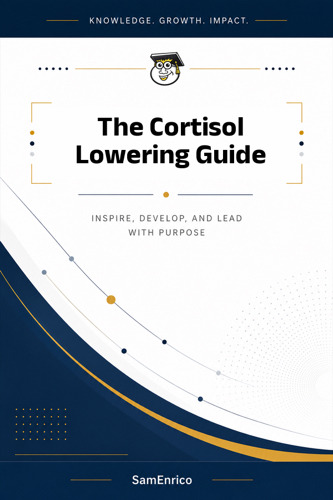
The Cortisol Lowering Guide eBook
Stress reduction for healthy circadian rhythm.
Stress reduction for healthy circadian rhythm.
Formats
Free sample
Chapter 1: The Great Misalignment--–- The alarm screams at 7:00 AM. You silence it, scroll through notifications you don’t remember reading, and stumble toward the coffee maker before your eyes are fully open. By 9:00 AM, you’ve answered fourteen emails, fought with your child about breakfast, and already feel like you’ve worked a full day. At 11:00 PM, you fall into bed utterly exhausted—but your mind refuses to follow. It races through tomorrow’s meetings, last week’s embarrassing comment, and that thing your partner said three years ago that still stings.
You finally drift off around 1:00 AM, only to do it all again eight hours later.If this sounds familiar, you are not lazy. You are not broken. You are not weak-willed, undisciplined, or somehow defective. You are, quite simply, living out of sync with 3.5 billion years of evolution.This chapter introduces the single most important concept in this entire book: social jetlag—the chronic mismatch between your biological clock (circadian rhythm) and your social schedule (work hours, screen time, meal times, and bedtime). This mismatch is the hidden driver of your fatigue, anxiety, insomnia, brain fog, and stubborn belly fat.
And the good news is that once you understand it, you can fix it without medication, expensive gadgets, or quitting your job.The Archetypal Modern Struggle Let me paint a more detailed picture of the person this book was written for. Perhaps you see yourself here.You wake up groggy, needing at least one—probably two—cups of coffee before you can form complete sentences. You drag yourself through the morning, finally feeling alert around 11:00 AM. Then the afternoon hits. Between 2:00 and 4:00 PM, your energy plummets.
You reach for sugar, caffeine, or both. You push through because you have to, but by 6:00 PM you are running on fumes.Then something strange happens. Around 9:00 or 10:00 PM, you get a second wind. Your mind sharpens. You feel suddenly productive, or at least awake.
You stay up later than you should, scrolling, watching, working, or just thinking. You fall into bed exhausted but wired, and the cycle repeats.This pattern is so common that we have normalized it. We call it “adulting” or “burnout” or “just how life is.” But it is not normal. It is a sign that your internal clock has drifted out of alignment with your external environment.Social jetlag is the term scientists use to describe the gap between when your body wants to sleep and when your schedule forces you to sleep. For most people with a typical 9-to-5 job, that gap is between one and three hours.
You go to bed at 11:00 PM because you “should,” but your body would naturally prefer 1:00 AM. You wake at 7:00 AM because you have to, but your body would naturally prefer 9:00 AM.Every day, you live in a state of low-grade jetlag—the same biological disruption you would feel after flying from New York to Los Angeles. The difference is that travel jetlag resolves in a few days. Social jetlag never ends. It is chronic, cumulative, and corrosive.Your Internal Clock: A 3.5-Billion-Year-Old Masterpiece To understand why social jetlag wreaks havoc on your cortisol, you need to meet your body’s most ancient and powerful timekeeper: the circadian rhythm.Every living organism on Earth—from bacteria to blue whales to you—has an internal clock that roughly follows the 24-hour cycle of day and night.
This is not a metaphor. It is a physical, biological structure. In humans, the master clock is a tiny cluster of approximately 20,000 neurons called the suprachiasmatic nucleus (SCN), located in the hypothalamus at the base of your brain.The SCN is your body’s conductor. It orchestrates a symphony of hormones, body temperature, digestion, immune function, and sleep-wake cycles. It tells your liver when to process toxins, your stomach when to release digestive enzymes, your heart when to raise or lower your blood pressure, and your adrenal glands when to release cortisol.Your SCN did not learn to do this.
It was born knowing how. Circadian rhythms are encoded in your DNA, a legacy of evolution that dates back to the very first photosynthetic bacteria that learned to protect their DNA from UV radiation by hiding during the day and feeding at night.Here is what matters for you: your SCN is designed to receive one primary signal to set the time each day—bright light in the morning. When light enters your eyes, it travels along a dedicated pathway (the retinohypothalamic tract) directly to your SCN. That light signal tells your master clock, “It is morning. Reset.”Without that morning light signal, your SCN drifts.
It runs on its own natural rhythm, which for humans averages about 24.2 hours. That might not sound like much, but over weeks and months, a .2-hour drift adds up. Your body slowly shifts later and later, while your alarm clock stays fixed at 7:00 AM. The gap widens. Social jetlag deepens.The HPA Axis: Your Body’s Stress Switchboard Now let’s introduce the other major player in this story: the HPA axis (Hypothalamus-Pituitary-Adrenal).
If the SCN is your conductor, the HPA axis is your emergency response team.The HPA axis is a feedback loop involving three structures:The Hypothalamus (in your brain) detects a threat—real or perceived—and releases a hormone called CRH (corticotropin-releasing hormone).The Pituitary gland (just below the hypothalamus) responds to CRH by releasing ACTH (adrenocorticotropic hormone) into your bloodstream.The Adrenal glands (sitting on top of your kidneys) receive ACTH and respond by releasing cortisol—your primary stress hormone.Cortisol then travels throughout your body, raising blood sugar, suppressing non-essential functions (digestion, reproduction, growth), sharpening focus, and preparing your muscles for action. When the threat passes, cortisol signals back to the hypothalamus to shut down the whole system.This loop is elegant and efficient—for acute threats. It evolved to handle saber-toothed tigers, flash floods, and tribal conflicts lasting minutes or hours. It did not evolve to handle email notifications, social media comparison, news alerts, work deadlines, financial stress, traffic jams, relationship conflicts, and pandemic anxiety—all happening simultaneously, all day, every day, for years.When the HPA axis is activated too frequently or for too long, the feedback loop breaks. The hypothalamus stops listening to cortisol’s “stop” signal.
The adrenal glands keep pumping. Your body remains in a state of low-grade, chronic alarm. This is not a psychological failure. It is a biological inevitability of living in an environment your stress system does not recognize.Acute Stress vs. Chronic Circadian Disruption Here is a distinction that will change how you think about stress: acute stress saves your life; chronic circadian disruption shortens it.Acute stress is a burst of cortisol that lasts minutes.
You almost crash your car; you swerve; your heart pounds; your hands shake; you pull over; ten minutes later, you are fine. Your cortisol spiked, did its job, and returned to baseline. This is healthy. In fact, intermittent acute stress makes your HPA axis more resilient, like exercise makes your muscles stronger.Chronic circadian disruption is a low, steady drip of cortisol that lasts months or years. Your alarm clock jerks you out of deep sleep.
Your commute spikes your blood pressure. Your inbox floods with “urgent” requests. Your phone pings with notifications. Your blood sugar…
This is the end of the free sample. Get the eBook to keep going. Buy now
About this book
Details
- Author
- Mancini Domitila
- Publisher
- SamEnrico
- Language
- English
- Genre
- Non-Fiction, Health & Wellness, Stress Management
- Released
- 2026-06-05
- Pages (approx.)
- 148
- Available as
- eBook, Audiobook

Read better in the ZLOADR app
Your eBooks on your phone or tablet. Sign in with your SamEnrico account and start reading.
More by Mancini Domitila
 Ticketing System Implementation GuideMancini Domitila$11.99
 The Chris Farley StoryMancini Domitila$11.99
 Restaurant Meal Calorie EstimationMancini Domitila$11.99
 Foster Care Laundry RulesMancini Domitila$11.99
 The Copycat Killer of Mumbai: How a Serial Murderer Exploited Police FailuresMancini Domitila$11.99
 RSPB Site ManagerMancini Domitila$11.99
 Startup Bank ReconciliationMancini Domitila$12.99
 Minority Firm Disaster ContractingMancini Domitila$12.99
 The Breeder's Guide to Yokohama ChickensMancini Domitila$11.99
 How to Become a Steel-post InstallerMancini Domitila$11.99
You may also like
 Hong Kong Handover 1997Dunn Johnnie$11.99
 Zumba For Postnatal Recovery CourseNeal Christian$11.99
 Zumba for BeginnersLadner Nikia$11.99
 YouTube Comment Mining GuideHumes Pandora$12.99
 Worry Box MeditationCarlin Rudy$11.99
 Workplace Stress MeditationNguyen Lynn$11.99
 Workplace Stress and Sleep RepairHawley Ivory$11.99
 Workplace Perfectionism CureDelaney Jeffry$11.99
 Workplace Injustice Anger GuideWallen Isabelle$11.99
 Work Addiction and Burnout LinkGreenwood Ester$11.99
 Women in Yoga and WellnessBeattie Galina$11.99
 Women in Stand Up ComedyChun Evangeline$11.99