
Non-FictionSelf-HelpBiology of Stress
The Cortisol Couple eBook
Explains how high stress hormones hijack relations
Explains how high stress hormones hijack relationships and how to counter biologically.
Formats
Free sample
Chapter 1: The Third Person...--The recycling bin sat in the middle of the kitchen floor like a bomb waiting to detonate. Mark had walked past it three times. Elena had stepped over it twice. Neither said a word. Then, at exactly 7:42 p.m., the silence broke."You see this?" Elena held up an empty almond milk carton, her voice pitched half an octave higher than normal.
"You walked past this. Three times."Mark looked up from his phone. "I was going to take it out after dinner.""After dinner. Like you took out the trash last week? After dinner?""I forgot.
It's a recycling bin, Elena. It's not a betrayal.""No, the betrayal is that I have to ask. I have to notice. I have to carry the entire mental load of this house while you sit there scrolling through Twitter."Mark's jaw tightened. "Mental load.
Okay. Let's talk about mental load. Who worked sixty hours this week? Who is paying for the roof over your head?""Oh, here we go. The martyr act.""The what?""The martyr act.
'I work so hard, no one appreciates me.' You think I don't work? You think managing a toddler and a part-time job and this entire household isn't work?""I never said that.""You just did.""I did not.""You implied it.""You're putting words in my mouth.""I'm putting reality in your face."Forty-five minutes later, they weren't speaking. Elena was crying in the bedroom. Mark was sleeping on the couch. The recycling bin was still in the middle of the kitchen floor.Neither of them knew that their cortisol levels—measured three days later by a wearable device at a couples' health clinic—were nearly identical.
Mark's had spiked at work, stayed elevated on the commute home, and remained high through dinner. Elena's had been normal until Mark walked through the door. Within fifteen minutes, her cortisol had risen to match his.They weren't fighting about recycling. They were fighting about chemistry. And the third person in their bed that night—the one who had instigated the fight, escalated it, and ensured neither of them would sleep—wasn't an affair partner or an in-law or an addiction.It was cortisol.The Uninvited Guest Every couple fights.
This is not news. What is news—what the last decade of endocrinology has revealed, and what this book will spend twelve chapters proving—is that most of what couples call "relationship problems" are not relationship problems at all. They are stress problems dressed up in relationship clothing. The dirty dishes are not the issue. The forgotten anniversary is not the issue.
The sexless marriage, the yelling, the withdrawal, the contemptuous eye-roll, the feeling that you are married to a stranger who somehow knows exactly how to hurt you—none of these are primarily communication failures or attachment wounds or incompatibilities.They are biochemical events.This chapter introduces a concept that will reshape everything you think you know about your relationship: chronic stress acts as an uninvited third partner in your marriage, influencing behavior more powerfully than personality, love, or communication skills ever could.Call it the third person in your bed. Call it the ghost in the kitchen. Call it the silent hijacker. Whatever name you choose, recognize this: For as long as your cortisol remains chronically elevated, you are not fighting your partner. You are fighting a chemistry that has turned your partner into a perceived threat.The Paradox of Modern Intimacy Here is the great cruel joke of twenty-first-century relationships: We have never had more tools for connection, and we have never been more chemically disconnected.Consider the data points that every couple lives but few name aloud:Dual-income couples now work an average of 67 combined hours per week—17 hours more than couples in 1980.The average American parent spends 6 hours per day on screens but only 27 minutes per day in focused conversation with their partner.Since 2010, the number of couples reporting that they "never or almost never" have sex has tripled.Divorce rates among couples over 40 have doubled in the last two decades, with "growing apart" and "irreconcilable differences" masking a deeper cause: chronic, unmanaged stress.These are not statistics about bad relationships.
They are statistics about overwhelmed nervous systems.The paradox is this: Modern couples face unprecedented pressure—dual careers, financial instability, digital overload, the erosion of extended family support, the collapse of community structures, the 24/7 news cycle, the performative demands of social media, the constant low-grade hum of existential dread—yet they are expected to solve these pressures through "better communication" and "date nights."This is like handing someone a map and telling them to navigate a hurricane.The result isn't just fatigue. It is a biochemical state of emergency. And when the body is in a state of emergency, it does not care about your marriage vows. It does not care about your love for each other. It does not care about the life you have built together.
It cares about one thing and one thing only: survival.What Is Cortisol? A Brief Biology Lesson Before we go any further, we need to understand the chemical protagonist—and antagonist—of this book.Cortisol is a glucocorticoid hormone produced by the adrenal glands, which sit atop your kidneys. It is often called the "stress hormone," but this is a simplification. Cortisol is actually your body's master metabolic regulator. It controls:Blood sugar levels (by triggering glucose production in the liver)Immune system response (by suppressing inflammation)Circadian rhythms (by rising in the morning and falling at night)Memory formation (by influencing the hippocampus)Blood pressure (by constricting blood vessels)Cortisol is not evil.
You would die without it. The problem is not cortisol; the problem is chronic cortisol—the sustained elevation of this hormone for weeks, months, or years beyond its designed duration.Under normal, healthy conditions, cortisol follows a predictable daily rhythm called the diurnal curve:6–8 a.m.: Cortisol surges (the "awakening response") to wake you up and mobilize energy for the day.10 a.m.–12 p.m.: Cortisol remains moderately elevated for focus and activity.2–4 p.m.: Cortisol begins a slow decline.8–10 p.m.: Cortisol reaches its lowest point, allowing melatonin to rise for sleep.2–4 a.m.: Cortisol is at its absolute nadir, enabling deep restorative sleep.This is what healthy cortisol looks like: a mountain in the morning, a valley at night.Chronic stress—the kind produced by financial insecurity, toxic work environments, caregiving demands, sleep deprivation, and relationship conflict—flattens this curve. Cortisol remains elevated throughout the day and fails to drop at night. You wake up already stressed (high baseline), you stay stressed through the day (no recovery), and you go to bed stressed (poor sleep, which raises cortisol further). This is the biochemical definition of burnout.And here is the kicker: Chronic cortisol elevation physically changes your brain.The Hijack Mechanism: How Stress Turns Your Partner into a Threat Under normal, low-stress conditions, your partner's presence activates your parasympathetic nervous system—the "rest and digest" branch of your autonomic nervous system.
When you see your partner's face, hear their voice, or feel their touch, your heart rate slows, your blood pressure drops, your…
This is the end of the free sample. Get the eBook to keep going. Buy now
About this book
Details
- Author
- Lacroix Adena
- Publisher
- SamEnrico
- Language
- English
- Genre
- Non-Fiction, Self-Help, Biology of Stress
- Released
- 2026-06-07
- Pages (approx.)
- 147
- Available as
- eBook, Audiobook

Read better in the ZLOADR app
Your eBooks on your phone or tablet. Sign in with your SamEnrico account and start reading.
More by Lacroix Adena
 Name Memory for NeighborsLacroix Adena$11.99
 Kacey Musgraves Golden HourLacroix Adena$11.99
 Mattress Subscription Trial PeriodLacroix Adena$11.99
 Jacqueline Kennedy OnassisLacroix Adena$11.99
 F1 Race Engineer DutiesLacroix Adena$11.99
 Men Mental Health In PovertyLacroix Adena$11.99
 Insurance Detox CoverageLacroix Adena$11.99
 The Cambridge Five: Britain's Greatest BetrayalLacroix Adena$11.99
 The Bone Dragon’s LamentLacroix Adena$11.99
 How to Produce Shower HeadsLacroix Adena$11.99
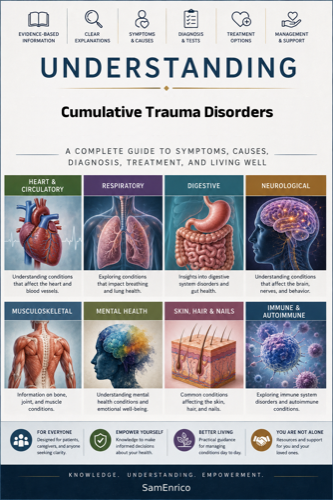 Understanding Cumulative Trauma DisordersLacroix Adena$11.99
 How to Produce For Women ProductsLacroix Adena$11.99
You may also like
 Hong Kong Handover 1997Dunn Johnnie$11.99
 Zumba For Postnatal Recovery CourseNeal Christian$11.99
 Zumba for BeginnersLadner Nikia$11.99
 YouTube Comment Mining GuideHumes Pandora$12.99
 Worry Box MeditationCarlin Rudy$11.99
 Workplace Stress MeditationNguyen Lynn$11.99
 Workplace Stress and Sleep RepairHawley Ivory$11.99
 Workplace Perfectionism CureDelaney Jeffry$11.99
 Workplace Injustice Anger GuideWallen Isabelle$11.99
 Work Addiction and Burnout LinkGreenwood Ester$11.99
 Women in Yoga and WellnessBeattie Galina$11.99
 Women in Stand Up ComedyChun Evangeline$11.99