
Non-FictionSelf-HelpDialectical Thinking
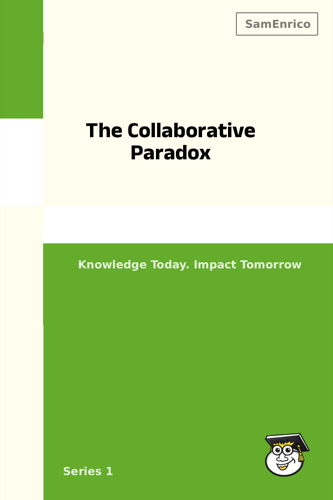
The Collaborative Paradox eBook
Holds two opposing ideas simultaneously for creati
Holds two opposing ideas simultaneously for creative tension.
Formats
Free sample
Chapter 1: The Either/Or Lobotomy--Every failed team meeting begins with a question that sounds perfectly reasonable. “Should we focus on speed or quality?” “Do we want innovation or reliability?” “Is this about the individual or the team?” These questions feel logical, even wise. They seem like the responsible way to narrow a complex problem into something manageable. But they are not wise. They are not logical.
They are a form of collective self-harm—a slow, polite, professionally sanctioned lobotomy performed by well-intentioned people who have confused clarity with intelligence.The problem is not that these questions are wrong. The problem is that they are traps. And the human brain, for reasons rooted in survival rather than creativity, walks into these traps every single time.Imagine you are in a conference room. The whiteboard is full of sticky notes. The coffee is cold.
Two factions have emerged. One side argues passionately for aggressive growth—new products, new markets, new risks. The other side argues just as passionately for protecting the core business—stabilizing operations, conserving cash, avoiding mistakes. Both sides have data. Both sides have valid points.
Both sides are also, in the strictest sense of the word, doomed.Because here is what happens next: the team will spend forty-five minutes debating. They will find compromises. They will split the difference. They will agree to “grow carefully” or “protect creatively”—phrases that sound like solutions but are actually just prettier versions of surrender. And six months later, the growth initiative will starve for lack of resources, and the core business will stagnate from lack of attention, and no one will remember that the real problem was not a lack of compromise but a lack of imagination.This is the Either/Or Lobotomy.
It is the systematic removal of creative possibility by the surgical instrument of false choice. And it is happening in your organization right now.The Evolutionary Origins of Stupid Choices To understand why teams default to binary thinking, we must first forgive them. The human brain did not evolve to handle ambiguity. It evolved to handle saber-toothed tigers. When our ancestors heard rustling in the bushes, the ones who survived were not the ones who considered nuanced, context-dependent possibilities.
The ones who survived were the ones who decided instantly: tiger or no tiger? Fight or flee? Eat or be eaten?This binary decision-making architecture is etched into our neural circuitry. It is fast, efficient, and in life-threatening situations, brilliant. But in a product strategy meeting, it is catastrophic.The problem is that modern collaboration triggers the same ancient response patterns.
When faced with two competing priorities—say, speed and quality—the brain perceives a threat. It does not perceive an opportunity for synthesis. It perceives a zero-sum game: if speed wins, quality loses. If quality wins, speed loses. The amygdala activates.
Cortisol rises. And suddenly, perfectly intelligent adults are arguing as if the future of the species depends on whether the launch date moves by two weeks.This is not a character flaw. It is biology. But biology is not destiny. The first step to escaping the Either/Or Lobotomy is recognizing that you are under its influence.
The second step is naming the specific ways it manifests in team behavior.The Three Faces of the Trap Over a decade of observing teams across industries, researchers have identified three distinct patterns of either/ör thinking. Think of them as the three faces of the trap—each destructive, each seductive, and each entirely avoidable once you know what to look for.The Rabbit Hole The Rabbit Hole is what happens when a team overanalyzes one side of a debate to death. These teams are often proud of their rigor. They create subcommittees. They request more data.
They schedule follow-up meetings to discuss the follow-up meetings. They mistake motion for progress and thoroughness for courage.Consider a technology company that spent eleven weeks debating whether to redesign their user interface. The pro-redesign team had compelling evidence that the current interface was dated. The anti-redesign team had compelling evidence that users hated change. Both were right.
So the team did what sensible people do: they formed a task force. The task force commissioned a survey. The survey generated ambiguous results, so they commissioned a focus group. The focus group disagreed with itself, so they commissioned a usability study. Eleven weeks later, they had four hundred pages of data and no decision.
The market, unimpressed by their thoroughness, moved on.The Rabbit Hole feels like diligence. It feels like being responsible. But it is actually a form of cowardice—a way to avoid the discomfort of holding two opposing ideas at once by pretending that more information will eventually make one of them disappear. It will not.The Wrecking Ball The Wrecking Ball is the opposite pathology. Where the Rabbit Hole freezes, the Wrecking Ball smashes.
These teams do not overanalyze; they overattack. Every disagreement becomes a battle. Every alternative viewpoint becomes an enemy. The goal is not to find the best answer but to win the argument.A manufacturing executive once described his leadership team as “a knife fight in a phone booth.” Every meeting was a blood sport. The head of operations believed that efficiency was everything.
The head of innovation believed that experimentation was everything. Each treated the other’s priorities as threats to be destroyed rather than tensions to be managed. The result was not better decisions but exhausted people and a culture where the loudest voice won.The Wrecking Ball feels like passion. It feels like commitment. But it is actually a form of intellectual laziness—a refusal to engage with complexity because complexity is harder than combat.The Trench Warrior The Trench Warrior is the most insidious of the three because it looks like maturity.
These teams do not freeze or fight. They entrench. Each side digs into its position, not because they are stubborn but because they have genuinely concluded that the other side is wrong. And once that conclusion is reached, the only logical next step is to hold the line.A healthcare organization spent eighteen months in trench warfare over a new electronic medical records system. The clinical team believed that patient safety required extensive customization.
The IT team believed that system stability required standardization. Both were right. Both refused to budge. The result was a series of escalating memos, a governance committee that met weekly and accomplished nothing, and eventually a complete paralysis that cost the organization millions in lost productivity.The Trench Warrior feels like integrity. It feels like standing up for what matters.
But it is actually a form of organizational suicide—a slow, dignified death by mutual assured destruction.The High Cost of Certainty These three patterns—Rabbit Holes, Wrecking Balls, and Trench Warfare—are not rare. They are the default operating system of most teams. And the cost is staggering.Teams stuck in either/or thinking make worse decisions, not better ones. A landmark study of seventy teams across multiple industries found that teams that suppressed debate and forced early consensus made decisions that were 40 percent less effective than teams that deliberately held opposing views in tension. The “decisive” teams felt more confident.…
This is the end of the free sample. Get the eBook to keep going. Buy now
About this book
Details
- Author
- Mcdonald Violet
- Publisher
- SamEnrico
- Language
- English
- Genre
- Non-Fiction, Self-Help, Dialectical Thinking
- Released
- 2026-06-07
- Pages (approx.)
- 125
- Available as
- eBook, Audiobook

Read better in the ZLOADR app
Your eBooks on your phone or tablet. Sign in with your SamEnrico account and start reading.
More by Mcdonald Violet
 Antwerp Heist Psychological ProfileMcdonald Violet$11.99
 Sick Day Guilt Elimination GuideMcdonald Violet$11.99
 Monday Morning Quarterback ReflectionMcdonald Violet$11.99
 TM for Graduate StudentsMcdonald Violet$11.99
 Technical Spec LociMcdonald Violet$11.99
 HGH Research History GuideMcdonald Violet$11.99
 Childhood HGH DeficiencyMcdonald Violet$11.99
 Belgian Green Tax CreditsMcdonald Violet$11.99
 The Frozen Scrolls of the Silk Road: Unlocking Central Asia's Lost CivilizationsMcdonald Violet$11.99
 Phoenix Ascent: The Rise of the Lost City of HelikeMcdonald Violet$11.99
 Echoes of the Underground: The Pirate Radio Wars of the 1960sMcdonald Violet$11.99
 Growing Saintpaulia (African Violet)Mcdonald Violet$11.99
You may also like
 Hong Kong Handover 1997Dunn Johnnie$11.99
 Zumba For Postnatal Recovery CourseNeal Christian$11.99
 Zumba for BeginnersLadner Nikia$11.99
 YouTube Comment Mining GuideHumes Pandora$12.99
 Worry Box MeditationCarlin Rudy$11.99
 Workplace Stress MeditationNguyen Lynn$11.99
 Workplace Stress and Sleep RepairHawley Ivory$11.99
 Workplace Perfectionism CureDelaney Jeffry$11.99
 Workplace Injustice Anger GuideWallen Isabelle$11.99
 Work Addiction and Burnout LinkGreenwood Ester$11.99
 Women in Yoga and WellnessBeattie Galina$11.99
 Women in Stand Up ComedyChun Evangeline$11.99