
Non-FictionSelf-HelpCollaboration
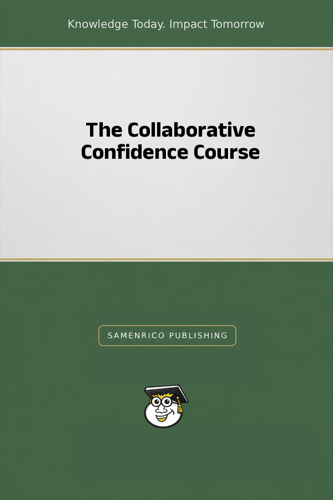
The Collaborative Confidence Course eBook
Share credit freely because your worth isn't threa
Share credit freely because your worth isn't threatened by others' success.
Formats
Free sample
Chapter 1: The Scarcity Lie...--I was thirty-four years old, standing in a fluorescent-lit conference room, when I realized I had become someone I didn't want to be.The moment passed in less than three seconds. My colleague Sarah had just presented a pricing model—my pricing model, actually, the one I'd stayed up until 2 AM building—and the VP had turned to me and said, "Great work on this." I opened my mouth to say, "Thank you." Those two words. That's all it would have taken.Instead, I said, "Yeah, I really dug into the elasticity assumptions."I did not mention Sarah. I did not mention that she had reframed the entire presentation around a client insight I'd missed. I did not mention that without her, my beautiful model would have been an academic exercise, not a business solution.
I took the praise. I let the silence after my words imply that I had done it alone.Sarah never said anything. But I saw her face fall. Just for a moment. And then she smiled, nodded, and excused herself to get coffee.That was ten years ago.
I still remember the exact shade of gray on the carpet. I still remember the way my stomach clenched the moment I realized what I'd done. And I still remember the excuse I made to myself: I deserved that credit. I did the work.Here is what I have learned since then: I was wrong. Not about doing the work—I had done it.
I was wrong about what credit is, what it's for, and what happens when you grab it instead of sharing it. I was wrong about scarcity.And this book is the apology I owe Sarah, written in the only language I have left: the truth about why we hoard credit, why it destroys us, and how to stop.The Lie You Didn't Know You Believed Let me ask you something. When a colleague gets praised for something you helped with, what is your first feeling? Not your second thought—the one you polish for polite conversation. The first feeling, the one that arrives before you can stop it.Is it warmth?
Genuine, uncomplicated happiness for their success?Or is it something else? A tiny sting. A flicker of "what about me?" A knot in your stomach that you immediately feel guilty for having.If you felt the second one, you are not a bad person. You are not selfish or jealous or small. You are a human being who has learned a lie so deeply that you don't even recognize it as a lie anymore.
The lie is this: success is a finite resource. Someone else's win means less for you. Their praise diminishes your potential praise. Their promotion takes a spot you could have filled.Economists call this zero-sum thinking. Psychologists call it fixed mindset.
I call it the Scarcity Lie, and it is the single most destructive belief in modern professional life.Let me prove it to you.The Campfire and the Pie Here is the metaphor that changed everything for me. Most people, most of the time, treat credit like a pie. You know the image: a finite number of slices, and every slice someone else takes is a slice you don't get. If your colleague gets praised for the presentation, that's one less opportunity for you to be praised. If your teammate is recognized for the client win, that's one less spotlight to go around.The pie model feels true because our organizations often reward scarcity.
There are only so many promotions. Only so many bonuses. Only so many "exceeds expectations" ratings. When resources are genuinely scarce, it makes sense to protect your slice.But here is what I have learned from watching hundreds of professionals over fifteen years: credit is not a pie. Credit is a campfire.Think about it.
When you share fire, you don't have less warmth. The opposite happens. More people gather. The fire gets tended. Someone adds a log.
Someone else points out an ember you hadn't noticed. The fire grows—not despite being shared, but because it is shared.I watched this happen in real time with a product manager named Elena. Early in her career, she made a habit of crediting everyone who touched her projects. Not vaguely—specifically. In every presentation, she named the engineer who fixed the bug, the designer who reworked the flow, the analyst who found the data.
Her colleagues noticed. They started bringing her ideas before they were polished. They defended her work when she wasn't in the room. They nominated her for a leadership award without her knowledge.Her career didn't suffer from sharing credit. It accelerated.
Not because she was generous in a naive, self-sacrificing way, but because she understood something most people don't: generosity creates a loop.The Generosity Loop (A Quick Preview)Here is how the loop works, and we will spend Chapter 3 on this, so consider this a taste. When you share credit, three things happen. First, the person you credited feels safe and loyal. Second, they advocate for you when you're not in the room. Third, you gain what I call leadership capital—the kind of influence that doesn't depend on your title.And here is the part that surprises people: once you have that capital, you feel more secure, not less.
Which makes it easier to share credit again. The loop reinforces itself.But most people never enter the loop because they can't get past the Scarcity Lie. They are so convinced that credit is a pie that they grip their slice with both hands, never noticing that the pie is shrinking while the campfire blazes behind them.Where the Scarcity Lie Comes From The Scarcity Lie is not your fault. You were taught it. Let me show you how.First, our education system trains us in zero-sum thinking from kindergarten.
There are only so many A's. Only so many spots on the honor roll. Only so many valedictorian speeches. We learn early that someone else's success is, if not a threat, at least a reduction in our own opportunities.Second, our workplaces reward individual heroism. Look at most performance review forms.
They ask about your achievements, your impact, your deliverables. Even when companies claim to value teamwork, they promote individuals. The message is clear: stand out or stand aside.Third, and most insidiously, the Scarcity Lie preys on our deepest fears. Fear of being replaceable. Fear of being invisible.
Fear that if we don't claim credit loudly and quickly, someone else will erase us. These fears are not irrational. People do get erased. People do get overlooked. The Scarcity Lie feels true because it has a kernel of truth.But a kernel is not the whole truth.Your Brain on Scarcity Here is where the science comes in, and I promise to keep it painless.
Researchers have found that scarcity—real or perceived—changes how your brain operates. When you believe resources are limited, your cognitive bandwidth shrinks. You become more focused on short-term survival and less able to think strategically. You make impulsive decisions. You hoard.This is not a character flaw.
This is neurology.I saw this in a software engineer named David. David was brilliant—genuinely one of the best coders I've…
This is the end of the free sample. Get the eBook to keep going. Buy now
About this book
Details
- Author
- Huffman Karyn
- Publisher
- SamEnrico
- Language
- English
- Genre
- Non-Fiction, Self-Help, Collaboration
- Released
- 2026-06-07
- Pages (approx.)
- 120
- Available as
- eBook, Audiobook

Read better in the ZLOADR app
Your eBooks on your phone or tablet. Sign in with your SamEnrico account and start reading.
More by Huffman Karyn
 Financial Self Care GuideHuffman Karyn$11.99
 Jimmy Hoffa Retirement And Return Bid ManualHuffman Karyn$11.99
 Burnout Recovery Guide For MenHuffman Karyn$11.99
 OnlyFans Body Comparison CrisisHuffman Karyn$11.99
 Spin Bike SetupHuffman Karyn$11.99
 OKR for Learning SkillsHuffman Karyn$11.99
 Bosnia No Fly Zone ProtesterHuffman Karyn$11.99
 The Tides of Trafalgar: Nelson’s Last Stand Against the Leviathans of the DeepHuffman Karyn$11.99
 Glitch in the Grid: The Day the Internet VanishedHuffman Karyn$11.99
 How to Start a Meteorological Instruments (non-electronic) Business (Beginners Guide)Huffman Karyn$11.99
 How to Produce RamsHuffman Karyn$11.99
 UAE Tax Invoice RequirementsHuffman Karyn$12.99
You may also like
 Hong Kong Handover 1997Dunn Johnnie$11.99
 Zumba For Postnatal Recovery CourseNeal Christian$11.99
 Zumba for BeginnersLadner Nikia$11.99
 YouTube Comment Mining GuideHumes Pandora$12.99
 Worry Box MeditationCarlin Rudy$11.99
 Workplace Stress MeditationNguyen Lynn$11.99
 Workplace Stress and Sleep RepairHawley Ivory$11.99
 Workplace Perfectionism CureDelaney Jeffry$11.99
 Workplace Injustice Anger GuideWallen Isabelle$11.99
 Work Addiction and Burnout LinkGreenwood Ester$11.99
 Women in Yoga and WellnessBeattie Galina$11.99
 Women in Stand Up ComedyChun Evangeline$11.99