
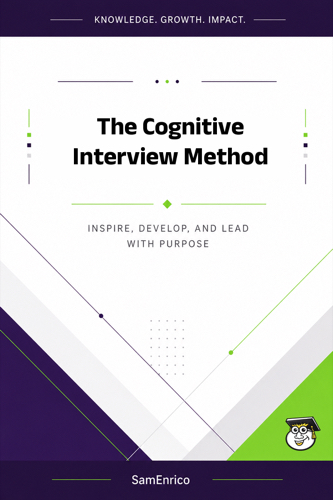
Non-FictionTrue CrimeInterview Technique
The Cognitive Interview Method eBook
Teaches unbiased interview techniques to gather ac
Teaches unbiased interview techniques to gather accurate witness memory without contamination.
Formats
Free sample
Chapter 1: The Memory Illusion--–- Jennifer Thompson was absolutely certain. On July 28, 1984, a man broke into her apartment in Burlington, North Carolina, held a knife to her throat, and raped her. During the attack, she studied his face with desperate intensity. She memorized his features, his eyes, his jawline, his scent. She told herself: I will survive this, and I will make sure this man never hurts anyone again.When police arrived, Jennifer worked with a sketch artist to create a composite drawing.
She reviewed mugshots. She picked Ronald Cotton from a photographic lineup, then again from a live lineup, then testified against him in court with absolute, unshakable confidence."I have no doubt," she told the jury. "I will never forget that face as long as I live."Ronald Cotton was convicted and sentenced to life plus fifty years.Eleven years later, DNA evidence proved what Ronald Cotton had insisted from the beginning: he was innocent. The actual perpetrator was another man named Bobby Poole, who bore only a passing resemblance to Cotton. Jennifer Thompson had not lied.
She had not been careless. She had done everything she and the police believed was right.Her memory had simply been wrong.The human mind is not a camera. It does not record events like a video file, store them intact, and play them back on demand. Memory is a reconstruction—a story we tell ourselves, cobbled together from fragments, influenced by emotion, expectation, suggestion, and the countless invisible forces that shape every recollection. When Jennifer Thompson looked at Ronald Cotton's photograph, she did not see a stranger.
She saw the face her brain had constructed from a composite sketch, from police encouragement, from her own desperate desire for justice and closure.This is not a story about a bad person. It is a story about a normal brain doing what normal brains do.And it is the reason you are reading this book.The Problem That Demands a Solution Every year, thousands of criminal cases rise or fall on eyewitness memory. In the United States alone, eyewitness misidentification is the single greatest contributor to wrongful convictions, playing a role in approximately seventy percent of convictions later overturned by DNA evidence. The Innocence Project has documented over three hundred and seventy-five exonerations based on faulty eyewitness testimony. Behind each number is a person who lost years, decades, or a lifetime to a memory that was never true.But the problem extends far beyond criminal justice.
Workplace investigations, human resources complaints, insurance claims, journalistic interviews, medical histories, military debriefings, and even conversations between parents and children all depend on the same fragile mechanism: one person asking questions, another person remembering. When that process is contaminated, the consequences range from minor misunderstandings to catastrophic injustice.The Cognitive Interview Method exists because the standard way of questioning witnesses—the way most of us naturally ask questions—systematically destroys accurate memory. Police officers, investigators, lawyers, and even therapists are trained, if they are trained at all, in techniques developed before we understood how memory actually works. They ask leading questions. They interrupt.
They make assumptions. They contaminate the very evidence they seek to preserve.This book offers a different way.What You Will Learn The Cognitive Interview is not a collection of tricks or interrogation tactics. It is a scientifically grounded protocol based on decades of research in cognitive psychology, developed by R. Edward Geiselman and Ronald Fisher at UCLA in the 1980s and refined through thousands of field studies across multiple continents. It has been adopted by law enforcement agencies in the United Kingdom, Australia, Canada, Norway, and New Zealand.
It has survived the scrutiny of peer review and the crucible of real-world application.The chapters ahead will teach you, step by step, how to conduct a Cognitive Interview.You will learn how memory actually works—not the metaphors and misconceptions we absorb from television, but the real, messy, extraordinary process by which the brain encodes, stores, and retrieves experience. You will learn why the standard interview methods you have probably used your entire life are not merely unhelpful but actively destructive. You will learn to recognize the subtle ways your own biases contaminate the questions you ask.You will learn to prepare yourself and your environment before a single question is spoken. You will master the four core retrieval techniques that form the heart of the method: free narrative, mental context reinstatement, strategic probing, and advanced strategies for resistant or edited recall. You will learn to protect memory as carefully as a crime scene investigator protects physical evidence.And you will learn to measure your own performance—because mastery is not a destination but a continuous practice of humility and self-correction.Who This Book Is For If you are a police officer, detective, or forensic interviewer, this book will transform how you gather evidence.
If you are a lawyer, judge, or legal professional, this book will sharpen your ability to evaluate witness testimony. If you are a human resources professional, therapist, journalist, military debriefer, insurance adjuster, educator, or parent—anyone who asks questions and depends on accurate answers—this book will make you better at your work.The Cognitive Interview Method works across contexts. It is effective with children and the elderly, with trauma survivors and reluctant witnesses, with individuals who have cognitive impairments and those who are highly articulate. It has been successfully adapted for medical interviews, public health investigations, and even historical research.What unites all these applications is a single principle: respect for the fragility of memory.Two Visions of the Witness The history of investigative interviewing can be understood as a struggle between two opposing visions of the witness.The first vision, dominant for most of the twentieth century, treats the witness as a container to be emptied. The interviewer's job is to ask questions—as many as necessary, as directly as possible—to extract the information inside.
This approach assumes that memory is stable, that witnesses know what they know, and that the interviewer's role is simply to ask the right questions. It is intuitive. It is natural. It is also wrong.This vision produces the accusatorial interview: rapid-fire questions, frequent interruptions, leading prompts, forced-choice options, and a steady pressure to provide answers. The interviewer drives.
The witness follows. The result, research shows, is an account that is shorter, less detailed, and less accurate than what the witness could have produced under better conditions.The second vision, which animates this book, treats the witness as an expert guide. The interviewer's job is to create conditions for remembering—to reduce cognitive load, to build rapport, to provide retrieval cues, and then to get out of the way. This approach assumes that memory is reconstructive, that witnesses need support to access their own knowledge, and that the interviewer's role is to facilitate, not to direct.This vision produces the information-gathering interview: open-ended prompts, long pauses, active listening, and a partnership in which the witness controls the narrative. The witness drives.
The interviewer follows. The result, research shows, is an account that is longer, richer, and more accurate.The difference is not subtle. Studies comparing standard police interviews with Cognitive Interviews consistently…
This is the end of the free sample. Get the eBook to keep going. Buy now
About this book
Details
- Author
- Alfieri Myron
- Publisher
- SamEnrico
- Language
- English
- Genre
- Non-Fiction, True Crime, Interview Technique
- Released
- 2026-06-07
- Pages (approx.)
- 149
- Available as
- eBook, Audiobook

Read better in the ZLOADR app
Your eBooks on your phone or tablet. Sign in with your SamEnrico account and start reading.
More by Alfieri Myron
 Chunking Psychology ConceptsAlfieri Myron$11.99
 Berber Marabout Saint VenerationAlfieri Myron$11.99
 The Prostate Immunotherapy GuideAlfieri Myron$11.99
 The Ghosts of Thermopylae: Spartans, Gods, and the Persian TideAlfieri Myron$11.99
 Quartz MiningAlfieri Myron$11.99
 Franchise Brand Protection GlobalAlfieri Myron$12.99
 Canadian Masters in AI GuideAlfieri Myron$12.99
 Understanding SclerosteosisAlfieri Myron$17.99
 Ultimate Handbook Guide to Baotou : (China) Travel GuideAlfieri Myron$11.99
You may also like
 Hong Kong Handover 1997Dunn Johnnie$11.99
 Zumba For Postnatal Recovery CourseNeal Christian$11.99
 Zumba for BeginnersLadner Nikia$11.99
 YouTube Comment Mining GuideHumes Pandora$12.99
 Worry Box MeditationCarlin Rudy$11.99
 Workplace Stress MeditationNguyen Lynn$11.99
 Workplace Stress and Sleep RepairHawley Ivory$11.99
 Workplace Perfectionism CureDelaney Jeffry$11.99
 Workplace Injustice Anger GuideWallen Isabelle$11.99
 Work Addiction and Burnout LinkGreenwood Ester$11.99
 Women in Yoga and WellnessBeattie Galina$11.99
 Women in Stand Up ComedyChun Evangeline$11.99