
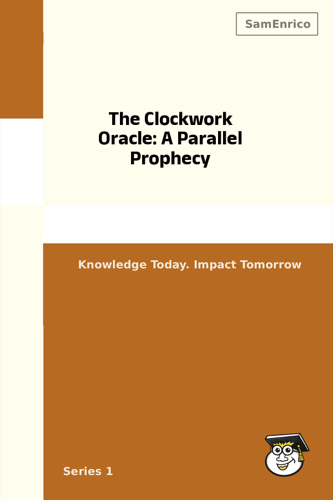
The Clockwork Oracle: A Parallel Prophecy eBook
Unravels the fate of the ancient Oracle of Delphi
by Earley Jewel
Unravels the fate of the ancient Oracle of Delphi if her prophecies were dictated by a hidden mechanical device instead of divine intervention.
Formats
Free sample
Chapter 1: The Bronze Lungs...--The first thing Dr. Mira Savalas noticed was the silence.Not the ordinary silence of a closed archaeological site at midnight—that she knew well, a companion she had made peace with during a dozen lonely digs across the Mediterranean. This was a different silence. A listening silence. As if the stones of Delphi were holding their breath, waiting to see what she would do next.She knelt in the inner fissure of the Temple of Apollo, her knees pressing into two thousand years of dust and shattered pottery, and scraped her trowel against a crack in the bedrock that had been overlooked by every excavator since the French began digging here in the 1880s.
The crack was narrow—barely two centimeters wide—and ran diagonally across the limestone floor like a forgotten scar. Her mentor, Professor Dimitriou, had called it "geological noise" and told her to focus on the main chamber. But Mira had learned long ago that history hid in the noise.The trowel struck something that was not stone.The sound was wrong. Stone gave a dull, dead thunk. This was a soft, musical ping—metal against metal, barely audible but unmistakable to a trained ear.
Her heart, already quick from the cold night air, accelerated further. She set down the trowel and reached for a smaller tool: a dental pick, delicate as a surgeon's scalpel, which she used for exactly this kind of精密 work.She probed the crack. The metal object was lodged deep, perhaps eight centimeters down, and it was not moving easily. The surrounding sediment had compressed around it over centuries, fusing it into place like a fossil in amber. She worked slowly, patiently, brushing away grains of soil one at a time, her headlamp casting a narrow cone of white light into the darkness.Twenty minutes later, the object came free.It was a gear.The Cog Mira held it up to her headlamp, turning it slowly between her thumb and forefinger.
Brass. Definitely brass, not bronze—the color was too pale, too golden. Bronze had a deeper, reddish hue from its copper content. This was something else, an alloy that spoke to a more sophisticated metallurgy than she would have expected from classical Greece.The gear was small, no larger than a modern euro coin, but its teeth were what made her breath catch. They were not triangular, the simple sawtooth pattern found on ancient water wheels and grain mills.
They were cycloidal—curved, like the teeth of a modern clock or a precision timepiece. Machined, not cast. The difference was subtle but absolute, the difference between a cave drawing and a photograph."What in the name of Zeus..." she whispered.She fumbled for her phone, activated the camera, and took a dozen photos from different angles. The gear's surface was encrusted with a dark, resinous residue—not mineral deposit, as she had first assumed, but something organic. Burned plant matter?
Oil? She scraped a tiny sample into a sterile vial and sealed it with shaking hands.The gear had been used. It had spun against another gear, probably many others, inside some larger mechanism. The wear patterns on the teeth were asymmetrical, indicating repeated stress in one direction. This was not a decorative piece.
It was a functional component of a machine.A machine at Delphi. A machine from the time of the Oracle.She sat back on her heels, suddenly aware of how cold the stone was, how far she was from anyone who might hear her if she called out. The fissure was a narrow gash in the earth, barely a meter wide at its widest point, and the walls rose above her like frozen waves. Above, through the gap, she could see the stars. Ancient Greek stars.
The same stars the Pythia would have seen on her way to the inner sanctum, drugged and dizzy from the ethylene gas that seeped from the fault below.Every schoolchild knew the story. The Oracle of Delphi sat on a tripod above a chasm, inhaled the sacred vapors, fell into a trance, and spoke the words of Apollo. The gas was real—modern geology had confirmed that the Delphi fault emitted ethylene, a sweet-smelling hydrocarbon that produced euphoria and dissociation. But the mechanism of prophecy had always been understood as divine, or at least natural. The Pythia breathed.
The god spoke.But a gear implied something else. Something designed. Something engineered.The Footnote Mira's mind raced back to a footnote she had read years ago, during her doctoral research at Oxford. She had been studying the intersection of ancient Greek religion and early technology—a niche so narrow that her advisor had called it "the archaeology of impossible things." In Plutarch's Moralia, a sprawling collection of essays and dialogues from the first century CE, there was a passing reference to the Oracle of Delphi that had always bothered her.Most ancient authors described the Oracle with reverence or skepticism, but always in supernatural terms. Plutarch, who served as a priest at Delphi late in his life, was different.
He wrote about the mechanics of the temple with an engineer's precision. He described the tripod, the chasm, the gases. And then, almost as an aside, he mentioned something strange:"The tripod groaned not from the god, but from the bronze lungs beneath."Bronze lungs. Not a metaphor, Mira had always suspected, but a description. A device that breathed—that inhaled and exhaled—made of bronze.
A machine that regulated the flow of gas, or perhaps something more.She had written a paper on it, arguing that Plutarch was describing a primitive valve system used by the temple priests to control the ethylene emissions. The paper had been rejected by three journals. "Speculative," the reviewers said. "Lacks archaeological evidence." She had moved on to other projects, other questions, but the footnote had never left her. It had lodged in her mind like a splinter, working its way deeper over time.Now she held the splinter in her hand.She needed to know how old the gear was.
Not the geological age of the surrounding rock—that was millions of years—but the age of the organic residue trapped in its teeth. If the residue dated to the classical period, to the fifth century BCE, then the gear was not a later intrusion. It was original. It was evidence.Her phone had no signal inside the fissure. She would have to wait until morning, when she could access the portable mass spectrometer in her field lab.
The waiting would be unbearable.The Mentor Dawn came slowly over the mountains of Phocis, painting the sky in shades of rose and gold. Mira had not slept. She had sat in the fissure until her legs went numb, then climbed out and walked to the small prefabricated building that served as the excavation's field laboratory. She had spent the night cleaning the gear under a microscope, documenting every scratch, every oxidation pattern, every irregularity in its surface.Professor Dimitriou arrived at seven, as he did every morning, carrying a thermos of bitter Greek coffee and a copy of that day's Kathimerini. He was sixty-two, bald…
This is the end of the free sample. Get the eBook to keep going. Buy now
About this book
Details
- Author
- Earley Jewel
- Publisher
- SamEnrico
- Language
- English
- Genre
- Non-Fiction, Parallel Universe
- Released
- 2026-06-04
- Pages (approx.)
- 116
- Available as
- eBook, Audiobook

Read better in the ZLOADR app
Your eBooks on your phone or tablet. Sign in with your SamEnrico account and start reading.
More by Earley Jewel
 Shift Work Split Shift GuideEarley Jewel$11.99
 Self Esteem for Domestic Violence Survivors WorkbookEarley Jewel$11.99
 Sulfur In Human HealthEarley Jewel$11.99
 The Nonprofit ConnectorEarley Jewel$11.99
 Peg System for Memorizing GeographyEarley Jewel$11.99
 The Silent Killer of the Skies: The Balloonist Who Poisoned EuropeEarley Jewel$11.99
 Understanding Exostoses Anetodermia Brachydactyly Type EEarley Jewel$17.99
 Office Administrative AssistantEarley Jewel$11.99
 Invoice Processing EfficiencyEarley Jewel$12.99
 Executive Summary Mistakes That Kill Your ProposalEarley Jewel$12.99
 How to Become a Molding SanderEarley Jewel$11.99
You may also like
 Hong Kong Handover 1997Dunn Johnnie$11.99
 Zumba For Postnatal Recovery CourseNeal Christian$11.99
 Zumba for BeginnersLadner Nikia$11.99
 YouTube Comment Mining GuideHumes Pandora$12.99
 Worry Box MeditationCarlin Rudy$11.99
 Workplace Stress MeditationNguyen Lynn$11.99
 Workplace Stress and Sleep RepairHawley Ivory$11.99
 Workplace Perfectionism CureDelaney Jeffry$11.99
 Workplace Injustice Anger GuideWallen Isabelle$11.99
 Work Addiction and Burnout LinkGreenwood Ester$11.99
 Women in Yoga and WellnessBeattie Galina$11.99
 Women in Stand Up ComedyChun Evangeline$11.99