
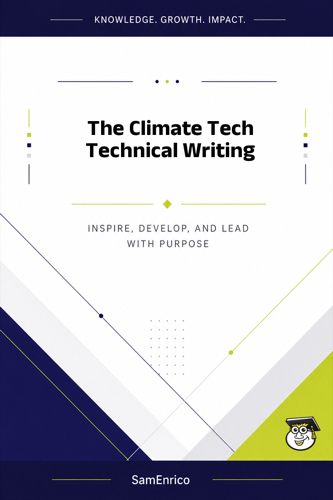
Non-FictionNon-Obvious CareerTechnical Writing
The Climate Tech Technical Writing eBook
Creates documentation for green hardware and softw
Creates documentation for green hardware and software.
Formats
Free sample
Chapter 1: The $100 Million Typo...--It was a Tuesday when the legal team walked in. Not the friendly, "let's review your contract" legal team. The other one. The one carrying binders and looking like they hadn't slept in a week. The CEO of Veridium Carbon, a promising climate tech startup that had raised over a hundred million dollars, watched as they placed three identical binders on the conference table.
Each binder contained the same thing: a forensic audit of the company's API documentation. Each binder would eventually become Exhibit A in a lawsuit that would destroy the company.The technology was brilliant. Veridium had built a carbon accounting platform that could ingest raw sensor data from factory floors, cross-reference it with grid carbon intensity APIs, and output real-time emissions reports that were supposed to be accurate within two percent. Investors had lined up. Customers included two Fortune 500 manufacturers.
The company was mentioned in the same breath as Stripe Climate and Watershed. And then someone tried to verify the numbers.An intern at a customer company, following the API documentation to the letter, tried to pull a report for a specific manufacturing line. The documentation said the factory_id parameter accepted any alphanumeric string. It did not mention that the underlying database had a hidden constraint: factory_id could not contain the letter 'Q' because an early engineer had used 'Q' as a delimiter in a now-removed logging system. The documentation was wrong.
The report pulled data from a different factory line entirely. The customer over-reported their emissions reductions by forty percent. The carbon credits they sold based on those numbers were invalid. The buyer of those credits sued. Veridium's insurance company refused to cover the claim, citing willful negligence in documentation.
The company folded eighteen months later.The CEO's final interview, given to a tech publication that no longer exists, contained a line that should be carved into every technical writer's desk: "We thought we had a documentation problem. We actually had a survival problem. We just didn't know it until it was too late."This is the world of climate tech technical writing. It is not about formatting user manuals or choosing the right font for a help center. It is about whether the technology actually works, whether the carbon reductions are real, and whether the people operating the hardware go home safe at the end of their shift.
This book exists because the stakes are too high for the old ways of doing things.The Seven-Figure Sentence Let me tell you about another company. This one survived, barely. A battery storage startup called Grid Forge had built a containerized lithium-ion system for utility-scale applications. Their hardware was solid. Their software was elegant.
Their documentation was written by a single overworked engineer who hated writing documentation and made no secret of it. The lockout/tagout procedure for the battery system's high-voltage disconnects was a single paragraph that read: "De-energize the system before performing maintenance." That was it. No diagram. No step-by-step verification. No mention of which breakers to lock and tag.
No guidance on testing for absence of voltage.A technician followed that documentation. He de-energized the wrong breaker, believing he had followed the instructions correctly. When he opened the panel, he encountered a 600-volt bus that was still live. His arc flash suit saved his life, but he spent three weeks in a burn unit. The lawsuit that followed named not just Grid Forge but the engineer who wrote the documentation personally.
The settlement was seven figures. The engineer's career in climate tech ended the day the check was cut.The company survived because their hardware was genuinely good and because the founder made a public commitment to overhauling every piece of documentation they produced. They hired three technical writers. They implemented a mandatory review process that required physical verification of every safety procedure. They created a "red team" of external safety officers whose only job was to try to hurt themselves following the documentation.
Two years later, they had one of the lowest incident rates in the industry and a documentation library that customers praised as "boring" – which, in the world of safety documentation, is the highest compliment.These two stories are not anomalies. They are the canaries in the coal mine of climate tech. As the industry grows from niche to mainstream, from venture-funded experiments to critical infrastructure, the quality of its documentation will determine which companies survive, which technologies scale, and ultimately, whether the climate solutions we are building actually deliver on their promises.What This Book Is Not Before we go any further, let me clear up a few misconceptions. This is not a book about how to write user manuals. If you are looking for a template for a software help center or a guide to writing clear English prose, there are excellent books already available.
This is also not a book about the science of climate change, though you will learn enough about carbon accounting and battery chemistry to be dangerous. And this is not a book about project management or agile methodology, though you will find plenty of process advice.This book is about a specific, urgent, and under-appreciated discipline: the technical writing that makes climate technology work, verifiable, and safe. It is for the engineer who has just been told to "write some docs" and has no idea where to start. It is for the professional technical writer who is moving from fintech or healthcare into climate and needs to understand what is different. It is for the founder who knows that their documentation is a mess but cannot articulate what a good version would look like.
And it is for the student who wants to build a career that matters, who understands that the world does not need more code without documentation, more hardware without manuals, more carbon credits without auditable provenance.The core argument of this book is simple: in climate tech, documentation is infrastructure. Not a cost center. Not a compliance checkbox. Not a nice-to-have that you will get to after the product ships. Infrastructure.
The same way you would not build a wind farm without transmission lines, you cannot build climate software without documentation that makes it verifiable. The same way you would not install a battery system without fire suppression, you cannot ship hardware without documentation that makes it safe.The Triple Bottom Line of Documentation Every piece of climate tech documentation serves three masters simultaneously. I call this the Triple Bottom Line of Documentation, and it will appear throughout this book as a lens for evaluating every decision you make as a technical writer.The first master is People. Can the user operate the technology safely and effectively? This is the traditional domain of technical writing: usability.
But in climate tech, usability has teeth. A confusing interface on a smart thermostat means wasted energy. An unclear procedure on a battery system means electrocution. A poorly explained API parameter means incorrect carbon calculations. People – the engineers, technicians, operators, and auditors who interact with your documentation – need precision, not just clarity.
They need to be able to follow your instructions without filling in gaps with guesswork.The second master is Planet. Does…
This is the end of the free sample. Get the eBook to keep going. Buy now
About this book
Details
- Author
- Lemaster Maura
- Publisher
- SamEnrico
- Language
- English
- Genre
- Non-Fiction, Non-Obvious Career, Technical Writing
- Released
- 2026-06-06
- Pages (approx.)
- 139
- Available as
- eBook, Audiobook

Read better in the ZLOADR app
Your eBooks on your phone or tablet. Sign in with your SamEnrico account and start reading.
More by Lemaster Maura
 Emotional Regulation For DisgustLemaster Maura$11.99
 Dreams After Electrocution TraumaLemaster Maura$11.99
 The High School Stress GuideLemaster Maura$11.99
 DBT For ParamedicsLemaster Maura$11.99
 Kolokotronis: The Lion of the Morea RisesLemaster Maura$11.99
 Understanding TaeniasisLemaster Maura$17.99
 How to Start a Pallets Made of Metal Business (Beginners Guide)Lemaster Maura$11.99
 Publication Gap ExplanationLemaster Maura$12.99
 Storefront NYC GuideLemaster Maura$12.99
 Journeyman Automotive Service TechnicianLemaster Maura$11.99
You may also like
 Hong Kong Handover 1997Dunn Johnnie$11.99
 Zumba For Postnatal Recovery CourseNeal Christian$11.99
 Zumba for BeginnersLadner Nikia$11.99
 YouTube Comment Mining GuideHumes Pandora$12.99
 Worry Box MeditationCarlin Rudy$11.99
 Workplace Stress MeditationNguyen Lynn$11.99
 Workplace Stress and Sleep RepairHawley Ivory$11.99
 Workplace Perfectionism CureDelaney Jeffry$11.99
 Workplace Injustice Anger GuideWallen Isabelle$11.99
 Work Addiction and Burnout LinkGreenwood Ester$11.99
 Women in Yoga and WellnessBeattie Galina$11.99
 Women in Stand Up ComedyChun Evangeline$11.99