
Non-FictionNon-Obvious CareerGreen Data
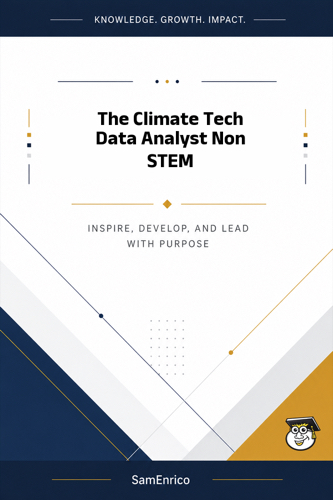
The Climate Tech Data Analyst Non STEM eBook
Uses Excel and BI tools for sustainability reporti
by Banks Rickey
Uses Excel and BI tools for sustainability reporting without coding.
Formats
Free sample
Chapter 1: The Spreadsheet Superpower--It was 4:47 PM on a Thursday when Sarah’s boss appeared at her cubicle with the kind of request that makes a finance analyst’s stomach drop. “We need our carbon footprint by Monday,” he said, holding a thick folder of utility bills and fuel receipts. “Sustainability consultant quoted us $40,000. You know Excel, right? Figure it out.”Sarah had been reconciling accounts payable at a mid-sized manufacturing company for six years.
She knew procurement, logistics, and general ledger codes. She knew how to make a Pivot Table sing and how to VLOOKUP her way out of almost any data mess. But climate change? Carbon footprints? She had no climate science background, no engineering degree, and certainly no coding skills.
She had never written a line of Python or SQL in her life.She went home that night convinced she was about to fail spectacularly.By Friday at 3 PM, Sarah had done something remarkable. Using nothing but Microsoft Excel, she calculated the company’s complete Scope 1 and Scope 2 emissions, identified the three facilities responsible for 70 percent of their carbon footprint, and prepared a one-page summary that her boss presented to the CEO on Monday morning. That single spreadsheet saved her department $40,000 in consulting fees and, within six months, led to $400,000 in energy efficiency investments that paid for themselves in eighteen months.Sarah is not a climate scientist. She is not a software engineer. She is not a data scientist with a master’s degree in artificial intelligence.
Sarah is a business analyst who knew how to organize messy data, apply consistent formulas, and present numbers in a way that decision-makers understood.This book is written for the thousands of Sarahs working in offices around the world right now. You are being asked—or you will soon be asked—to help your company measure, report, and reduce its environmental impact. And you have been told, implicitly or explicitly, that you cannot do this important work without learning to code, without buying expensive software, or without hiring a team of consultants.That is a lie.The Great Misunderstanding Let me state this as clearly as I possibly can: The single biggest bottleneck in corporate sustainability today is not a lack of climate science. It is not a lack of government regulation. It is not even a lack of corporate ambition.The single biggest bottleneck is a lack of people who can organize, clean, and analyze messy data using the tools already sitting on their desks.We have more climate data than ever before.
Utility companies produce millions of meter readings every day. Procurement systems track billions of dollars in supplier spending. Fleet management systems log every mile driven and every gallon burned. Building management systems record every kilowatt-hour consumed in every office, factory, and warehouse across the global economy.This data is everywhere. And it is almost completely unusable in its raw form.The problem is not that the data does not exist.
The problem is that the data arrives in a thousand different formats: PDF invoices that someone has to retype, CSV exports with merged header rows, spreadsheets where dates are stored as text, and databases that require a Ph D in computer science to query. The people who understand the data—procurement managers, facilities directors, logistics coordinators, finance analysts—are often told that they are not “technical enough” to work with it. And the people who have the technical skills—software engineers, data scientists, IT professionals—rarely understand the business context of the data they are being asked to analyze.This gap between business knowledge and technical skills is where you live. And it is precisely why you are already qualified to become your company’s most valuable sustainability person.The Non-STEM Advantage Let me introduce a concept that will appear throughout this book: the Non-STEM Advantage.When most people think about climate tech or sustainability data, they imagine someone with a degree in environmental science, atmospheric physics, or computer engineering. They picture a person writing Python scripts, querying SQL databases, and building machine learning models to predict emission trajectories.Those people exist.
They are brilliant. And they are also expensive, overworked, and often completely disconnected from the day-to-day reality of how businesses actually operate.Here is what those STEM-trained experts often do not know: how to read a procurement contract, how to reconcile a utility invoice against a budget, how to talk to a facilities manager about why their building uses twice as much energy as the building next door, or how to present a financial case for a solar installation to a skeptical CFO.You know these things. You have been living in the world of business data your entire career.The Non-STEM Advantage is this: you already understand where the data comes from, what it means, who owns it, and how to talk to the people who create it. You do not need to learn Python to be valuable. You need to learn how to apply your existing spreadsheet skills to a new domain.
And that is exactly what this book will teach you.The 90 Percent Reality Let me share a statistic that should make you feel immediately more confident. According to multiple industry surveys and my own experience working with hundreds of companies, approximately 90 percent of organizations still use Microsoft Excel as their primary tool for carbon accounting and sustainability reporting.Not specialized software. Not cloud-based platforms. Not custom databases built by teams of developers.Excel.The world’s largest companies—Fortune 500 giants with billions of dollars in revenue and thousands of employees—are tracking their carbon footprints in the same tool you use to balance your personal budget. They are not doing this because they are backward or incompetent.
They are doing this because spreadsheets are flexible, auditable, universally understood, and already installed on every single computer in the organization.The companies that claim to have moved beyond Excel are often using Excel as the hidden engine behind their “sophisticated” platforms. Their fancy dashboards are pulling data from spreadsheets. Their automated reports are generated by Excel macros running on a server somewhere. Their consultants deliver their final deliverables as Excel files because they know that is what the client will actually use.You are learning the right tool for the right job. You are not behind.
You are exactly where you need to be.The Lie About Coding Before we go any further, let me address the elephant in the room: the persistent, pervasive, and frankly destructive belief that you cannot work with data unless you can write code.This lie is told by bootcamps trying to sell you expensive courses. It is told by technologists who mistake their specific skill set for universal competence. It is told by consultants who want you to believe that sustainability is too complex for mere mortals to understand. It is even told by well-meaning colleagues who genuinely believe they are being helpful when they say, “You should really learn Python.”Here is the truth: Most corporate sustainability reporting does not require a single line of code.Most of the work is data cleaning, data transformation, data matching, and data aggregation. These tasks were designed to be performed in spreadsheets.…
This is the end of the free sample. Get the eBook to keep going. Buy now
About this book
Details
- Author
- Banks Rickey
- Publisher
- SamEnrico
- Language
- English
- Genre
- Non-Fiction, Non-Obvious Career, Green Data
- Released
- 2026-06-06
- Pages (approx.)
- 147
- Available as
- eBook, Audiobook

Read better in the ZLOADR app
Your eBooks on your phone or tablet. Sign in with your SamEnrico account and start reading.
More by Banks Rickey
 The Student Social Support GuideBanks Rickey$11.99
 Litigation Lawyer BurnoutBanks Rickey$11.99
 Dreams And Organ TransplantBanks Rickey$11.99
 DBT For FirefightersBanks Rickey$11.99
 The Salon of Voltaire: Enlightenment's Spark in ParisBanks Rickey$11.99
 Jeweler / GemologistBanks Rickey$11.99
 How to Start a Pamphlet Publishing (except Exclusive Internet Publishing) BusinessBanks Rickey$11.99
 Waiver of Publication RequirementBanks Rickey$12.99
 Appear Here London GuideBanks Rickey$12.99
 Understanding TachycardiaBanks Rickey$17.99
You may also like
 Hong Kong Handover 1997Dunn Johnnie$11.99
 Zumba For Postnatal Recovery CourseNeal Christian$11.99
 Zumba for BeginnersLadner Nikia$11.99
 YouTube Comment Mining GuideHumes Pandora$12.99
 Worry Box MeditationCarlin Rudy$11.99
 Workplace Stress MeditationNguyen Lynn$11.99
 Workplace Stress and Sleep RepairHawley Ivory$11.99
 Workplace Perfectionism CureDelaney Jeffry$11.99
 Workplace Injustice Anger GuideWallen Isabelle$11.99
 Work Addiction and Burnout LinkGreenwood Ester$11.99
 Women in Yoga and WellnessBeattie Galina$11.99
 Women in Stand Up ComedyChun Evangeline$11.99