
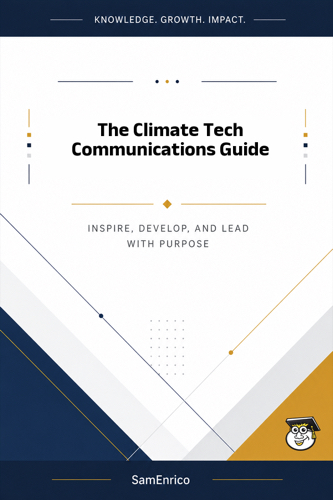
Non-FictionNon-Obvious CareerGreen Comms
The Climate Tech Communications Guide eBook
PR, social media, and storytelling for climate bra
PR, social media, and storytelling for climate brands.
Formats
Free sample
Chapter 1: The Logic Trap--–- In 2019, a climate tech startup raised $50 million for a direct air capture facility. Their press release led with a statistic: “Removes 1,000,000 tons of CO2 annually.” The CEO posted a graph on Linked In showing global temperature projections. The company hired a science communicator to explain the p H balance of ocean acidification. Eighteen months later, they had sold exactly zero carbon removal credits. Not because the technology failed.
Because no one remembered their name.Across the same period, a different startup—selling a simpler product, a heat pump for water heaters—ran a campaign with no graphs, no gigaton targets, no apocalyptic warnings. They showed a single image: a father holding a sleeping child next to a utility bill marked “$0.” Their tagline: “The last blackout your family will ever live through.” They sold out their first production run in eleven days.The difference between these two outcomes is not the quality of the technology. It is not the size of the carbon impact. It is not the scientific accuracy of the claims. The difference is a fundamental misunderstanding of how human beings process information about threats that feel distant, abstract, and overwhelming.This chapter dismantles the most common and costly mistake in climate tech communications: the assumption that more data equals more action.
It explains why the “information deficit model” is failing, introduces the concept of psychological distance, and provides a practical framework for making climate tech feel urgent, local, and personal. By the end, you will understand why your last three communications pieces probably started with a statistic—and why that is the fastest way to be ignored.The Broken Default The climate tech sector has an education problem. Not in the sense that its practitioners lack knowledge. Quite the opposite. The problem is that climate tech founders, engineers, and scientists are among the most data-literate people on the planet.
They live in a world of gigawatts, parts per million, and twenty-year climate models. They communicate with investors who speak the same language. And then they take that same language—dense, precise, abstract—and point it at normal human beings.The result is the information deficit model: the mistaken belief that if people just understood the facts, they would change their behavior. This model underpins nearly every failed climate campaign of the past three decades. It assumes that resistance to climate action is a knowledge problem rather than a psychological one.The evidence says otherwise.
In 2015, researchers at Yale surveyed thousands of Americans about climate change. They found that 70 percent accepted that climate change was real. Sixty-three percent understood it was primarily human-caused. But only 42 percent believed it would harm them personally. The gap between intellectual acceptance and personal relevance is where the information deficit model dies.People do not act on facts.
They act on feelings, identities, social pressures, and immediate stakes. Climate data lands in the brain like a textbook chapter on a topic you never signed up to study. It is not that the data is wrong. It is that the data is not designed for the system it is entering.The climate tech communicator faces a cruel irony: the more scientifically accurate you are, the less persuasive you may become. Not because accuracy is bad, but because accuracy without translation is noise.
The most honest description of a direct air capture plant—"a facility that uses amine-based sorbents to chemically bind atmospheric CO2 before releasing concentrated gas for sequestration"—is also the least memorable. The human brain hears that sentence and files it under “not relevant to my dinner plans.”This chapter is not an argument against accuracy. It is an argument against accuracy as a substitute for strategy. You can be both precise and compelling. But you have to understand the psychology of the person on the other end of your message.Psychological Distance: Why Tomorrow Never Comes The single most important concept in climate communication is psychological distance.
It is the brain’s tendency to relegate events that are far away in time, space, social proximity, or probability to the category of “not urgent.” Climate change is the perfect storm of psychological distance: it feels far in the future (decades from now), far in space (melting poles, drowning islands), socially distant (affecting polar bears more than people like us), and uncertain in probability (maybe bad, maybe catastrophic, but not tomorrow).When a communicator leads with “by 2050, sea levels will rise X inches,” the brain does not panic. The brain yawns. 2050 is not a deadline. It is a sci-fi movie setting. The brain has evolved to prioritize threats that are here, now, and personal.
A rustle in the bushes gets your attention. A graph about 2050 does not.This is not a failure of your audience. It is a feature of human cognition. George Marshall, in his essential book Don’t Even Think About It, documents how people who fully accept climate science still fail to act because the threat does not trigger the brain’s alarm system. Marshall tells the story of climate scientists who drive gas-guzzling cars and take frequent flights.
They know the data better than anyone. But knowing is not feeling.The implications for climate tech are brutal. Your technology may be the single most important solution to the greatest threat humanity has ever faced. But if you communicate it as a solution to a distant, abstract problem, you are asking your audience to care about something their brain is wired to ignore.The solution is not to make the threat bigger. Louder, more apocalyptic warnings do not work.
When fear has no immediate behavioral outlet, the brain does not mobilize—it dissociates. This is why images of starving polar bears do not sell heat pumps. They create a feeling of helplessness, and helplessness is the enemy of action.The solution is to collapse psychological distance. To bring the future into the present. To move the problem from “over there” to “right here.” From “someday” to “tonight.” From “them” to “me.”System 1 and System 2: The Two Brains To understand how to collapse psychological distance, you need to understand how the brain actually processes information.
Daniel Kahneman, in his Nobel Prize-winning work Thinking, Fast and Slow, describes two cognitive systems that operate in parallel.System 2 is slow, analytical, effortful, and deliberate. It is the part of your brain that does long division, compares mortgage rates, and reads scientific papers. System 2 is powerful but lazy. It requires energy and attention to engage. Most people spend most of their day avoiding System 2 thinking because it is exhausting.System 1 is fast, intuitive, emotional, and automatic.
It is the part of your brain that flinches at a loud noise, smiles at a baby, and knows that an angry face means danger. System 1 runs constantly in the background. It makes thousands of decisions per day without you even noticing. It is the default mode of the human mind.Climate data is pure System 2. Reading a graph, comparing emissions scenarios, calculating carbon footprints—these are effortful, analytical tasks.
Your audience will only engage System 2 if they are already motivated, already interested, or already paid to care. For everyone else, System 1 is…
This is the end of the free sample. Get the eBook to keep going. Buy now
About this book
Details
- Author
- Galvin Eldora
- Publisher
- SamEnrico
- Language
- English
- Genre
- Non-Fiction, Non-Obvious Career, Green Comms
- Released
- 2026-06-05
- Pages (approx.)
- 142
- Available as
- eBook, Audiobook

Read better in the ZLOADR app
Your eBooks on your phone or tablet. Sign in with your SamEnrico account and start reading.
More by Galvin Eldora
 DBT For VeteransGalvin Eldora$11.99
 The Sleep and Grades GuideGalvin Eldora$11.99
 Dreams And Cancer Trauma GuideGalvin Eldora$11.99
 Surgeon Resilience WorkbookGalvin Eldora$11.99
 The Blood Diamond Conspiracy: The 1870s Cape Colony Heist That Shook the EmpireGalvin Eldora$11.99
 International Trade and Finance LawGalvin Eldora$11.99
 How to Start a Palm Oil Refining Business (Beginners Guide)Galvin Eldora$11.99
 Research Summary for PhD AppsGalvin Eldora$12.99
 Pop Up Locations London GuideGalvin Eldora$12.99
 Understanding Systemic Lupus ErythematosusGalvin Eldora$17.99
You may also like
 Hong Kong Handover 1997Dunn Johnnie$11.99
 Zumba For Postnatal Recovery CourseNeal Christian$11.99
 Zumba for BeginnersLadner Nikia$11.99
 YouTube Comment Mining GuideHumes Pandora$12.99
 Worry Box MeditationCarlin Rudy$11.99
 Workplace Stress MeditationNguyen Lynn$11.99
 Workplace Stress and Sleep RepairHawley Ivory$11.99
 Workplace Perfectionism CureDelaney Jeffry$11.99
 Workplace Injustice Anger GuideWallen Isabelle$11.99
 Work Addiction and Burnout LinkGreenwood Ester$11.99
 Women in Yoga and WellnessBeattie Galina$11.99
 Women in Stand Up ComedyChun Evangeline$11.99