
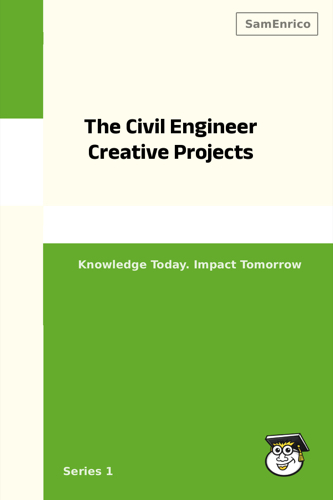
The Civil Engineer Creative Projects eBook
Design infrastructure with community engagement, m
Design infrastructure with community engagement, multi-use spaces, and adaptive reuse.
Formats
Free sample
Chapter 1: The Weaver’s Arrival...-- The call came in on a Tuesday. A city had a problem. An abandoned rail yard, forty acres of rusting tracks, crumbling platforms, and soil so contaminated that lawyers had circled it like vultures for a decade. The official request was simple: “Design a drainage system.” The unofficial request, whispered after the meeting by a woman who had lived across from the yard for thirty years, was different. “Don’t pave it,” she said.
“We’ve lost enough. Bring back the place where we used to hear music.”That moment—the gap between the official problem and the lived need—is where this book begins.For two centuries, civil engineering has been defined by answers. How much weight can this beam hold? How fast can water flow through this pipe? How many cars per hour can this road move?
These are honorable questions. They have given us safe bridges, clean drinking water, and cities that do not drown in their own rain. But they are incomplete. The 20th-century engineer was a solver of isolated problems. The 21st-century engineer must be something else entirely: a weaver of systems.This chapter introduces the central metaphor that will thread through every page of this book.
The weaver does not invent thread. The weaver takes what exists—wool, cotton, silk, scraps from previous projects—and combines them into a fabric stronger than any single strand. The creative civil engineer does the same: taking abandoned buildings, budget cuts, contaminated soil, community memory, and regulatory hurdles, and weaving them into infrastructure that does not just function, but generates life.This is not a book of theory. It is a field guide for engineers who are tired of watching their projects get ignored, vandalized, or demolished twenty years too early. It is for the city engineer who knows that the new stormwater pipe will be obsolete before it is paid off.
It is for the young professional who secretly wonders why they spent four years learning calculus but nothing about how to run a meeting where residents stop shouting and start drawing. It is for the veteran who has seen too many “community engagement” sessions that were actually just Power Point presentations with weak coffee.The argument of this book is simple, and it will offend some engineers: technical proficiency is the price of entry, not the mark of excellence. The genius of modern civil engineering lies elsewhere—in resourcefulness. Using local materials, donated labor, and community wisdom to solve structural and hydrological problems. Designing infrastructure that children want to play on, that old men want to sit beside, that teenagers want to claim as their own.
Building not for the ribbon-cutting photograph, but for the generation that will inherit the project long after the engineer has retired.The top ten best-selling books on adaptive reuse, community engagement, and regenerative design—from Stewart Brand’s How Buildings Learn to Sandra Albro’s Vacant to Vibrant—agree on one thing: the demolition-first model of the 20th century is dead. It is financially unsustainable (demolition wastes the embodied energy of existing materials). It is culturally destructive (erasing memory along with buildings). And it is politically stupid (communities are tired of being presented with finished plans and asked for applause).What replaces it? That is the subject of the next twelve chapters.
But first, we must understand what kind of person becomes a weaver. And that requires unlearning some of the most cherished myths of engineering education.The Myth of the Blank Slate Every engineering student learns the same workflow: survey the site, run the numbers, design the solution, present the plans. This workflow assumes that the site is empty—a blank slate waiting for the engineer’s genius. It is a lie.The sites where creative civil engineers work are never empty. They are layered with history.
The abandoned gas station was once someone’s first job. The contaminated lot was once a playground. The dead mall was once the place where a generation learned to flirt. These layers are not sentimental distractions. They are structural data.
A community that remembers a building with affection will defend it, maintain it, and adapt it. A community that watches a building get demolished will distrust every engineer who follows.The weaver knows this. Before the first line is drawn, the weaver walks the site with the people who live there. Not to “gather input” in the sterile sense, but to learn what the survey cannot show: where water actually pools (not where the model says it should), which walls collect graffiti (and therefore which sightlines need attention), where children play despite the fences (and therefore where desire lines are already written in the dirt).This book will teach you how to see those invisible landscapes. But the first step is admitting that you are not arriving at a blank slate.
You are arriving at a conversation that has been going on for decades without you.The Three Mindsets of the Resourceful Engineer Across the case studies that populate this book—from a WWII bunker turned mushroom farm to a parking garage turned rooftop farm—three mindsets recur. They are the weaver’s tools. They will appear as icons throughout the remaining chapters, and by the end of this book, they will become reflexes.1. Bricolage [icon: a woven knot]Bricolage is a French word that means, roughly, “making do with what is at hand.” It is the opposite of the specification-driven, order-everything-from-a-catalog approach that dominates modern engineering. The bricoleur looks at a pile of discarded conveyor belts and sees flooring.
The bricoleur looks at old billboard vinyl and sees roofing. The bricoleur looks at a decommissioned water tower and sees a wedding venue.This is not poverty thinking. It is strategic abundance. The materials you need are already in your city, often free for the hauling. The abandoned building down the street is not a problem to be demolished; it is a kit of parts waiting for a new purpose.
The bricoleur’s question is never “Where can I buy this?” but “What already does this job badly enough that I can adapt it?”Chapter 6 will give you the legal and logistical frameworks for superuse—harvesting steel beams, old-growth timber, and circular staircases from buildings scheduled for demolition. But the mindset begins here: treat the city as a quarry, not a catalog.2. Circular Innovation [icon: a looped arrow]The linear model of infrastructure—extract, build, use, demolish, landfill—is a hangover from the era of cheap energy and infinite resources. That era is over. Circular Innovation means designing so that materials flow from one project to the next.
The concrete crushed from a demolished sidewalk becomes the sub-base for a new path. The steel beams from a decommissioned factory become the frame for a community center. The wood from a fallen city tree becomes benches in a plaza.Circular Innovation also applies to programs, not just materials. A plaza that serves as a school drop-off in the morning, a market at noon, and a concert venue at night is a circular system: the same square footage generates multiple values without requiring additional land. Chapter 4 will introduce…
This is the end of the free sample. Get the eBook to keep going. Buy now
About this book
Details
- Author
- Hardin Shakira
- Publisher
- SamEnrico
- Language
- English
- Genre
- Non-Fiction, Self-Help, Civil
- Released
- 2026-06-10
- Pages (approx.)
- 138
- Available as
- eBook, Audiobook

Read better in the ZLOADR app
Your eBooks on your phone or tablet. Sign in with your SamEnrico account and start reading.
More by Hardin Shakira
 Self Hypnosis For Intuition DevelopmentHardin Shakira$11.99
 Sensory Walking MeditationHardin Shakira$11.99
 Spouse Loss Anger ManagementHardin Shakira$11.99
 Blood Dream Jungian MeaningHardin Shakira$11.99
 Ayurvedic Herbal RemediesHardin Shakira$11.99
 Cocaine Cold Water TherapyHardin Shakira$11.99
 Cloze Deletion Technique GuideHardin Shakira$11.99
 IBS Gut Brain ConnectionHardin Shakira$11.99
 The Bitcoin Boom and Bust: How a Digital Dream Turned into a Global NightmareHardin Shakira$11.99
 The Great Unwind: How a Tiny Island Toppled a Global Financial GiantHardin Shakira$11.99
 The Divine Architect: Bach, Mozart, and Beethoven’s Harmonic RevolutionHardin Shakira$11.99
 Chinese Student Networking GuideHardin Shakira$12.99
You may also like
 Hong Kong Handover 1997Dunn Johnnie$11.99
 Zumba For Postnatal Recovery CourseNeal Christian$11.99
 Zumba for BeginnersLadner Nikia$11.99
 YouTube Comment Mining GuideHumes Pandora$12.99
 Worry Box MeditationCarlin Rudy$11.99
 Workplace Stress MeditationNguyen Lynn$11.99
 Workplace Stress and Sleep RepairHawley Ivory$11.99
 Workplace Perfectionism CureDelaney Jeffry$11.99
 Workplace Injustice Anger GuideWallen Isabelle$11.99
 Work Addiction and Burnout LinkGreenwood Ester$11.99
 Women in Yoga and WellnessBeattie Galina$11.99
 Women in Stand Up ComedyChun Evangeline$11.99