
Non-FictionSelf-HelpComparative Health
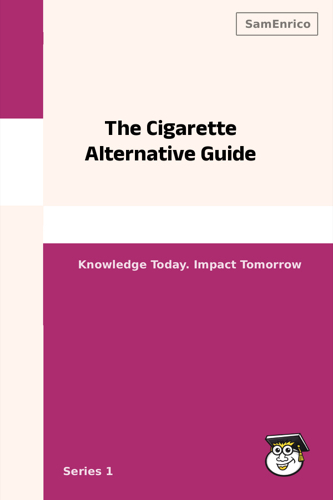
The Cigarette Alternative Guide eBook
Compares NRT, vaping, medication, and behavioral o
Compares NRT, vaping, medication, and behavioral options to find your best fit.
Formats
Free sample
Chapter 1: The Combustion Lie--You have been told, probably hundreds of times, that the only acceptable goal is to quit nicotine entirely. Zero. Nothing. Cold turkey or failure. This singular message has been drilled into your head by public health campaigns, well-meaning doctors, and every quit-smoking poster you have ever seen.
There is just one problem with that message. It is killing people.Not figuratively. Literally.The abstinence-only, zero-nicotine-or-nothing approach has a documented failure rate of ninety-five percent over one year. Read that number again. Ninety-five percent.
In any other field—aviation, medicine, engineering—a ninety-five percent failure rate would be called a catastrophe. In smoking cessation, it is called "standard care." And the victims of this catastrophe are the millions of smokers who try, fail, feel shame, and then light another cigarette because they believe they lack willpower.You do not lack willpower. You have been set up to fail by a framework that refuses to distinguish between the poison and the delivery system.This chapter dismantles the single most damaging lie in tobacco control. The lie that nicotine is the enemy. The lie that substitution is surrender.
The lie that your only choices are to smoke or to suffer. By the end of these pages, you will understand something that most doctors are not taught, most cessation programs ignore, and most best-selling quit-lit books deliberately obscure: combustible cigarettes are uniquely deadly because of combustion, not because of nicotine. Once you separate those two things, your entire understanding of quitting transforms completely.The Anatomy of a Cigarette: What You Are Actually Burning Let us start with a simple chemical fact. A cigarette is a small cylindrical device that burns plant material. When that plant material burns, it does not simply release nicotine.
It releases over seven thousand distinct chemical compounds. At least seventy of those compounds are known carcinogens.Here is a partial list of what you inhale every time you light up: tar, carbon monoxide, formaldehyde, arsenic, ammonia, benzene, lead, hydrogen cyanide, and polonium-210. Yes, that is the same polonium used in nuclear weapons. None of these chemicals are added for flavor. They are the natural byproducts of combustion.
When you burn organic matter—tobacco, marijuana, wood, even incense—you create a chemical soup of pyrolysis products. The difference is that cigarette smokers perform this combustion forty to sixty times per day, every day, for decades.Now contrast that with the alternatives.A nicotine patch contains nicotine and pharmaceutical-grade binders. That is it. Two ingredients. A piece of nicotine gum contains nicotine, a polymer base, and food-grade flavorings.
A vape aerosol, when generated from a legitimate device and quality e-liquid, contains propylene glycol, vegetable glycerin, nicotine, and flavor compounds. Typically five to ten ingredients, none of which produce the tar, carbon monoxide, or heavy metals found in cigarette smoke.The distinction could not be clearer. The patch is not "safer" than a cigarette in the sense of being marginally less dangerous. It is in an entirely different category of risk. Comparing a cigarette to a nicotine patch is like comparing a glass of wine to a bottle of industrial solvent.
They both contain liquid. The similarity ends there.This is not opinion. This is analytical chemistry. The combustion of organic material produces a class of compounds called polycyclic aromatic hydrocarbons, which are directly responsible for the majority of smoking-related cancers. None of these compounds are present in nicotine replacement therapy.
None are present in pharmaceutical-grade nicotine. They exist only when you burn something.If you take nothing else from this chapter, take this: you are not addicted to the poison. You are addicted to the nicotine that happens to be delivered alongside the poison. And that nicotine can be delivered in other ways.The Ninety-Five Percent Failure Myth: Why Raw Willpower Does Not Work You have heard it a thousand times. Quitting smoking is simply a matter of willpower.
If you want it badly enough, you can just stop. This advice is not merely unhelpful. It is actively destructive.Let us examine the data. Population-level studies on unassisted cessation—quitting cold turkey with no medication, no replacement, no behavioral support—show a long-term success rate of approximately three to five percent. That means ninety-five to ninety-seven percent of people who try to quit using raw willpower alone will relapse within one year.
Among heavy smokers, defined as one or more packs per day, the success rate drops to less than two percent.These numbers are not opinions. They come from the American Cancer Society, the Centers for Disease Control and Prevention, and multiple meta-analyses published in peer-reviewed medical journals. The consistency across studies is remarkable. Regardless of country, time period, or demographic, unassisted cessation fails approximately ninety-five percent of the time.Why is raw willpower so ineffective? Because nicotine addiction is not a moral weakness.
It is a neurobiological adaptation.When you chronically expose your brain to nicotine, it upregulates nicotinic acetylcholine receptors. Your brain essentially grows more docking stations for nicotine. When nicotine levels drop, those receptors send intense distress signals—cravings, irritability, anxiety, difficulty concentrating, sleep disturbances. That distress is not imaginary. It is measurable on functional MRI scans.
It activates the same brain regions as hunger, thirst, and pain.Raw willpower—white-knuckling through withdrawal, suppressing cravings, shaming yourself for wanting a cigarette—requires you to override these signals using your prefrontal cortex, the part of your brain responsible for executive function and impulse control. The problem is that nicotine withdrawal impairs prefrontal cortex activity. Studies show that within twenty-four hours of nicotine cessation, performance on tasks requiring attention, working memory, and impulse control declines significantly.You are trying to use a weakened muscle to lift a heavy weight. That is possible for a tiny minority of people with exceptional cognitive reserve and low baseline addiction severity. For the vast majority, it fails.But here is the critical distinction that almost every quit-smoking guide gets wrong.
There is a difference between raw willpower and skilled willpower.Raw willpower is white-knuckling, suppression, shame-based resistance, and the belief that you should be able to quit through sheer force of desire. Raw willpower fails ninety-five percent of the time.Skilled willpower is strategic effort using evidence-based tools: medication, replacement therapy, cognitive behavioral techniques, mindfulness practices, logging, delaying, environmental redesign, and social accountability. Skilled willpower succeeds thirty-five to fifty-five percent of the time, depending on the combination of methods used.This book teaches skilled willpower. It never asks you to simply "try harder." It gives you specific, actionable, evidence-based protocols.Substitution Versus Transformation: The Two Valid Paths Here is where we must address a fundamental tension in the quit-lit world. There are two valid philosophies about nicotine cessation.
They contradict each other. Both have evidence supporting them. And the failure to acknowledge this contradiction has caused countless relapses.Path One: Substitution. This philosophy holds that the primary health goal is to stop combusting tobacco. Nicotine itself, when separated from smoke, is a relatively low-risk substance—comparable to daily caffeine use for most people without cardiovascular disease.
Under this model, switching from cigarettes to vaping, NRT, or medication is a medical victory. If you remain on nicotine indefinitely but never smoke again…
This is the end of the free sample. Get the eBook to keep going. Buy now
About this book
Details
- Author
- Jasper Tawnya
- Publisher
- SamEnrico
- Language
- English
- Genre
- Non-Fiction, Self-Help, Comparative Health
- Released
- 2026-06-10
- Pages (approx.)
- 145
- Available as
- eBook, Audiobook

Read better in the ZLOADR app
Your eBooks on your phone or tablet. Sign in with your SamEnrico account and start reading.
More by Jasper Tawnya
 Mindfulness Meditation Audio GuideJasper Tawnya$11.99
 The Differentiation EffectJasper Tawnya$11.99
 Financial Stress for ArtistsJasper Tawnya$11.99
 The Phantom of the Opera: The Real-Life Scandal That Inspired a MasterpieceJasper Tawnya$11.99
 How to Start a Blank Optical Discs Business (Beginners Guide)Jasper Tawnya$11.99
 How to Produce Audio ConvertersJasper Tawnya$11.99
 Elasticity Calculator Economics ManualJasper Tawnya$12.99
 Deal Flow Creation Through ContentJasper Tawnya$11.99
You may also like
 Hong Kong Handover 1997Dunn Johnnie$11.99
 Zumba For Postnatal Recovery CourseNeal Christian$11.99
 Zumba for BeginnersLadner Nikia$11.99
 YouTube Comment Mining GuideHumes Pandora$12.99
 Worry Box MeditationCarlin Rudy$11.99
 Workplace Stress MeditationNguyen Lynn$11.99
 Workplace Stress and Sleep RepairHawley Ivory$11.99
 Workplace Perfectionism CureDelaney Jeffry$11.99
 Workplace Injustice Anger GuideWallen Isabelle$11.99
 Work Addiction and Burnout LinkGreenwood Ester$11.99
 Women in Yoga and WellnessBeattie Galina$11.99
 Women in Stand Up ComedyChun Evangeline$11.99