
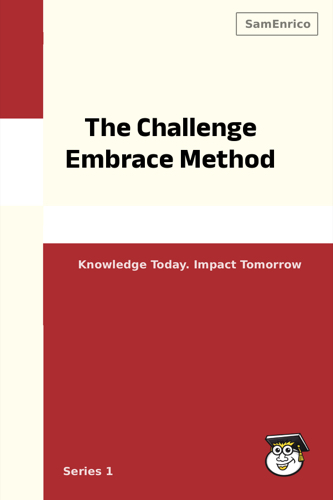
Non-FictionSelf-HelpChallenge Seeking
The Challenge Embrace Method eBook
Teaches actively seeking difficulty as a path to f
by Seaton Sunny
Teaches actively seeking difficulty as a path to faster growth and skill building.
Formats
Free sample
Chapter 1: The Comfort Trap--–- The first time I realized comfort was killing me, I was sitting in an airport lounge eating free cookies.Not because I was hungry. Because they were there. Because the lounge was warm, the chair was ergonomic, and my flight was delayed by only forty-five minutes—a delay so minor that any previous generation of travelers would have called it a miracle. But I was irritated. Actually, more than irritated.
I was subtly, deeply, irrationally angry. A forty-five-minute delay felt like a personal insult.That was the moment the question arrived, unbidden and unwelcome: When did I become so soft?I looked around the lounge. Every single person was doing the same thing I was—scrolling, eating, waiting, avoiding. No one was reading a difficult book. No one was practicing a skill.
No one was having an uncomfortable conversation. We were all just... dissolving. Slowly, comfortably, collectively dissolving into the softest versions of ourselves.And we had no idea it was happening.The Great Paradox of Modern Life Here is the strangest fact about the world you live in: You have never had it so easy, and you have never felt so fragile.Think about what your great-grandparents endured. Physical labor from sunrise to sunset.
Food that required hunting, planting, or preserving. Communication that took weeks. Travel that took months. Medicine that was essentially guesswork. Death that was a frequent dinner guest.Now think about your typical Tuesday.
Temperature controlled. Food delivered. Entertainment infinite. Communication instantaneous. Pain optional.
Discomfort something you have to seek out intentionally, like a tourist visiting a hardship theme park.By every objective measure, life is better. Longer. Safer. Easier.So why do anxiety, depression, and existential aimlessness track in the opposite direction? Why are the wealthiest, most comfortable societies in human history also the most mentally fragile?The answer is uncomfortable, and this book is built entirely around it: Comfort does not make you stronger.
Comfort makes you weaker.The less discomfort you voluntarily experience, the smaller your window of tolerance for stress becomes. Your psychological immune system, like your biological one, atrophies without exposure to manageable threats. You are not born fragile. You are trained into fragility by a world that has removed nearly every natural source of productive difficulty.This chapter is called The Comfort Trap because that is exactly what it is—a trap baited with convenience, sprung with good intentions, and locked by your own neurology. The trap whispers: You deserve this ease.
You worked hard. Relax. Take the shortcut. Skip the hard conversation. Order the delivery.
Watch the next episode.And every time you say yes to the whisper, you sell a small piece of your future resilience.The Science of Psychological Fragility Let me be precise about what I mean by "fragility." I am not talking about mental illness, trauma, or clinical conditions that require professional care. Those are real, and they deserve compassion and treatment. I am talking about something different: the low-grade, widespread, culturally normalized inability to tolerate ordinary discomfort.Researchers call this the "stress inoculation gap." Just as vaccines expose your immune system to a weakened virus to build antibodies, manageable stress exposures build psychological antibodies. But when you eliminate all stress from your daily life—when the temperature is always perfect, the food is always fast, the entertainment is always engaging, and the conversations are always agreeable—your stress inoculation decays.The result is a phenomenon psychologists have named "antifragility reversal." Antifragility, a term coined by scholar Nassim Taleb, describes systems that actually benefit from volatility, randomness, and stress. Muscles are antifragile: they tear slightly during exercise, then grow back stronger.
Bones are antifragile: weight-bearing stress increases density. Immune systems are antifragile: exposure to germs builds resistance.But here is the cruel trick: humans are antifragile only when stress is voluntarily and incrementally applied. When stress is imposed traumatically, it breaks you. When it is removed entirely, you shrink.The comfort trap removes it entirely.A 2021 study from the Journal of Experimental Psychology gave two groups of people difficult puzzles to solve. One group was first exposed to mildly uncomfortable temperatures (a slightly cold room).
The other group sat in a perfectly climate-controlled room. The group that experienced the mild discomfort persisted 40% longer on the puzzles. Why? Because they had already activated their "discomfort tolerance" circuitry. The cold room was a warm-up for the hard mental work.You cannot warm up if you never get cold.The Three Domains of Avoidance The comfort trap operates in three specific domains.
Most people are trapped in at least two of them. Some are trapped in all three.Domain One: Physical Comfort This is the most obvious domain. Heated seats. Air conditioning. Processed food engineered to hit the exact bliss point of sugar, fat, and salt.
Elevators for one floor. Delivery for everything. Sleep masks. White noise machines. Orthopedic everything.None of these are bad in isolation.
The trap is not the technology; the trap is the expectation that comfort is the default state. When your baseline is perfect temperature, perfect texture, perfect taste, anything less feels like deprivation. You haven't raised your standard of living. You have lowered your tolerance for living.The research on "thermal habituation" is instructive. People who take cold showers regularly report not only lower baseline anxiety but also faster recovery from illness and injury.
Why? Because cold exposure activates the vagus nerve, which regulates your parasympathetic nervous system. But more importantly, it teaches you a lesson that generalizes far beyond the shower: I can tolerate discomfort, and I will be fine.Every time you turn the water hotter because the cold is uncomfortable, you reinforce the opposite lesson.Domain Two: Cognitive Comfort This domain is more subtle and, in many ways, more damaging. Cognitive comfort is the avoidance of mental friction. The easy answer over the hard question.
The familiar opinion over the challenging one. The summarized article over the book. The video over the text. The algorithm's recommendation over your own curiosity.Social media platforms are engineered for cognitive comfort. They show you what you already agree with.
They hide what might challenge you. They reward quick reactions and punish sustained attention. The result is not just a shorter attention span—though that is real—but a deeper incapacity: the inability to sit with confusion, to tolerate not knowing, to persist through the uncomfortable middle of a difficult problem.This is why the most educated generation in history is also the most susceptible to misinformation. Knowing facts is not the same as having the cognitive stamina to evaluate them. Stamina is built through friction.
Friction has been removed.Domain Three: Emotional Comfort The most dangerous domain of all. Emotional comfort is the avoidance of any feeling that might be classified as "bad." Boredom? Scroll. Loneliness? Notification.
Sadness? Distraction. Anger? Suppression. Disappointment?
Reframe it away before it fully arrives.The therapeutic culture has done wonderful things for destigmatizing mental health. But it has also accidentally created a generation that believes any negative emotion is a symptom of pathology rather than a feature of being alive. You are not supposed to be happy all the time. You are not…
This is the end of the free sample. Get the eBook to keep going. Buy now
About this book
Details
- Author
- Seaton Sunny
- Publisher
- SamEnrico
- Language
- English
- Genre
- Non-Fiction, Self-Help, Challenge Seeking
- Released
- 2026-06-10
- Pages (approx.)
- 113
- Available as
- eBook, Audiobook

Read better in the ZLOADR app
Your eBooks on your phone or tablet. Sign in with your SamEnrico account and start reading.
More by Seaton Sunny
 The Lawrenceville House SystemSeaton Sunny$11.99
 Strategy Formulation CreativitySeaton Sunny$11.99
 Managing Loneliness Without Acting OutSeaton Sunny$11.99
 Red Persuasion InfluenceSeaton Sunny$11.99
 The Curse of Erysichthon: Gluttony and the Oak That BleedsSeaton Sunny$11.99
 Understanding Tunglang–savage–bellman SyndromeSeaton Sunny$17.99
 How to Become a Planer OperatorSeaton Sunny$11.99
 YC African Startup Offline GuideSeaton Sunny$12.99
 VAT and Oil & GasSeaton Sunny$12.99
 Development LeadSeaton Sunny$11.99
You may also like
 Hong Kong Handover 1997Dunn Johnnie$11.99
 Zumba For Postnatal Recovery CourseNeal Christian$11.99
 Zumba for BeginnersLadner Nikia$11.99
 YouTube Comment Mining GuideHumes Pandora$12.99
 Worry Box MeditationCarlin Rudy$11.99
 Workplace Stress MeditationNguyen Lynn$11.99
 Workplace Stress and Sleep RepairHawley Ivory$11.99
 Workplace Perfectionism CureDelaney Jeffry$11.99
 Workplace Injustice Anger GuideWallen Isabelle$11.99
 Work Addiction and Burnout LinkGreenwood Ester$11.99
 Women in Yoga and WellnessBeattie Galina$11.99
 Women in Stand Up ComedyChun Evangeline$11.99