
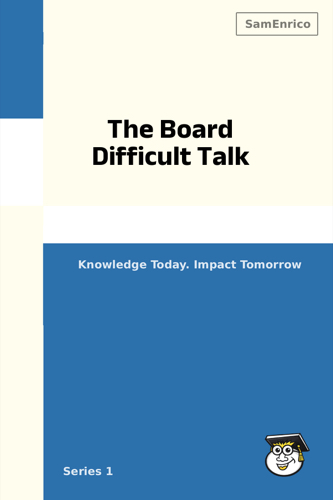
The Board Difficult Talk eBook
Address sensitive issues with organizational leade
Address sensitive issues with organizational leadership.
Formats
Free sample
Chapter 1: The Silence Tax...--– In a boardroom overlooking a city skyline, seventeen highly intelligent, deeply experienced executives sat in perfect silence while a $47 million problem grew worse by the minute. Not one of them was ignorant of the issue. Not one of them lacked the authority to speak. And yet, no one said a word.This is not a scene from a cautionary fable. It is a composite drawn from dozens of real board meetings, strategy offsites, and executive sessions that the author has witnessed or studied over two decades of corporate governance.
In every case, the pattern is identical: the information is present, the people are competent, the stakes are high, and yet the conversation simply does not happen. The topic sits on the table like a bomb no one wants to defuse. Minutes tick by. Agendas are followed. Decisions are made—often the wrong ones—and everyone walks out knowing that the most important issue was never discussed.This book is called The Board Difficult Talk because that is the precise skill set required to break this pattern.
But before we can learn how to speak, we must first understand why we stay silent. And the answer is far more disturbing than simple fear.The Knowing-Doing Gap in the Corner Office In the late 1990s, researchers Jeffrey Pfeffer and Robert Sutton coined the term "knowing-doing gap" to describe a perplexing organizational phenomenon: companies consistently fail to act on what they know. They know that customer service matters, yet they treat frontline staff poorly. They know that innovation requires psychological safety, yet they punish failure. The gap between knowledge and action is not a failure of intelligence.
It is a failure of courage, structure, and culture.In the boardroom, this gap becomes a chasm. Consider the following scenario, which plays out in various forms across industries every quarter: The board receives a routine financial report showing that a key product line is underperforming. The data is clear. The trend lines are unmistakable. Two directors privately believe the product should be discontinued.
A third believes the head of that division should be replaced. The CEO, sitting at the head of the table, has made this product line a personal priority. He hired the division head. He championed the strategy in the last annual report. To question the product is to question him.So no one asks the question.
The report is accepted. The meeting moves on. Six months later, the product is officially written down as a $47 million loss, and the board holds a somber post-mortem about "market conditions." Everyone in the room knows the truth, but no one says it out loud.This is the knowing-doing gap in its purest form. The knowledge was present. The capacity to act was present.
The only missing ingredient was the willingness to speak.The Architecture of Silence Silence in the boardroom is not a simple absence of sound. It is an active, dynamic force with its own architecture, its own logic, and its own devastating consequences. To break silence, we must first understand its three distinct faces.The first face is Fear. This is the most obvious and the most easily named, but also the most misunderstood. Fear in the boardroom is rarely fear of physical harm or even direct termination.
It is more subtle and more pervasive: fear of being seen as difficult, fear of damaging a valuable relationship, fear of being excluded from future meetings, fear of being labeled "not a team player," fear of losing the social capital that makes board service rewarding. These fears are not irrational. Retaliation in corporate governance is rarely a pink slip delivered on a Friday afternoon. It is a slow, quiet process of marginalization: fewer invitations to pre-meeting dinners, less eye contact across the table, a subtle shift in tone when you speak. The fear is real, and it operates below the level of conscious calculation.The second face is Futility.
This is the belief, often born from painful experience, that speaking will not change anything anyway. The director who has raised the same concern three times without any visible response eventually stops raising it. The executive who watched a colleague get ignored or dismissed internalizes the lesson: why waste the energy? Futility is particularly dangerous because it masquerades as wisdom. "I've learned to pick my battles," a seasoned director might say, when what they really mean is "I have learned that most battles are unwinnable, so I have stopped fighting." This is not wisdom.
It is learned helplessness dressed in the robes of experience.The third face is Fidelity. This is the most insidious because it feels like virtue. Fidelity is the misplaced loyalty that convinces us to protect a leader from hard truths. "The CEO has so much on his plate right now," we tell ourselves. "It's not the right time to add to his stress." Or: "She's just come out of a difficult board meeting; I don't want to pile on." Or the most dangerous version: "I believe in this leader, and good followers don't create problems for their leaders." This is not loyalty.
It is codependency disguised as professionalism. True loyalty to a leader includes the willingness to tell them what they need to hear, not just what they want to hear. But fidelity traps us in the opposite direction, turning us into enablers rather than allies.These three faces—Fear, Futility, and Fidelity—rarely appear in isolation. They reinforce one another. Fear of retaliation strengthens futility ("if I speak, nothing will change and I will suffer").
Fidelity amplifies fear ("I should protect him, not confront him"). Together, they create a self-reinforcing loop that transforms silence from a momentary choice into a permanent condition.The Silence Spiral Once silence takes hold, it accelerates through a predictable pattern that this book calls the Silence Spiral. Understanding this spiral is essential because it reveals why silence is not static but dynamic—it gets worse over time unless actively interrupted.The spiral begins with a single individual who notices a problem but chooses not to speak. Usually, this person has good reasons: they want to gather more data, they want to find the right moment, they want to check their perception with a trusted colleague first. But every day of silence makes the next day harder.
The longer the issue goes unmentioned, the more awkward it becomes to raise it. "If it was really a problem," the silent observer thinks, "surely someone else would have said something by now."This brings us to the second turn of the spiral: the interpretation of silence as agreement. When one person stays quiet, others do not see an individual choosing silence. They see a group that appears unbothered. Human beings are social animals, deeply attuned to the reactions of those around us.
In the absence of explicit dissent, we default to the assumption that the group has reached consensus. This is not a flaw in our reasoning; it is a feature of our social cognition. But in the boardroom, this feature becomes a bug. Silence is not neutrality—it is taken as endorsement.The third turn of the spiral is the rising cost of speaking. As…
This is the end of the free sample. Get the eBook to keep going. Buy now
About this book
Details
- Author
- Messer Deidra
- Publisher
- SamEnrico
- Language
- English
- Genre
- Non-Fiction, Self-Help, Board
- Released
- 2026-06-07
- Pages (approx.)
- 135
- Available as
- eBook, Audiobook

Read better in the ZLOADR app
Your eBooks on your phone or tablet. Sign in with your SamEnrico account and start reading.
More by Messer Deidra
 Carson Underwater World ExplorerMesser Deidra$11.99
 Social Media Firing RecoveryMesser Deidra$11.99
 Public Speaking for ScientistsMesser Deidra$11.99
 Gratitude for SensesMesser Deidra$11.99
 Parental Anger Mantras GuideMesser Deidra$11.99
 Mossi Raids on MaliMesser Deidra$11.99
 Spontaneity for IntrovertsMesser Deidra$11.99
 The Iron Fist of Shanghai: The Green Gang and the Corrupted Constabulary (1920s-1930s)Messer Deidra$11.99
 The Scorched Earth: Iran and Iraq's Brutal War of Attrition (1980-1988)Messer Deidra$11.99
 How to Produce Outdoor BlanketsMesser Deidra$11.99
 How to Produce Computer ComponentsMesser Deidra$11.99
 UAE VAT Registration HandbookMesser Deidra$12.99
You may also like
 Hong Kong Handover 1997Dunn Johnnie$11.99
 Zumba For Postnatal Recovery CourseNeal Christian$11.99
 Zumba for BeginnersLadner Nikia$11.99
 YouTube Comment Mining GuideHumes Pandora$12.99
 Worry Box MeditationCarlin Rudy$11.99
 Workplace Stress MeditationNguyen Lynn$11.99
 Workplace Stress and Sleep RepairHawley Ivory$11.99
 Workplace Perfectionism CureDelaney Jeffry$11.99
 Workplace Injustice Anger GuideWallen Isabelle$11.99
 Work Addiction and Burnout LinkGreenwood Ester$11.99
 Women in Yoga and WellnessBeattie Galina$11.99
 Women in Stand Up ComedyChun Evangeline$11.99