
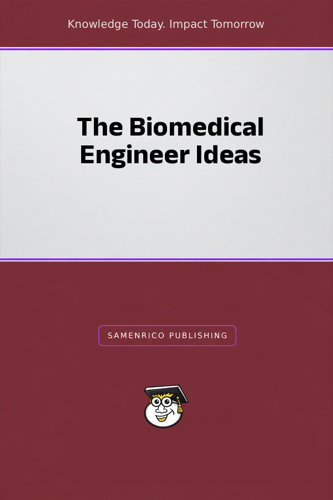
Non-FictionSelf-HelpBiomedical
The Biomedical Engineer Ideas
Design medical devices using anatomical analogy, u
by Liu Jeane
Design medical devices using anatomical analogy, user safety, and regulatory constraints.
Formats
About this book
Free sample
Chapter 1: The Body's Secrets--–- Every biomedical engineer eventually faces the same humbling realization: the human body got there first. Not just first, but better. The heart's valves have been opening and closing without failure for decades inside a single person, enduring over a billion cycles, with no replacement parts, no maintenance schedule, and no recall notices. The femur, that long bone in your thigh, supports roughly four times your body weight during walking and up to ten times during a stumble, yet it weighs less than a can of soup. The knee joint articulates through millions of cycles with a coefficient of friction lower than most engineered ceramics, lubricated by a fluid that costs the body nothing to produce.
These are not merely biological curiosities. They are design solutions, refined by evolution over hundreds of millions of years, and they are freely available for any engineer willing to learn their language.This book is built on a single provocative claim: the most innovative, safe, and commercially successful medical devices are not invented from scratch. They are reverse-engineered from the human body. But reverse-engineering anatomy is not what most people think it is. It is not biomimicry—the superficial copying of nature's shapes, like adding shark-skin纹理 to a catheter or giving a prosthetic hand a "natural" curve.
That approach, while visually appealing, often fails because it mistakes appearance for function. The body's genius is not in how it looks. It is in how it performs under load, how it adapts to injury, how it communicates failure before catastrophe, and how it integrates countless subsystems into a coherent whole. This deeper level of analysis is what this book calls anatomical analogy: the disciplined practice of treating the body's systems as solved engineering problems, then extracting their governing principles and embedding them into synthetic devices.This chapter lays the foundation for everything that follows. It explains why anatomical analogy is not a soft, inspirational notion but a rigorous engineering methodology with measurable benefits: shorter development timelines, fewer design iterations, lower failure rates in clinical trials, and stronger patent positions.
It introduces the core distinction that will recur throughout this book—between superficial biomimicry (copying form without understanding function) and deep…
This is the end of the free sample. Get the eBook to keep going. Buy now
Contents
- Chapter 1
- Chapter 2
- Chapter 3
- Chapter 4
- Chapter 5
- Chapter 6
- Chapter 7
- Chapter 8
- Chapter 9
- Chapter 10
- Chapter 11
- Chapter 12
Details
- Author
- Liu Jeane
- Publisher
- SamEnrico
- Language
- English
- Genre
- Non-Fiction, Self-Help, Biomedical
- Released
- 2026-06-06
- Pages (approx.)
- 150
- Available as
- eBook, Audiobook

Read better in the ZLOADR app
Your eBooks on your phone or tablet. Sign in with your SamEnrico account and start reading.
More by Liu Jeane
 Anti Yakuza Laws 1992Liu Jeane$11.99
 Metta for a Rival Team MemberLiu Jeane$11.99
 Lyme Disease Pain ProtocolLiu Jeane$11.99
 The Jhansi Ki Rani PoetryLiu Jeane$11.99
 Spouse Loss Dating GuideLiu Jeane$11.99
 Tulsi Holy BasilLiu Jeane$11.99
 The Stress Liver DamageLiu Jeane$11.99
 SRS For Philosophy ConceptsLiu Jeane$11.99
 When the World Was a Turtle: The Iroquois Skywoman’s DescentLiu Jeane$11.99
 The Vanishing Flight: MH370's Last TransmissionLiu Jeane$11.99
 The Skyhook Gambit: How a 1970s Construction Feat Defied GravityLiu Jeane$11.99
 The Complete Guide to the Energy Boosting DietLiu Jeane$11.99
You may also like
 Hong Kong Handover 1997Dunn Johnnie$11.99
 Zumba For Postnatal Recovery CourseNeal Christian$11.99
 Zumba for BeginnersLadner Nikia$11.99
 YouTube Comment Mining GuideHumes Pandora$12.99
 Worry Box MeditationCarlin Rudy$11.99
 Workplace Stress MeditationNguyen Lynn$11.99
 Workplace Stress and Sleep RepairHawley Ivory$11.99
 Workplace Perfectionism CureDelaney Jeffry$11.99
 Workplace Injustice Anger GuideWallen Isabelle$11.99
 Work Addiction and Burnout LinkGreenwood Ester$11.99
 Women in Yoga and WellnessBeattie Galina$11.99
 Women in Stand Up ComedyChun Evangeline$11.99