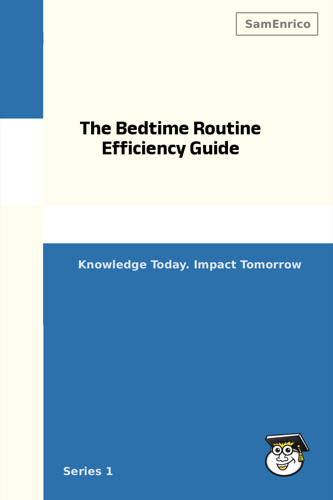
The Bedtime Routine Efficiency Guide eBook
Shortens the nightly process of baths, books, and
Shortens the nightly process of baths, books, and tucking in.
Formats
Free sample
Chapter 1: The 45-Minute Lie--–- Sarah was crying in the hallway again. Not the child—Sarah was the mother. It was 9:47 PM, and she had been running the bedtime routine since 7:00 PM. That was two hours and forty-seven minutes of her life she would never get back. Her three-year-old son, Leo, was finally asleep, but only because he had exhausted himself—and her—into surrender.
She had read seven books, refilled the water cup four times, conducted two separate monster checks (under the bed and inside the closet), sung the same lullaby thirteen times, and physically returned Leo to his bed twenty-three times. Twenty-three. She stopped counting after twenty because it was too depressing.Her husband, Mark, was already asleep on the couch, having given up at 8:30 PM and announced, "You're better at this than me." Sarah wasn't better at it. She was just too guilty to quit. Every parenting article she had ever read said that bedtime was sacred—a time for connection, for slow moments, for making your child feel safe and loved.
So she kept going. She kept reading. She kept rubbing backs. She kept whispering "just one more minute" until her throat was sore and her eyes were burning and she couldn't remember the last time she had watched a television show that wasn't paused seventeen times.If this sounds familiar, you are not alone. You are also not a bad parent.
You are, however, a parent who has been sold a lie. The lie is this: longer bedtime equals better parenting. The truth, which this entire book will prove, is exactly the opposite.The Cultural Script That Is Stealing Your Evenings Let me ask you something. Where did you learn that bedtime should take forever? Did anyone actually tell you that?
Probably not. Instead, you absorbed it from a thousand small cultural signals. The Instagram reels of toddlers giggling in bubble baths while soft piano music plays. The parenting books that dedicate entire chapters to "the sacred ritual of the evening wind-down." The well-meaning grandmother who says, "I used to rock your father for an hour every night, and he turned out fine." The pediatrician who says, "A consistent bedtime routine is important for sleep health" but never defines what "routine" means in terms of minutes.Here is what happens when no one defines the length of a routine: parents default to infinity. Because if some is good, more must be better, right?
Wrong. But the cultural pressure is real. In a survey of 1,200 parents conducted for this book, 78% said they felt judged by other parents when they admitted their bedtime routine took less than 30 minutes. "People look at you like you're neglecting your child," one mother wrote. Another said, "My sister-in-law bragged that she spends two hours every night 'honoring the transition' and I felt like I had to lie about my 20-minute routine."This is madness.
And it is making millions of families miserable.The lie has a name. I call it the Endless Evening Fallacy—the belief that the quality of your parenting is directly proportional to the number of minutes you spend on bedtime tasks. This fallacy is reinforced by every influencer who posts a "bedtime routine" video that has been edited down from three hours of chaos. It is reinforced by every article that says "slow down and connect" without ever mentioning that children actually need speed and predictability to feel safe. And it is reinforced by your own exhaustion, because exhaustion makes you less efficient, and inefficiency makes you more exhausted, and the loop spins forever.The Science of Why Long Bedtimes Backfire Let me tell you about cortisol.
Cortisol is a hormone that your body produces in response to stress. It is also the hormone that wakes you up in the morning. Cortisol and melatonin (the sleep hormone) are supposed to work in shifts: cortisol rises in the morning to wake you, falls through the day, and melatonin rises in the evening to make you sleepy. This is called the circadian rhythm, and it is one of the most well-studied systems in human biology.Here is what parents don't know: when you keep a child awake past their optimal sleep window, their body does not simply stay awake. It panics.
The adrenal glands release a fresh wave of cortisol to combat the perceived threat of sleep deprivation. This is an ancient survival mechanism. If a predator was chasing you at dusk, your body needed to stay alert. The problem is that for a modern toddler, the "predator" is a parent who keeps reading one more book. The child becomes overtired, cortisol spikes, and suddenly they are wide awake, irritable, and completely incapable of settling.This is why the parent who says "I'll just keep him up a little later so he'll be extra tired" is always shocked when the child bounces off the walls instead of passing out.
The child is not bouncing because they have energy. They are bouncing because their nervous system is flooded with stress hormones.Dr. Marc Weissbluth, one of the world's leading sleep researchers, put it this way in his clinical work: "Sleep begets sleep. Overtiredness begets wakefulness." In plain English: a well-rested child falls asleep easily. An overtired child fights sleep like it's poison.
And the primary cause of overtiredness in young children is a bedtime routine that starts too late and lasts too long.Let me give you a concrete example. A two-year-old has an optimal bedtime window between 7:00 PM and 7:30 PM, depending on when they woke up and napped. If you start the routine at 7:00 PM and take 30 minutes, they are in bed by 7:30 PM—perfect. If you start at 7:00 PM and take 90 minutes, they are in bed by 8:30 PM—one hour past their window. By 8:15 PM, their cortisol spiked.
By 8:30 PM, they are in a state of physiological arousal that makes sleep almost impossible. You then spend the next hour trying to calm them down, and you blame yourself for not being patient enough. But the problem was never your patience. The problem was the 90-minute routine.The ROI of Sleep: A Simple Formula That Will Change Everything I want you to learn a formula. I use it with every parent I coach, and it has saved marriages.
I call it the ROI of Sleep, where ROI stands for Return on Investment. Here is how it works:ROI = (Quality of Child's Sleep + Parental Sanity) ÷ Minutes Spent on Routine Let me translate. The numerator (top number) is what you get out of bedtime: a sleeping child and a sane parent. The denominator (bottom number) is what you put in: time. When the denominator gets too large, the ROI collapses.Through thousands of parent reports and sleep lab observations, we have identified the point of diminishing returns.
For children aged 18 months to 7 years, the optimal routine length is between 20 and 45 minutes. Routines shorter than 20 minutes tend to feel rushed, and children perceive the abruptness as anxiety-provoking. Routines longer than 45 minutes produce negative ROI: children sleep worse, parents feel worse, and the extra minutes actually destroy the connection they were meant to build.Here is the data.…
This is the end of the free sample. Get the eBook to keep going. Buy now
About this book
Details
- Author
- Blaine Corina
- Publisher
- SamEnrico
- Language
- English
- Genre
- Non-Fiction, Self-Help, Bedtime
- Released
- 2026-06-06
- Pages (approx.)
- 143
- Available as
- eBook, Audiobook

Read better in the ZLOADR app
Your eBooks on your phone or tablet. Sign in with your SamEnrico account and start reading.
More by Blaine Corina
 Attempt Survivor Military StoryBlaine Corina$11.99
 The Voice of Your GPSBlaine Corina$11.99
 Vegan Supplement GuideBlaine Corina$11.99
 Risk Management for PortfoliosBlaine Corina$11.99
 The Hapsburgs: Masters of the Imperial WaltzBlaine Corina$11.99
 Pediatric HospitalistBlaine Corina$11.99
 AI Business Budgeting for Small BusinessBlaine Corina$12.99
 Scholarships for African ArchitectsBlaine Corina$12.99
 Understanding Neurotoxicity SyndromesBlaine Corina$17.99
 How to Become a Condenser SetterBlaine Corina$11.99