
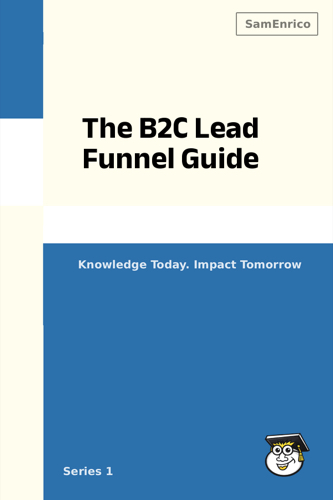
The B2C Lead Funnel Guide
Design funnels for direct-to-consumer brands and i
Design funnels for direct-to-consumer brands and impulse purchases.
Formats
About this book
Free sample
Chapter 1: The Three-Second Sieve--The average smartphone user now makes a purchase decision in less time than it takes to tie a shoelace. Three seconds. That is the window between “I want that” and “never mind” for the modern direct-to-consumer impulse buyer. Everything you learned about B2B lead funnels—the nurturing sequences, the lead scoring, the educational email drips—is not just inefficient here. It is actively destructive.If you are reading this book, you have likely experienced the frustration of building what you thought was a perfect funnel.
Beautiful landing page. Compelling copy. A lead magnet that performed well in your last B2B campaign. And yet, your direct-to-consumer brand is bleeding visitors at every stage. You are paying for traffic that arrives, glances at your offer, and vanishes into the infinite scroll of social media or search results.
The problem is not your product. The problem is not your price. The problem is that you are using a slow funnel designed for rational buyers to capture irrational, impulse-driven consumers.This chapter dismantles the most dangerous myth in D2C marketing: that a funnel is a funnel. It is not. B2B funnels assume time, research, committee approval, and a rational weighing of features and benefits.
Impulse D2C funnels assume the opposite: no time, no research, no committee, and emotional urgency that overrides logic. The B2C lead funnel is not a slower version of B2B. It is a different species entirely.Welcome to the Three-Second Sieve.The Collapse of the Linear Path For decades, marketers worshipped the linear funnel. Awareness led to Interest, which led to Desire, which led to Action. AIDA was gospel.
The assumption baked into every stage was that the buyer moved deliberately, gathering information, comparing options, and finally, after sufficient deliberation, making a rational choice. This model worked reasonably well for automobiles, enterprise software, and B2B services. It never worked for impulse purchases, but marketers forced it to fit anyway. They created “consideration phases” for $19 t-shirts and “evaluation stages” for flavored lip balm. The result was friction disguised as strategy.The direct-to-consumer…
This is the end of the free sample. Get the eBook to keep going. Buy now
Contents
- Chapter 1
- Chapter 2
- Chapter 3
- Chapter 4
- Chapter 5
- Chapter 6
- Chapter 7
- Chapter 8
- Chapter 9
- Chapter 10
- Chapter 11
- Chapter 12
Details
- Author
- Dunne Rashida
- Publisher
- SamEnrico
- Language
- English
- Genre
- Non-Fiction, Business Brief, B2C
- Released
- 2026-06-11
- Pages (approx.)
- 151
- Available as
- eBook, Audiobook

Read better in the ZLOADR app
Your eBooks on your phone or tablet. Sign in with your SamEnrico account and start reading.
More by Dunne Rashida
 Workaholic Life Balance Audit GuideDunne Rashida$11.99
 Burnout Legal ProtectionsDunne Rashida$11.99
 IBS Soluble Fiber GuideDunne Rashida$11.99
 Feeling Manipulated Anger GuideDunne Rashida$11.99
 Midnight Velvet: The Unstoppable Heist of the 1936 Bugatti Type 57SCDunne Rashida$11.99
 Echoes of the Ice: The Forgotten Race to the South PoleDunne Rashida$11.99
 Diatomite (Diatomaceous Earth) MiningDunne Rashida$11.99
 Pre Launch Email SequenceDunne Rashida$12.99
 Customer Persona Creation GuideDunne Rashida$12.99
 Understanding Chronic Necrotizing VasculitisDunne Rashida$17.99
 How to Start a Construction of Underground Railways Business (Beginners Guide)Dunne Rashida$11.99
You may also like
 Hong Kong Handover 1997Dunn Johnnie$11.99
 Zumba For Postnatal Recovery CourseNeal Christian$11.99
 Zumba for BeginnersLadner Nikia$11.99
 YouTube Comment Mining GuideHumes Pandora$12.99
 Worry Box MeditationCarlin Rudy$11.99
 Workplace Stress MeditationNguyen Lynn$11.99
 Workplace Stress and Sleep RepairHawley Ivory$11.99
 Workplace Perfectionism CureDelaney Jeffry$11.99
 Workplace Injustice Anger GuideWallen Isabelle$11.99
 Work Addiction and Burnout LinkGreenwood Ester$11.99
 Women in Yoga and WellnessBeattie Galina$11.99
 Women in Stand Up ComedyChun Evangeline$11.99