
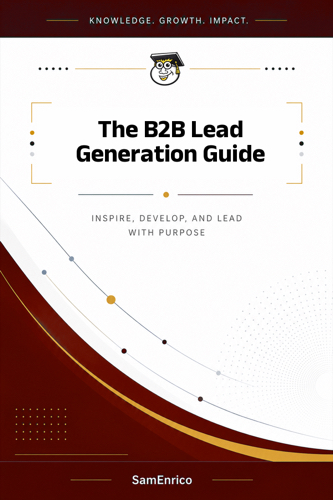
Non-FictionBusiness BriefB2B Marketing
The B2B Lead Generation Guide eBook
Build funnels targeting decision-makers in other b
by Lange Mellie
Build funnels targeting decision-makers in other businesses.
Formats
Free sample
Chapter 1: The 95% Lie--–- I have a confession to make. Five years ago, I was the head of demand generation for a mid-sized Saa S company. We had a team of twelve, a budget of $2.3 million, and a mandate to "fill the pipeline." We did everything right. We ran Linked In ads to meticulously crafted personas. We sent nurture sequences with open rates that would make any marketer weep with joy.
We hosted webinars with thousands of registrants. We generated 47,000 leads in a single quarter. And then the sales team closed fourteen deals. Fourteen. I was fired six weeks later.
That night, sitting in my home office with a spreadsheet that made no sense, I realized something that would change my entire career: we had been lied to. Not maliciously, not by any single person, but by an entire industry that had convinced us that more leads meant more success. The lie is simple, seductive, and completely wrong: if you generate enough leads, sales will figure it out.This book is the playbook I wish I had five years ago. It is not about generating more leads. It is about generating the right conversations with the right people at the right time.
And it starts by unlearning almost everything you think you know about B2B lead generation.The Million-Dollar Mistake Most Marketers Make Let me tell you about a software company called Logi Sync. They sold supply chain optimization software to mid-sized manufacturers. Their average contract value was $45,000 per year. Their sales team had eighteen reps. Their marketing team had seven.
And they were bleeding cash. The marketing team was generating approximately 2,200 leads per month through a combination of content syndication, trade show booths, and Linked In advertising. The sales team was following up on every single one because "that's what sales does." The result was chaos. The sales reps spent 80% of their time chasing leads that would never buy, leaving them with only 20% of their time to actually close the deals that might.When I was brought in as a consultant, the CEO asked me a simple question: "Why do we generate so many leads and sell so little?" The answer was painful. Of the 2,200 monthly leads, approximately 1,900 were from companies that would never, under any circumstances, buy their software.
These were companies that were too small (no budget), too large (already had a solution they were locked into for three more years), in the wrong industry (manufacturing software doesn't work for logistics companies), or simply not in the market (happy with their current spreadsheet-based chaos). The marketing team was generating leads from the 95% of the market that was never going to buy.Think about that for a moment. They were spending $187,000 per month to generate leads that had a 0% chance of ever becoming customers. And they were celebrating those leads. They were reporting them to the board.
They were getting bonuses based on lead volume. The system was designed to reward activity over outcomes, volume over value, lead generation over revenue generation.Logi Sync stopped generating leads from the 95%. Within ninety days, their lead volume dropped by 84%. Their sales team stopped complaining about lead quality for the first time in three years. Their win rate increased from 3% to 22% because sales reps were finally talking to people who could actually buy.
Their cost per customer dropped by 67%. And they went from burning $400,000 per month to profitable growth in five months. The lesson is brutal but essential: most of your leads are lying to you, not intentionally, but because your funnel is designed to attract people who will never buy.The 95-5 Rule: The Fundamental Law of B2B Buying Here is the single most important concept in this entire book. I call it the 95-5 Rule, and it will change how you think about every marketing dollar you spend. The rule is simple: at any given moment, only 5% of your total addressable market is actively looking to buy a solution like yours.
The other 95% are either completely satisfied with their current solution, have no budget allocated for this problem, are unaware they even have the problem you solve, or are under a contract with a competitor that cannot be broken for six to eighteen months.Let me repeat that because it is so counter to how most B2B marketing operates: 95% of the people in your target market are not buying right now. They might buy in six months. They might buy in two years. They might never buy. But right now, in this moment, they are not in the market.The research backing this is overwhelming.
The B2B buying behavior studies conducted by organizations like Gartner, Forrester, and the Ehrenberg-Bass Institute have consistently found that the vast majority of businesses are not actively seeking new solutions at any given time. In fact, the average B2B company enters the market for a given category approximately once every three to five years. That means in any given quarter, only 5-10% of your target accounts are even considering a purchase.Yet most B2B marketing strategies are built as if 100% of the market is ready to buy right now. We run ads to everyone. We send emails to everyone.
We spend money on trade shows where 95% of the attendees are not in the market. We generate leads from people who are just curious, just bored, just collecting information for a project two years from now. And then we get angry when sales can't close them.The 95-5 Rule is not a flaw in the market. It is a feature of how businesses operate. Companies do not wake up every morning thinking, "What new software can I buy today?" They wake up thinking about their customers, their products, their employees, their cash flow.
Buying new solutions is a rare event, often driven by a specific trigger: a new competitor emerged, a contract is expiring, a key employee quit, a regulation changed, a system broke catastrophically.The implication of the 95-5 Rule is radical but simple: stop trying to generate demand and start detecting it. The 5% who are in the market are already researching. They are already on G2 and Capterra. They are already searching Google for comparison guides. They are already asking peers in Slack communities for recommendations.
They are already visiting your website, your competitors' websites, and review sites. They are leaving digital footprints everywhere. Your job is not to scream louder than everyone else. Your job is to build radar that detects the 5% so you can engage them before your competitors do.The 90% Invisible Journey: Why Your Funnel Is Leaking Without You Knowing The 95-5 Rule is only half of the problem. The other half is what I call the 90% Invisible Journey.
This is the reality that modern B2B buyers complete nearly 90% of their research before they ever talk to a salesperson or fill out a form on your website.Let me walk you through how a typical B2B buying process actually works today, based on research from Gartner, Forrester, and dozens of proprietary studies we have conducted with our clients.The buying process starts when someone on the buying committee—let's call her Sarah, a supply chain manager—realizes…
This is the end of the free sample. Get the eBook to keep going. Buy now
About this book
Details
- Author
- Lange Mellie
- Publisher
- SamEnrico
- Language
- English
- Genre
- Non-Fiction, Business Brief, B2B Marketing
- Released
- 2026-06-10
- Pages (approx.)
- 146
- Available as
- eBook, Audiobook

Read better in the ZLOADR app
Your eBooks on your phone or tablet. Sign in with your SamEnrico account and start reading.
More by Lange Mellie
 Mayor of the HomelessLange Mellie$11.99
 Burnout Disability Leave GuideLange Mellie$11.99
 Unpredictability Anger SensitivityLange Mellie$11.99
 Phil Mickelson Left Handed LegendLange Mellie$11.99
 The Vanishing Act: The Unsolved Mystery of the Disappearing D.B. CooperLange Mellie$11.99
 Echoes of the Underground: The Secret Tapes of the Velvet RevolutionLange Mellie$11.99
 Teachable Course LaunchLange Mellie$12.99
 Market Research On Public Wi-FiLange Mellie$12.99
 Dayforce Support AnalystLange Mellie$11.99
 Understanding Chronic Myelomonocytic LeukemiaLange Mellie$17.99
 How to Start a Construction of Utility Projects for Electricity Business (Beginners Guide)Lange Mellie$11.99
You may also like
 Hong Kong Handover 1997Dunn Johnnie$11.99
 Zumba For Postnatal Recovery CourseNeal Christian$11.99
 Zumba for BeginnersLadner Nikia$11.99
 YouTube Comment Mining GuideHumes Pandora$12.99
 Worry Box MeditationCarlin Rudy$11.99
 Workplace Stress MeditationNguyen Lynn$11.99
 Workplace Stress and Sleep RepairHawley Ivory$11.99
 Workplace Perfectionism CureDelaney Jeffry$11.99
 Workplace Injustice Anger GuideWallen Isabelle$11.99
 Work Addiction and Burnout LinkGreenwood Ester$11.99
 Women in Yoga and WellnessBeattie Galina$11.99
 Women in Stand Up ComedyChun Evangeline$11.99