
Non-FictionHistoryConfessional Documents
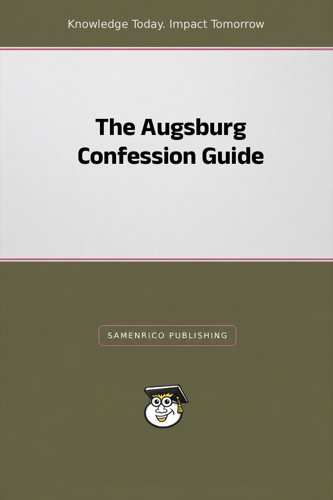
The Augsburg Confession Guide eBook
Analyzes the Lutheran statement of faith presented
by Cloud Arlean
Analyzes the Lutheran statement of faith presented to Charles V.
Formats
Free sample
Chapter 1: The Powder Keg...–- By the spring of 1530, the Holy Roman Empire had become a tinderbox. For nearly thirteen years, since Martin Luther had nailed his Ninety-Five Theses to the door of the Wittenberg Castle Church, the fragile unity of Christendom had been cracking. What began as an academic dispute over indulgences had metastasized into a full-blown religious rebellion. Princes had turned against emperors. Bishops had fled their dioceses.
Peasants had risen up and been slaughtered by the tens of thousands. And now, the most powerful ruler in the world was demanding answers.Emperor Charles V had not wanted this meeting. In truth, he had wanted to avoid it entirely. He had spent the first three decades of his life inheriting an empire so vast that it was said the sun never set on his domains—Spain, the Netherlands, Naples, Sicily, the vast territories of the Americas, and the crown of the Holy Roman Empire itself. But this sprawling inheritance came with a price: constant war.
He had fought the French for control of Italy. He had fought the Turks for control of the Mediterranean. He had fought the papacy itself when it suited his political needs. And now, just when he needed a unified Germany to stand against the Ottoman armies advancing on Vienna, he found himself facing a theological crisis he neither understood nor particularly cared about.The Emperor was a devout Catholic, but he was first and foremost a politician. He had been raised in Burgundy, spoke French as his native tongue, and governed a polyglot empire where religious unity was the glue holding everything together.
Without a common faith, how could he collect taxes? How could he raise armies? How could he trust his own German princes, who had begun forming secret alliances and minting their own coins? The situation was intolerable. And so, in January of 1530, he issued a decree from his court in Bologna, Italy: a Diet would be convened in the city of Augsburg.
All parties—Catholic and Protestant alike—would present their case. And then, by imperial authority, he would settle the matter once and for all.The reformers knew they were walking into a trap.The Gathering Storm The city of Augsburg, nestled on the banks of the Lech River in southern Germany, was a study in contradictions. On the one hand, it was one of the wealthiest cities in the empire, a center of banking and commerce where the Fugger family had loaned fortunes to emperors and popes. Its streets were paved, its churches were ornate, and its town hall was a monument to civic pride. On the other hand, it was also a free imperial city—answerable directly to the Emperor—and its citizens had already begun flirting with the new evangelical faith.
When the imperial herald arrived in March to announce the Diet, the city fathers scrambled to prepare. They would host the Emperor, seven electors, dozens of lesser princes, papal legates, ambassadors from France and England, and thousands of attendants, horses, and servants. The logistics were staggering. The tensions were even greater.By early June, the city was swollen with dignitaries. Charles V arrived on June 15, entering Augsburg in a procession that lasted hours.
He was accompanied by his brother Ferdinand (the King of the Romans), his Spanish bodyguards, and a retinue of Catholic bishops in full regalia. The Protestant princes—Elector John of Saxony, Landgrave Philip of Hesse, Margrave George of Brandenburg-Ansbach, and Duke Ernest of Lüneburg—had arrived days earlier, establishing themselves in quarters outside the city walls to avoid confrontation. They were outnumbered. They were outgunned. And they knew that if the Emperor decided to enforce his authority by force, they would have little recourse.But they had one thing on their side: the Word of God.
Or so they believed.Philip Melanchthon, the lead author of what would become the Augsburg Confession, was not a natural politician. He was a scholar, a humanist, a man who preferred the quiet of his study to the noise of court intrigue. Born in Bretten in 1497, he had been a child prodigy, mastering Greek and Latin before most boys learned to read. At the age of twelve, he entered the University of Heidelberg. At seventeen, he earned his master's degree.
At twenty-one, he was appointed professor of Greek at the newly founded University of Wittenberg—the same university where Martin Luther held the chair of biblical theology. Luther recognized Melanchthon's brilliance immediately. The two men became close friends, even as their temperaments could not have been more different. Luther was volcanic, impulsive, prone to thunderous outbursts and earthy humor. Melanchthon was cool, precise, methodical, and deeply anxious.
Where Luther would charge ahead, Melanchthon would pause, consult, revise, and revise again. This tendency to overthink would serve him well in the coming weeks—but it would also nearly destroy him.The Absence of the Thunderbolt The most conspicuous absence in Augsburg was Martin Luther himself. The Emperor had placed Luther under imperial ban four years earlier at the Diet of Worms. Any subject of the empire was legally permitted to kill Luther on sight without fear of punishment. Luther had survived only because Elector Frederick the Wise had kidnapped him and hidden him away in the Wartburg Castle for nearly a year.
By 1530, Luther was living in Saxony under the protection of Elector John, but traveling to Augsburg would have been suicide. Even the Electoral Saxon delegation knew better than to ask. Instead, Luther was installed at the Veste Coburg, a fortress perched on a hill overlooking the Thuringian Forest, some 150 miles north of Augsburg. From there, he could communicate with Melanchthon and the other reformers by letter—and he could watch the proceedings with a mixture of hope, dread, and barely suppressed fury.The letters that flew between Coburg and Augsburg during the summer of 1530 are some of the most revealing documents of the Reformation. Luther, trapped in his fortress, paced the ramparts like a caged lion.
He wrote to Melanchthon constantly, urging him not to compromise, not to give an inch, not to sacrifice the Gospel for the sake of political expediency. "I have received your Apology," Luther wrote after reading an early draft of the Confession, "and I do not like it. It is too humble. It asks too much and concedes too little. The cause is not ours but God's.
He will not be mocked." Melanchthon, by contrast, was terrified. He wrote to Luther describing the Catholic theologians as "wolves in sheep's clothing" and confessed that he woke each night in a cold sweat, unable to sleep for fear of making a mistake that would cost the evangelical movement everything.This tension between Luther's unbending conviction and Melanchthon's anxious diplomacy would shape the Augsburg Confession in ways that are still debated today.The Writing of the Confession Melanchthon began drafting the Confession in early April, working from a series of earlier documents: the Torgau Articles (drafted by Luther, Jonas, Bugenhagen, and Melanchthon himself in March), the Schwabach Articles (Luther's more confrontational statement), and the Marburg Articles (an attempt to bridge the gap with the Swiss reformers). The process was agony. Melanchthon wrote and rewrote…
This is the end of the free sample. Get the eBook to keep going. Buy now
About this book
Details
- Author
- Cloud Arlean
- Publisher
- SamEnrico
- Language
- English
- Genre
- Non-Fiction, History, Confessional Documents
- Released
- 2026-06-05
- Pages (approx.)
- 137
- Available as
- eBook, Audiobook

Read better in the ZLOADR app
Your eBooks on your phone or tablet. Sign in with your SamEnrico account and start reading.
More by Cloud Arlean
 The Assertiveness for Writers GuideCloud Arlean$11.99
 Difficult Person PracticeCloud Arlean$11.99
 Road Rage And Alcohol UseCloud Arlean$11.99
 Harassment Anger GuideCloud Arlean$11.99
 Bloodlines of Vukovar: The DNA of a Forgotten SiegeCloud Arlean$11.99
 Understanding Phosphomannoisomerase DeficiencyCloud Arlean$17.99
 Observability Vendor MapCloud Arlean$12.99
 Fiverr Pro VA Sourcing GuideCloud Arlean$12.99
 How to Start a Cabinet Case Made of Wood Business (Beginners Guide)Cloud Arlean$11.99
 Affect Recognition TechnicianCloud Arlean$11.99
You may also like
 Hong Kong Handover 1997Dunn Johnnie$11.99
 Zumba For Postnatal Recovery CourseNeal Christian$11.99
 Zumba for BeginnersLadner Nikia$11.99
 YouTube Comment Mining GuideHumes Pandora$12.99
 Worry Box MeditationCarlin Rudy$11.99
 Workplace Stress MeditationNguyen Lynn$11.99
 Workplace Stress and Sleep RepairHawley Ivory$11.99
 Workplace Perfectionism CureDelaney Jeffry$11.99
 Workplace Injustice Anger GuideWallen Isabelle$11.99
 Work Addiction and Burnout LinkGreenwood Ester$11.99
 Women in Yoga and WellnessBeattie Galina$11.99
 Women in Stand Up ComedyChun Evangeline$11.99