
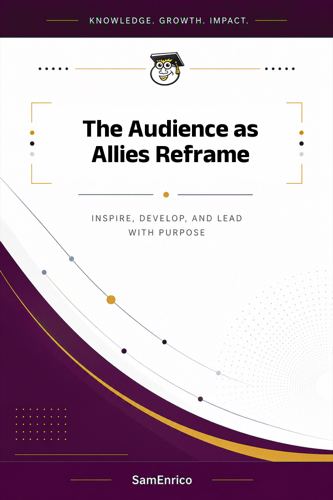
Non-FictionMental WealthPerspective
The Audience as Allies Reframe eBook
Shift perspective from judging jury to supportive
by Gillen Bari
Shift perspective from judging jury to supportive community rooting for you.
Formats
Free sample
Chapter 1: The Gavel Inside...--Most people believe the scariest room in the world is empty. An empty room has no one to witness your failure, no one to remember your stumble, no one to carry the memory of your voice cracking on the word "strategy" while forty-three pairs of eyes refused to blink. But you and I know better. The scariest room in the world is full. It is packed with strangers who have crossed their arms, tilted their heads, and activated the silent machinery of judgment that you have been dreading since you accepted the invitation to speak.You have felt it.
The walk from your seat to the front of the room, a journey that somehow stretches into an eternity. The sudden awareness of your own hands. The realization that you have no idea what to do with them. The microphone that feels both too heavy and too fragile. And then the worst part: the faces.
Dozens of faces looking at you, waiting for you to begin, and in their eyes you see not curiosity but evaluation. You see a jury.Here is the truth that will transform everything you know about public speaking: that jury is a ghost. The gavel has never been in their hands. It has always been in your head, and you have been swinging it against yourself for years.The Most Expensive Mistake in Human Communication Let me tell you about a woman named Sarah. Sarah was a senior product manager at a mid-sized technology company.
She knew her product better than anyone in the room. She had built the roadmap herself, negotiated with the engineers, sat through endless customer calls. When her CEO asked her to present the quarterly strategy to the executive team, she spent forty hours preparing. Forty hours. She rehearsed in front of her husband.
She rehearsed in front of her bathroom mirror. She rehearsed in her car during her commute, her hands gripping the steering wheel like a lifeline.The morning of the presentation, she woke up at 4:00 AM. She reviewed her slides three times. She arrived at the conference room forty-five minutes early. And when she stood up to speak, her mind went blank.
Not empty. Blank. There is a difference. An empty mind can be filled. A blank mind has been wiped clean by fear.
She saw the CFO glance at his watch. She saw the VP of Sales whisper something to the person next to him. She saw these tiny movements and translated them into a verdict: they already think I am wasting their time.What followed was not a failure of knowledge. Sarah knew her material. What followed was a failure of framing.
She had walked into that room as a defendant entering a courtroom, and she had spent every second of her presentation trying to prove her innocence. She spoke too fast because she wanted to get it over with. She avoided eye contact because she did not want to see the judgment. She apologized twice for taking up their time. And when it was over, she sat down and thought, "I will never recover from this."Here is what actually happened in that room.
The CFO glanced at his watch because he had a hard stop at 10:30 AM for another meeting. The VP of Sales whispered to his colleague because he was asking, "Did you see the email from the Seattle office?" Neither of them was thinking about Sarah. Neither of them was scoring her performance. They were thinking about their own schedules, their own problems, their own lives. Sarah had spent forty hours preparing and forty-five minutes panicking, and the entire time, the audience was barely paying attention to her in the way she feared.This is the most expensive mistake in human communication.
We assume that when we stand in front of other people, those people are actively evaluating us. We assume they are taking notes on our mistakes, cataloging our stumbles, waiting for us to fail so they can confirm their suspicions that we do not belong there. But the research tells a very different story.The Spotlight Effect: Why You Are Not as Visible as You Think You Are In the year 2000, a social psychologist named Thomas Gilovich conducted a landmark study at Cornell University. He asked college students to wear a t-shirt featuring a large photograph of the singer Barry Manilow. For context, Barry Manilow was not considered cool among college students in the year 2000.
He was considered deeply, almost comically, uncool. The students were mortified. They predicted that approximately fifty percent of the people they encountered would notice the embarrassing t-shirt.The actual number was twenty percent.Half of the students overestimated their visibility by more than double. Gilovich called this the "spotlight effect" – the cognitive bias that leads us to believe the social spotlight shines on us much more brightly than it actually does. We think people are watching us.
We think they are noticing our mistakes, our awkwardness, our trembling hands. But the truth is that most people are far too absorbed in their own internal experience to focus on us with anything resembling sustained attention.This bias is not a character flaw. It is a feature of human consciousness. Our brains evolved to be hyperaware of social threat because, for our ancestors, being rejected by the tribe could mean death. The person who failed to notice that the chief was frowning might be exiled.
The person who missed the subtle cues of disapproval might lose access to food and protection. So our brains developed a hair-trigger for social evaluation. We are constantly scanning for signs that we are being judged because, in the ancestral environment, being judged was a matter of survival.But here is the problem. We are no longer in the ancestral environment. We are in conference rooms and auditoriums and Zoom calls.
The stakes are rarely life and death. Yet our nervous systems have not received the memo. So we walk onto stages and into boardrooms with the same physiological activation we would experience if we were walking into a hostile tribe armed with spears. Our hearts race. Our palms sweat.
Our voices tighten. And we interpret these sensations as evidence that we are about to be judged.We are not about to be judged. We are about to be witnessed. And witnessing is not the same as judging.The Ally Bias: Why Your Audience Secretly Wants You to Win Here is the counterintuitive insight that will change everything. Not only is the audience not judging you as harshly as you think.
They are actively rooting for you to succeed. I call this the Ally Bias.Consider what happens when you watch someone struggle through a presentation. You do not think, "Look at this fool. Look at how badly they are doing." You think, "Oh no. I hope they find their place.
I hope they recover. I hope this gets better." Why? Because their struggle makes you uncomfortable. Their failure creates a secondhand awkwardness that you want to escape. The easiest way for you to escape that discomfort is for them to succeed.
So you unconsciously pull for them. You lean forward. You offer a small, encouraging nod. You want them to win…
This is the end of the free sample. Get the eBook to keep going. Buy now
About this book
Details
- Author
- Gillen Bari
- Publisher
- SamEnrico
- Language
- English
- Genre
- Non-Fiction, Mental Wealth, Perspective
- Released
- 2026-06-10
- Pages (approx.)
- 129
- Available as
- eBook, Audiobook

Read better in the ZLOADR app
Your eBooks on your phone or tablet. Sign in with your SamEnrico account and start reading.
More by Gillen Bari
 Murdoch Streaming Wars ResponseGillen Bari$11.99
 The Emotion Journal Method CourseGillen Bari$11.99
 Motherhood Burnout and Anger LinkGillen Bari$11.99
 Stockholm Syndrome SurvivorGillen Bari$11.99
 Echoes of the Underground: The Secret War of the Paris CatacombsGillen Bari$11.99
 Black Ice: The Vanished Flight Over the AndesGillen Bari$11.99
 Polish Remote Employment ContractsGillen Bari$12.99
 Apple Virtual Student ProgramGillen Bari$12.99
 Assistant BuyerGillen Bari$11.99
 Understanding Bonnemann–meinecke SyndromeGillen Bari$17.99
 10 Ways to Use Courgette (Recipe Book)Gillen Bari$11.99
You may also like
 Hong Kong Handover 1997Dunn Johnnie$11.99
 Zumba For Postnatal Recovery CourseNeal Christian$11.99
 Zumba for BeginnersLadner Nikia$11.99
 YouTube Comment Mining GuideHumes Pandora$12.99
 Worry Box MeditationCarlin Rudy$11.99
 Workplace Stress MeditationNguyen Lynn$11.99
 Workplace Stress and Sleep RepairHawley Ivory$11.99
 Workplace Perfectionism CureDelaney Jeffry$11.99
 Workplace Injustice Anger GuideWallen Isabelle$11.99
 Work Addiction and Burnout LinkGreenwood Ester$11.99
 Women in Yoga and WellnessBeattie Galina$11.99
 Women in Stand Up ComedyChun Evangeline$11.99