

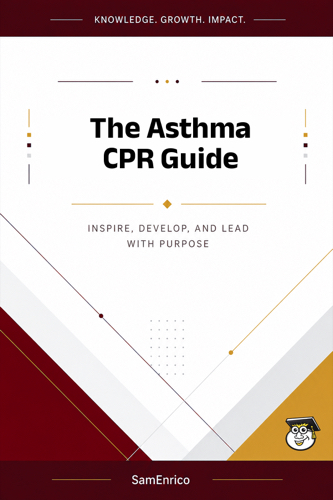
Non-FictionHealth & WellnessRespiratory
The Asthma CPR Guide eBook
Recognize respiratory arrest from severe asthma an
by Duff Coretta
Recognize respiratory arrest from severe asthma and provide rescue breaths.
Formats
Free sample
Chapter 1: The Silent Suffocation...--It happens in silence more often than it happens with a wheeze.This is the first thing you must unlearn. Everything television has taught you about asthma—the dramatic gasping, the loud whistling chest, the patient clutching their throat while making enough noise to wake the neighbors—that is not the shape of a fatal attack. The fatal attack is quiet. It is the absence of noise. It is a person sitting perfectly still, too exhausted to cough, too starved of oxygen to call for help, while their lungs slowly fill with trapped air that cannot escape.Meet Sarah.
She was forty-two years old, a third-grade teacher, a runner, and a mother of two. She had managed her asthma with a blue rescue inhaler for twenty years. On the night she died, her husband heard her coughing around 2:00 AM. She used her inhaler once. When the coughing stopped, he assumed she had fallen back asleep.
The silence was not sleep. The silence was her lungs giving up. By the time he checked on her at 6:00 AM, her lips were blue, and her body was cold. The medical examiner called it "status asthmaticus." Her husband called it the silence that should have warned him.This book exists because Sarah's death was preventable. Not preventable in the way that all deaths are inevitable, but preventable in the specific, technical sense: if her husband had known what the silence meant, if he had recognized the transition from a moderate attack to a life-threatening one, if he had understood that the absence of wheezing is not improvement but deterioration, she would have had a chance.
He did not know. Almost no one knows. And that is why you are reading this chapter.The Anatomy of a Trap To understand why asthma kills, you must first understand what asthma is not. Asthma is not a disease of the airways in the way that a kink in a garden hose is a problem. A kink prevents water from flowing in either direction.
Asthma is more insidious: it prevents air from flowing out, while still allowing some air to flow in. This asymmetry is the entire story of fatal asthma.The technical term is dynamic hyperinflation. Let me translate that into plain English.Imagine you are trying to blow up a balloon, but the balloon has a problem. The opening is partially blocked—not completely, just narrowed. You can blow air into the balloon, but when you try to let the air out, the narrow opening collapses shut.
Each breath you blow into the balloon adds a little more air. But the air cannot leave. The balloon gets bigger and bigger, tighter and tighter. Eventually, the pressure inside the balloon is so high that you cannot force any new air in. The balloon is now trapped, overinflated, and crushing everything around it.That is the asthmatic lung during a severe attack.The patient inhales.
Air rushes past narrowed airways into the alveoli, the tiny air sacs where oxygen exchange happens. But when the patient tries to exhale, the airways—already inflamed, already constricted—collapse even further. The air that just entered cannot leave. Each breath adds a small volume of trapped air. After twenty or thirty breaths, the lungs are significantly overinflated.
After a hundred breaths, the lungs are so full that the diaphragm is flattened, the rib cage is locked in an expanded position, and the heart is being compressed from the outside.The Three Mechanisms of Destruction How does a healthy airway become a one-way valve? Through three concurrent pathological processes. You need to know all three because each requires a different intervention, and none of them resolve on their own.The first mechanism is bronchospasm.The airways are surrounded by smooth muscle—the same kind of muscle that lines your blood vessels and your intestines. In a person with asthma, this smooth muscle is hyperreactive. It contracts violently in response to triggers that would not affect a normal airway: cold air, exercise, dust, pollen, pet dander, respiratory viruses, even stress.
When this muscle contracts, the diameter of the airway shrinks. In a moderate attack, the diameter might decrease by thirty to fifty percent. In a severe attack, the muscle can clamp down so tightly that the airway becomes a pinhole.Here is what you need to understand about bronchospasm: it is reversible with medication. Albuterol, the blue rescue inhaler, is a bronchodilator. It forces those clamped muscles to relax.
But albuterol takes time to work—usually five to ten minutes—and in a severe attack, the patient may need many puffs, not just one or two.The second mechanism is inflammation.Bronchospasm is the muscle. Inflammation is the lining. When the airway is exposed to an asthma trigger, the immune system floods the area with inflammatory cells. These cells release chemicals that cause the blood vessels in the airway walls to leak fluid. The walls swell.
Imagine the difference between a drinking straw and a cocktail straw. That is the difference between a healthy airway and an inflamed one.Here is what you need to understand about inflammation: it is not quickly reversible with albuterol. Albuterol works on muscle, not on swelling. The medications that reduce inflammation are steroids—prednisone, usually—and they take hours to work. If a patient is already in respiratory arrest, steroids are not going to save them in the moment.
Steroids are for prevention and for the recovery phase. In the acute crisis, you cannot wait for steroids to work.The third mechanism is mucus plugging.This is the mechanism that most people do not know about, and it is often the one that makes the difference between a severe attack and a fatal one. In response to inflammation, the cells that line the airways produce mucus. Not the thin, watery mucus of a cold—thick, tenacious, sticky mucus that acts like glue. This mucus accumulates in the small airways, the bronchioles, which are already narrowed by bronchospasm and inflammation.
The mucus forms plugs. These plugs seal off entire segments of the lung.Here is what you need to understand about mucus plugs: you cannot cough them out. The patient tries. The violent, hacking cough of an asthma attack is the body's desperate attempt to dislodge these plugs. But the plugs are sticky, and the airways are narrow, and the patient is exhausting their oxygen reserves with every cough.
In a fatal attack, the autopsy almost always reveals lungs filled with thick, tenacious mucus plugs that no amount of coughing could have cleared.The Physiology of Dying from Asthma Let me walk you through the sequence of a fatal asthma attack. This is not theoretical. This is the actual physiology that kills approximately ten Americans every day.Phase one: The trigger. The patient inhales something that their hyperreactive airways perceive as a threat. It could be a cold virus.
It could be pollen. It could be a sudden change in temperature. It could be nothing identifiable at all. The immune system launches a response.Phase two: The narrowing. Within minutes, the smooth muscle around the airways begins to contract.
The airway lining begins to swell. The patient feels chest tightness. They may start to cough. They reach for their…
This is the end of the free sample. Get the eBook to keep going. Buy now
About this book
Details
- Author
- Duff Coretta
- Publisher
- SamEnrico
- Language
- English
- Genre
- Non-Fiction, Health & Wellness, Respiratory
- Released
- 2026-06-08
- Pages (approx.)
- 147
- Available as
- eBook, Audiobook

Read better in the ZLOADR app
Your eBooks on your phone or tablet. Sign in with your SamEnrico account and start reading.
More by Duff Coretta
 Phantom of the Opera LegendDuff Coretta$11.99
 Gunshot Residue TraceDuff Coretta$11.99
 Burnout Prevention for Massage TherapistsDuff Coretta$11.99
 Samora Machel Mozambique FRELIMODuff Coretta$11.99
 Twin Or Multiple Loss SupportDuff Coretta$11.99
 Pedal to the Metal: The British Invasion of the Tour de FranceDuff Coretta$11.99
 Child Loss And Sibling RelationshipsDuff Coretta$11.99
 Collaborative Deck BuildingDuff Coretta$11.99
 Sparta Rises: The Battle of Navarino That Shattered Ottoman RuleDuff Coretta$11.99
 How to Produce Scrapbooking and Stamping KitsDuff Coretta$11.99
 Mentoring Across Language BarriersDuff Coretta$12.99
 Taxes for Online English TutorsDuff Coretta$12.99
You may also like
 Hong Kong Handover 1997Dunn Johnnie$11.99
 Zumba For Postnatal Recovery CourseNeal Christian$11.99
 Zumba for BeginnersLadner Nikia$11.99
 YouTube Comment Mining GuideHumes Pandora$12.99
 Worry Box MeditationCarlin Rudy$11.99
 Workplace Stress MeditationNguyen Lynn$11.99
 Workplace Stress and Sleep RepairHawley Ivory$11.99
 Workplace Perfectionism CureDelaney Jeffry$11.99
 Workplace Injustice Anger GuideWallen Isabelle$11.99
 Work Addiction and Burnout LinkGreenwood Ester$11.99
 Women in Yoga and WellnessBeattie Galina$11.99
 Women in Stand Up ComedyChun Evangeline$11.99