
Non-FictionSelf-HelpCreative Memory
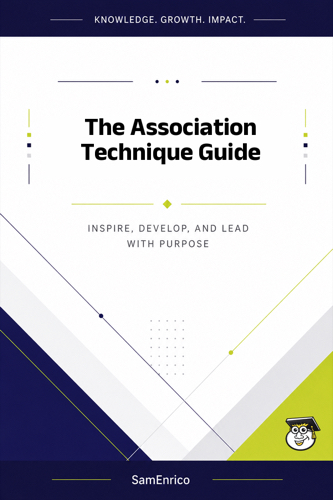
The Association Technique Guide eBook
Link names to vivid mental images, rhymes, or puns
Link names to vivid mental images, rhymes, or puns for instant recall.
Formats
Free sample
Chapter 1: The Baker-Baker Paradox--–- The man at the cocktail party extended his hand and said, "Hi, I'm Mr. Baker." You smiled, shook his hand, and said, "Nice to meet you." Three seconds later, you turned to get a drink, and when you looked back, his name was gone. Erased. As if it had never been spoken. But if that same man had said, "Hi, I'm a baker," you would have remembered.
You would have pictured flour-dusted hands, a warm baguette, the smell of yeast. You might have asked, "What do you bake?" or "Early mornings, huh?" The name would have stuck.This is not a failure of your memory. This is the Baker-Baker Paradox, one of the most replicated findings in cognitive psychology, and understanding it is the single most important step you will take toward never forgetting another name.The experiment is simple and devastating. Researchers show subjects two photographs. The first man is introduced as "Mr.
Baker." The second man is introduced as "a baker." Later, when asked to recall, people remember the profession roughly 80 percent of the time but the surname less than 30 percent of the time. Same word. Same sound. Same number of syllables. Radically different outcomes.Why?
Because the word "baker" as a profession comes wrapped in meaning. It arrives with baggage: flour, apron, oven, bread, early mornings, the smell of proofing dough, the heat of a brick oven, the satisfaction of a perfect crust. Your brain has somewhere to put it. The name "Baker" arrives naked. It is an arbitrary label pinned to a face with no connection, no context, no story.
Your brain, overloaded with sensory input from a crowded room, discards it as noise.This chapter will teach you why meaning is the currency of memory, why your working memory is not the enemy but simply limited, and how a simple metaphor called Cling Wrap will reframe everything you thought you knew about remembering names.The Forgetting That Feels Personal Let us be honest about the cost of forgetting names. It is not merely embarrassing. It is relationship poison. When you forget someone's name after they have told it to you, you are sending an unconscious message: You are not important enough for me to remember. The other person does not consciously think this, but the emotional residue is real.
They feel unseen. They feel interchangeable. And you feel guilty, which makes you anxious at the next introduction, which makes you forget even more names. A vicious cycle.The average person meets dozens of new people every week. In business, names are the currency of trust.
In social life, names are the building blocks of intimacy. In networking, names are the difference between being remembered and being replaceable. Yet most people walk through life saying, "I'm just not good with names," as if it were a fixed personality trait like shoe size or height.It is not fixed. It is not a trait. It is a skill.
And like any skill, it can be trained.The Seven-Item Prison To understand why names vanish, you must first understand the brutal limitations of your working memory. Working memory is what you are using right now to hold this sentence in your mind while simultaneously parsing its meaning and deciding whether to keep reading. It is the scratch pad of consciousness. And it is tiny.George Miller's famous 1956 paper, "The Magical Number Seven, Plus or Minus Two," established that the average human working memory can hold between five and nine discrete items for about fifteen to thirty seconds. That is it.
Seven phone numbers worth of space. A grocery list. The names of everyone sitting around a small dinner table.But here is the cruel part: those seven slots are not reserved for names. They are shared with everything else you are thinking about. The temperature of the room.
The lingering taste of the appetizer. Whether you remembered to lock your car. What you are going to say next. Whether your handshake was too sweaty. Whether the person you are talking to likes you.
All of these compete for the same seven slots.When someone says, "Hi, I'm Mr. Baker," your brain is already multitasking. It hears the sound "Baker" but has nowhere to put it. The seven slots are full of other concerns. The name bounces off the surface of your awareness and falls away.
This is not a memory problem. This is an attention problem dressed in memory's clothing.Now consider the alternative. If that same person says, "Hi, I'm a baker," the name arrives with a pre-built neural hook. Your brain instantly allocates one of those precious seven slots to the image of an oven, or a baguette, or a flour-dusted apron. The sound "baker" now has a place to live.
It is attached to something. It has meaning.The Cling Wrap Theory of Memory This book's central metaphor is simple: memories need Cling Wrap. Think of your brain's surface as smooth and slick, like a freshly waxed car. Abstract information — arbitrary sounds, random numbers, names without context — slides right off. It lands, sits for a moment, and then gravity and friction do their work.
Gone.But if you wrap that abstract information in a layer of meaning, imagery, emotion, or sensory detail, it becomes sticky. It adheres. It clings. The Cling Wrap is whatever transforms a naked sound into a remembered experience.For the profession "baker," the Cling Wrap is built in. You do not have to manufacture it.
The word itself triggers images, smells, textures, and even emotional associations (warmth, comfort, morning routines). For the surname "Baker," there is no Cling Wrap. You have to make it yourself. That is what this entire book teaches: how to manufacture Cling Wrap for any name, instantly, automatically, and permanently.The Baker-Baker Paradox is not a quirk of psychology. It is a window into how memory actually works.
The brain does not record information like a video camera. It does not store names in alphabetical files. It stores experiences, associations, and images. If you want to remember a name, you must turn it into an experience.The Neuroscience of Meaning Why does meaning matter so much to the brain? The answer lies in evolution.
Your brain did not evolve to remember arbitrary labels. It evolved to remember threats, opportunities, food sources, social alliances, and navigation routes. A berry bush that gave you food is worth remembering. A cliff that nearly killed you is worth remembering. A person who shared meat with you is worth remembering.
But an arbitrary sound attached to a face? That never appeared in the ancestral environment. Your brain has no dedicated hardware for it.What your brain does have is a remarkable ability to repurpose existing hardware. The same neural circuits that remember a berry bush (visual features, location, associated emotions) can be hijacked to remember a name. You just have to feed the brain the right kind of input.
It needs an image. It needs a location. It needs an emotion, or at least an absurdity. It needs Cling Wrap.Functional MRI studies have shown that when people successfully remember names, their visual cortex activates even though they…
This is the end of the free sample. Get the eBook to keep going. Buy now
About this book
Details
- Author
- Blackman Manuela
- Publisher
- SamEnrico
- Language
- English
- Genre
- Non-Fiction, Self-Help, Creative Memory
- Released
- 2026-06-07
- Pages (approx.)
- 125
- Available as
- eBook, Audiobook

Read better in the ZLOADR app
Your eBooks on your phone or tablet. Sign in with your SamEnrico account and start reading.
More by Blackman Manuela
 Compulsive Spending And Body Image CourseBlackman Manuela$11.99
 Novichok Poisoning AttacksBlackman Manuela$11.99
 Duty Drawback Program Business GuideBlackman Manuela$11.99
 The Beginner Non JudgmentBlackman Manuela$11.99
 Pieces of the Puzzle: The Unsolved Mystery of the Clown MurdersBlackman Manuela$11.99
 The Forgotten Speleologist: Unraveling the Mind of Édouard-Alfred Martel in the Depths of the AtlanticBlackman Manuela$11.99
 How to Become a Centrifugal-drier OperatorBlackman Manuela$11.99
 China Transportation GuideBlackman Manuela$12.99
 Affordable Housing Product FitBlackman Manuela$12.99
 Understanding Congenital Disorder of GlycosylationBlackman Manuela$17.99
 Notion Personal and Business SystemsBlackman Manuela$11.99
You may also like
 Hong Kong Handover 1997Dunn Johnnie$11.99
 Zumba For Postnatal Recovery CourseNeal Christian$11.99
 Zumba for BeginnersLadner Nikia$11.99
 YouTube Comment Mining GuideHumes Pandora$12.99
 Worry Box MeditationCarlin Rudy$11.99
 Workplace Stress MeditationNguyen Lynn$11.99
 Workplace Stress and Sleep RepairHawley Ivory$11.99
 Workplace Perfectionism CureDelaney Jeffry$11.99
 Workplace Injustice Anger GuideWallen Isabelle$11.99
 Work Addiction and Burnout LinkGreenwood Ester$11.99
 Women in Yoga and WellnessBeattie Galina$11.99
 Women in Stand Up ComedyChun Evangeline$11.99