
Non-FictionSelf-HelpCommunication Skills
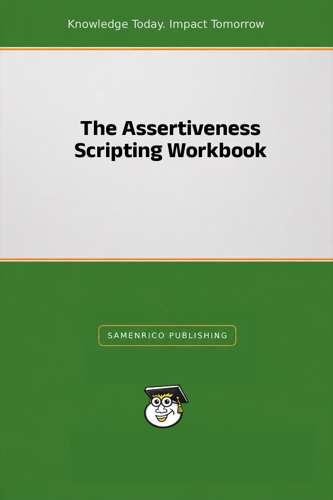
The Assertiveness Scripting Workbook eBook
Provides word for word phrases for saying no, aski
Provides word for word phrases for saying no, asking for needs, and setting boundaries.
Formats
Free sample
Chapter 1: The Diagnosis You’ve Been Avoiding--–- You just said yes to something you didn’t want to do. Again. The words left your mouth before your brain could catch them. Now your chest is tight. You’re already dreading the thing you agreed to.
And somewhere beneath the dread, there’s a quieter feeling—one you’ve learned to ignore. Resentment. Not at the person who asked. At yourself.If this feeling has a familiar address in your body, you are not broken. You are not weak.
You are not “too nice” in some unchangeable, character-flaw kind of way. You are, quite simply, operating on a default communication setting that was installed long ago—by your family, your culture, your past experiences, and your survival instincts. And the good news is that default settings can be changed.But before you can change how you speak, you need to know how you currently show up. This chapter is not about fixing anything yet. It is about diagnosing.
You wouldn’t take a medication without knowing what illness you’re treating. You wouldn’t follow a recipe without knowing what you’re cooking. And you shouldn’t start using assertiveness scripts without knowing which communication style is currently running the show.The four styles we’re about to explore—Passive, Aggressive, Passive-Aggressive, and Assertive—are not personality types. You are not locked into one forever. Most people shift between styles depending on who they’re with, how tired they are, and what’s at stake.
You might be assertive with your barista and passive with your boss. You might be aggressive with your siblings and passive-aggressive with your partner. That’s normal. The goal of this chapter is not to label you. It is to give you a map of where you are right now so you can decide where you want to go.The Cost of Staying Where You Are Let’s be honest about what’s at stake.
Your current communication style—whatever it is—is costing you something.If you tend toward passivity, it is costing you your time, your energy, and your peace of mind. Every “yes” you didn’t mean is a small theft from your future self. Every time you stay late when you wanted to leave, every favor you agreed to while biting your tongue, every request you accepted while feeling your stomach drop—those are not acts of kindness. They are acts of self-abandonment. And they add up.
The research on people-pleasing is unambiguous: chronic passivity is correlated with higher rates of burnout, anxiety, depression, and even physical illness. Your body keeps score.If you tend toward aggression, it is costing you relationships, opportunities, and respect. You might get what you want in the moment—the last word, the compliance, the silence of the other person—but you are building a reputation that follows you. People may fear you, but they won’t trust you. They may comply, but they won’t collaborate.
And over time, aggression isolates. The loudest person in the room is often the loneliest.If you tend toward passive-aggression, it is costing you authenticity and connection. Those sarcastic comments, the silent treatment, the “I’m fine” when you’re clearly not—these are not harmless quirks. They are indirect weapons that leave the other person confused and you still unresolved. Passive-aggression is the most socially costly style because it is the hardest to confront.
The other person can’t address what you won’t say directly.And if you are already somewhat assertive? Good. But even assertiveness has a cost when it’s inconsistent. The person who is assertive on Tuesday and passive on Thursday confuses everyone around them. Predictability is a form of safety.
The most effective communicators are not the ones who are always “nice” or always “tough.” They are the ones who are reliably themselves.So let’s find out who you are right now.The Four Communication Styles: A Field Guide Before you take the assessment, let’s walk through each style in plain language. You will recognize yourself in more than one. That’s fine. Note which one feels most familiar when you’re stressed, tired, or scared.The Passive Style: “Your Needs First, Mine Never”The passive communicator has learned, often for very good reasons, that silence is safer than speaking up. Maybe you grew up in a household where your opinions were dismissed.
Maybe you were punished for disagreeing. Maybe you learned that keeping the peace was your job. Whatever the origin, the passive style is characterized by one core behavior: you consistently prioritize others’ needs above your own, even when it harms you.Verbal markers of passivity include: “I’m sorry, but…”, “It’s probably nothing, but…”, “I hate to ask, but…”, “If it’s not too much trouble…”, “Oh, don’t worry about it…” You apologize for existing. You minimize your requests before they’re even fully spoken. You say “yes” when you mean “no” and then resent the person who asked—even though they didn’t do anything wrong.
You made the choice. You just didn’t realize you had one.Nonverbal markers: slumped shoulders, downcast eyes, a small voice, nodding while disagreeing internally. The passive communicator takes up less space—physically and socially.The passive person’s internal narrative is: “If I speak up, something bad will happen. If I say no, they won’t like me. If I ask for what I need, I’ll be a burden.”The Aggressive Style: “My Needs First, Yours Never”The aggressive communicator has also learned a survival strategy—but theirs is dominance.
Perhaps you grew up in an environment where the loudest voice won. Perhaps you learned that vulnerability was dangerous. Perhaps you discovered that intimidation gets results. The aggressive style is characterized by one core behavior: you consistently prioritize your own needs above others’, even when it harms them.Verbal markers of aggression include: “That’s stupid.” “You always…”, “You never…”, “What’s wrong with you?”, “Just do it.” You interrupt. You raise your voice.
You use absolute language (“always,” “never,” “everyone”). You attack the person, not the problem. You win arguments by exhausting the other person, not by persuading them.Nonverbal markers: pointing fingers, invading personal space, staring down, loud volume, fast speech. The aggressive communicator takes up more space than is socially comfortable.The aggressive person’s internal narrative is: “If I don’t fight, I’ll get walked on. The only way to be heard is to be loud.
Vulnerability is weakness.”The Passive-Aggressive Style: “My Needs First, But I Won’t Say So”The passive-aggressive communicator is the most difficult to pin down because their behavior is indirect. This style often develops when direct expression of anger or disappointment was punished, but the feeling didn’t go away. So the feeling leaks out sideways. The passive-aggressive style is characterized by one core behavior: you express negative feelings indirectly rather than addressing them directly.Verbal markers of passive-aggression include: “I’m fine.” (when you’re clearly not), “Whatever.”, “If that’s what you want to do…”, “Some people would do it differently, but what do I know?”, sarcasm, backhanded compliments (“You’re so brave…
This is the end of the free sample. Get the eBook to keep going. Buy now
About this book
Details
- Author
- Henderson Marsha
- Publisher
- SamEnrico
- Language
- English
- Genre
- Non-Fiction, Self-Help, Communication Skills
- Released
- 2026-06-05
- Pages (approx.)
- 141
- Available as
- eBook, Audiobook

Read better in the ZLOADR app
Your eBooks on your phone or tablet. Sign in with your SamEnrico account and start reading.
More by Henderson Marsha
 Being Rushed Anger Triggers WorkbookHenderson Marsha$11.99
 Morning Intention Walking PlanHenderson Marsha$11.99
 TTC With Azoospermia GuideHenderson Marsha$11.99
 Pomodoro for Team CollaborationHenderson Marsha$11.99
 The Concrete Dream: How a Visionary Architect Built Africa's First Modern StadiumHenderson Marsha$11.99
 Slack Remote Internship BlueprintHenderson Marsha$12.99
 Dexcom SWOT LibraryHenderson Marsha$12.99
 How to Start a White Water Rafting - Recreational BusinessHenderson Marsha$11.99
 Faceless Content Brand BuildingHenderson Marsha$11.99
 Understanding Olney's LesionsHenderson Marsha$17.99
You may also like
 Hong Kong Handover 1997Dunn Johnnie$11.99
 Zumba For Postnatal Recovery CourseNeal Christian$11.99
 Zumba for BeginnersLadner Nikia$11.99
 YouTube Comment Mining GuideHumes Pandora$12.99
 Worry Box MeditationCarlin Rudy$11.99
 Workplace Stress MeditationNguyen Lynn$11.99
 Workplace Stress and Sleep RepairHawley Ivory$11.99
 Workplace Perfectionism CureDelaney Jeffry$11.99
 Workplace Injustice Anger GuideWallen Isabelle$11.99
 Work Addiction and Burnout LinkGreenwood Ester$11.99
 Women in Yoga and WellnessBeattie Galina$11.99
 Women in Stand Up ComedyChun Evangeline$11.99