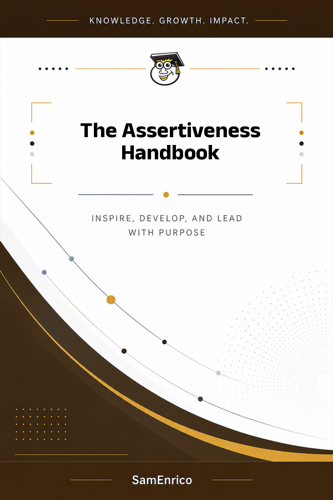
The Assertiveness Handbook eBook
Complete reference covering all techniques from ba
by Conti Dahlia
Complete reference covering all techniques from basic scripts to advanced negotiation.
Formats
Free sample
Chapter 1: The Hidden Cost--Most people who buy this book do not have a problem with aggression. They are not bullies, not screamers, not the ones who dominate meetings or intimidate their families. They are, by and large, people who have spent years—sometimes decades—being nice. They have said yes when they meant no. They have swallowed frustration to keep the peace.
They have apologized for things that were not their fault, laughed at jokes that stung, and stayed silent while their boundaries were quietly erased.And they are exhausted.Not the kind of exhaustion that comes from a long day of physical labor. A deeper kind. The exhaustion of someone who has betrayed themselves repeatedly, in small ways, until the cumulative weight of those betrayals has become unbearable. If this describes you, you have come to the right place. But the solution is not what you think.
It is not learning to be rude. It is not learning to dominate. It is learning something far more subtle and far more powerful: the art of standing up for yourself while still standing with others.This chapter will dismantle the false binary that has trapped you. It will show you that your only two options are not "nice" and "rude." It will name the hidden costs of chronic niceness, introduce the three behavior types that define human interaction, and give you a diagnostic tool to identify your default patterns. By the end of this chapter, you will understand why your current approach is not working—and you will see, perhaps for the first time, the shape of the path forward.The Myth of Niceness Let us begin with a hard truth.
Chronic niceness is not kindness. It is fear.Kindness is a choice made from abundance. It says, "I have enough security, enough self-worth, enough emotional resources to give freely to another person, and I choose to do so." Niceness, as it is usually practiced by the people who need this book, is a survival strategy. It says, "If I am agreeable enough, if I never cause friction, if I always put others first, then they will not reject me, criticize me, or abandon me."This distinction matters because the costs of chronic niceness are staggering. Let us trace them.First, resentment.
Every time you say yes when you want to say no, you do not erase your preference. You bury it. Buried preferences do not disappear; they fester. Over time, they accumulate into a mountain of unexpressed irritation. The coworker who asks you to cover their shift for the tenth time.
The friend who always chooses the restaurant. The partner who leaves their dishes in the sink. You smile and say "no problem" while inside you are building a case file. When that file eventually overflows, the explosion is rarely proportional to the final trigger. You do not snap because of the dishes.
You snap because of three years of dishes.Second, passive-aggression. Because direct expression feels unsafe, the chronically nice person learns indirect expression. The silent treatment. The sarcastic comment delivered with a smile. The "forgetting" to do a favor.
The exaggerated sigh. These behaviors are not kindness; they are aggression in disguise. They poison relationships more thoroughly than direct conflict ever could, because the other person can feel the hostility but cannot name it. They are left with a vague sense that something is wrong, which often leads them to withdraw—exactly the opposite of what the nice person wanted.Third, anxiety. Unexpressed feelings do not simply sit quietly in a corner.
They demand attention. Your brain, sensing that there are things you need to say but are not saying, keeps those issues active in working memory. This is exhausting. It is the mental equivalent of holding a dozen browser tabs open while your computer slows to a crawl. The chronic people-pleaser often reports feeling tired for no reason, unable to concentrate, or vaguely uneasy.
This is not a mystery. It is the cost of suppression.Fourth, broken relationships. This is the cruelest irony. The person who avoids conflict to preserve relationships often ends up destroying them. The friend who never says what they need eventually withdraws entirely, feeling unseen.
The partner who never voices frustration eventually explodes, shocking the other person who genuinely believed everything was fine. The employee who never sets boundaries eventually burns out and quits, leaving the employer confused about what went wrong.Niceness is not the same as goodness. Niceness is a performance of agreeability. Goodness is a commitment to honesty, even when it is uncomfortable. This book is about becoming good, not merely nice.The Three Behavior Types To understand where you are now, you need a map.
The assertiveness literature, drawing on decades of clinical and organizational research, identifies three primary behavior types in interpersonal conflict. Most people default to one of these patterns, though everyone is capable of all three under different circumstances.Passivity, also called submission or non-assertion, is the pattern of violating your own rights. You fail to express honest feelings, needs, or preferences. You allow others to violate your boundaries. You say "whatever you want" when you actually have a strong preference.
You apologize for things that are not your fault. You assume your needs are less important than everyone else's. The passive person often ends up feeling resentful, anxious, and exploited. They also, paradoxically, end up controlling the relationship through their resentment—a dynamic that benefits no one.Aggression is the opposite pattern: violating others' rights. You express your needs and feelings, but you do so in a way that disregards the other person's dignity.
You interrupt. You raise your voice. You use "you" statements that blame and shame ("You always do this," "You never think about me"). You threaten. You manipulate.
The aggressive person wins the immediate battle but loses the longer war. Colleagues avoid them. Partners withdraw emotionally. Friends eventually disappear. Aggression gets short-term results at the cost of long-term trust.Assertiveness is the third path.
You express your needs and feelings directly, honestly, and respectfully. You stand up for your rights while also respecting the rights of others. You say "I feel frustrated when the dishes are left in the sink" instead of "You're so lazy" or silent fuming. You say "I need to leave by 6 PM" instead of staying late and resenting it or storming out without explanation. Assertiveness is neither passive nor aggressive.
It is the balanced center.Here is the key insight that most people miss: passivity and aggression are not opposites. They are two sides of the same coin. Both are failures of integration. The passive person suppresses their own needs; the aggressive person suppresses their empathy. Both are incomplete.
Both lead to poor outcomes over time. Assertiveness integrates self-respect and other-respect. It is the only sustainable option.The Assertiveness Scorecard Theory is useful, but you need to know where you stand. Take out a piece of paper or open a note on your phone. Rate yourself on the following twenty scenarios.
For each, ask: In this situation, what do I typically do?Use this scale:1 = Usually passive (stay silent, go along, avoid)2 = Sometimes passive, sometimes assertive3 =…
This is the end of the free sample. Get the eBook to keep going. Buy now
About this book
Details
- Author
- Conti Dahlia
- Publisher
- SamEnrico
- Language
- English
- Genre
- Non-Fiction, Self-Help, Comprehensive
- Released
- 2026-06-10
- Pages (approx.)
- 131
- Available as
- eBook, Audiobook

Read better in the ZLOADR app
Your eBooks on your phone or tablet. Sign in with your SamEnrico account and start reading.
More by Conti Dahlia
 TM and Longevity GuideConti Dahlia$11.99
 Anger After Meetings GuideConti Dahlia$11.99
 Anger Journal For DriversConti Dahlia$11.99
 The Pelvic Floor Postpartum WorkbookConti Dahlia$11.99
 The Last-Minute Miracle: The Contract That Saved Saudi FootballConti Dahlia$11.99
 Understanding Phacomatosis FourthConti Dahlia$17.99
 Aerospace Defense MapConti Dahlia$12.99
 One Page Plan for NonprofitsConti Dahlia$12.99
 A Beginners Guide to Gridiron football (Volume 1)Conti Dahlia$11.99
 Rihanna: From Music to Billion-Dollar BusinessConti Dahlia$11.99