
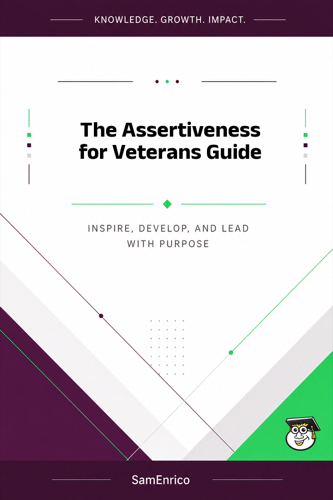
The Assertiveness for Veterans Guide eBook
Translate military directness into civilian workpl
Translate military directness into civilian workplace and social settings.
Formats
Free sample
Chapter 1: The Vibe Check--–- The first time someone tells you that you’re “intimidating,” you probably laugh it off. The second time, you start to wonder. The third time, you’re sitting in an HR office, and the nice lady with the kind voice is using words like “communication style” and “unintended impact,” and you realize she’s not talking about the civilian who shows up late every day or the one who cries during budget meetings. She’s talking about you. And you have absolutely no idea what you did wrong.Let’s rewind six months.You’re three weeks into a project management job at a mid-sized logistics firm.
You like the work. It’s orderly. There are metrics. There’s a mission, even if that mission is just “get the shipments to the warehouse by Thursday.” You arrive fifteen minutes early every day. You don’t call in sick.
You don’t complain about the coffee. You complete every task assigned to you, usually ahead of schedule, and you don’t ask for praise because praise was never part of the deal.Then your boss, a woman named Diane who has never served a day in uniform but somehow rose to Senior Director by age thirty-four, calls you into her office. She closes the door. You immediately scan the room for exits—a habit you’ve tried to break but can’t—and note that her window opens onto a fire escape. Good.
Diane sits down, folds her hands, and says, “Mike, I want to start by saying you’re one of the best hires we’ve made this year.”You wait for the “but.” In the military, the “but” always comes.“But,” she says, “I’ve had three people from your team come to me this week saying they’re uncomfortable working with you.”You feel your jaw tighten. You force it to relax. “Uncomfortable how?”Diane hesitates. She’s choosing her words carefully, which tells you she’s afraid of how you’ll react. That stings more than the complaint itself.
“They say you’re… abrupt. That when they ask a question, you make them feel stupid. That you stare at them like you’re angry. One person said you ‘loom.’”You don’t loom. You stand six feet tall, same as you always have.
You don’t stare; you maintain eye contact because that’s what respect looks like. You don’t make people feel stupid; you answer their questions directly because that’s what efficiency demands.You say none of this. You say, “I’ll work on it.”Diane nods, relieved. “Thank you, Mike. That’s all I needed.”You walk back to your desk and spend the rest of the day trying to figure out what the hell just happened.
You replay every interaction from the past three weeks. You can’t find the crime. You were polite. You were professional. You were on time and on target.
And somehow, you’re the problem.If this story sounds familiar, you’re not alone. According to the 2023 Veterans in the Workplace study from Syracuse University’s Institute for Veterans and Military Families, 67% of post-9/11 veterans have received formal or informal feedback that their communication style is “too direct,” “intimidating,” or “abrupt.” Of those, 41% reported that the feedback came with no actionable guidance on how to adjust. Just the complaint. Just the feeling that something was wrong with them.This chapter is the antidote to that feeling. We’re going to name the problem, map its origins, and give you the first set of tools to fix it—not by becoming softer, but by becoming more precise.The Operating System Mismatch Every veteran knows what a “hip pocket” class is.
It’s the five-minute lesson a senior NCO delivers while you’re standing in the motor pool waiting for someone to find the right wrench. No slides. No handouts. Just a voice that’s been doing this longer than you’ve been alive, telling you how not to die.Here’s your hip pocket class for this chapter:The military runs on a binary communication operating system. Comply or don’t comply.
Execute or fail to execute. Right or wrong. The stakes are often life and death, so ambiguity is the enemy. Orders are designed to be understood in seconds, under extreme stress, by people who may not like each other but who must trust each other with their lives. The chain of command exists to remove friction.
You speak. They listen. They speak. You execute.The civilian workplace runs on an interpretive consensus operating system. Compliance is negotiated.
Authority is distributed across budget holders, subject-matter experts, and whoever the CEO happens to like this quarter. Decisions emerge from discussion, alignment, and—let’s be honest—office politics. The stakes are almost never life and death, so ambiguity is tolerated, even preferred, because it allows people to avoid accountability later. (“Well, when I said ‘interesting approach,’ I didn’t mean you should actually do it.”)When you drop a binary operator into an interpretive system, the system doesn’t adapt to you. You break the system.
And then the system tells you that you’re “intimidating.”Neither system is morally superior. Military directness has saved countless lives. Civilian indirectness has preserved countless office relationships. The problem is not that one is good and the other is bad. The problem is that you are speaking Russian at a Portuguese dinner party.
The words are correct. The grammar is flawless. But the cultural code is wrong, and everyone is uncomfortable.Let’s get specific.The Four Places Veterans Leak “Intimidation”You don’t mean to be intimidating. Intimidation is a tool you used exactly when it was needed—during a tactical questioning, when establishing dominance over a hostile actor, or when a junior soldier was about to do something catastrophically stupid. It’s not your baseline.
But civilians perceive intimidation where you perceive professionalism. Here’s where the leakage happens.1. Eye Contact In the military, sustained eye contact signals respect, engagement, and trustworthiness. You look your superior in the eye when receiving orders. You look your subordinate in the eye when issuing them.
Averting your gaze is evasive, disrespectful, or—depending on the context—an admission of guilt.In the civilian world, sustained eye contact beyond three to five seconds signals dominance, aggression, or romantic interest. Civilians naturally break eye contact every few seconds to soften the interaction. They look at a spot on the wall, at their own hands, at the coffee mug. They are not being evasive; they are being polite.When you hold eye contact for ten seconds while a civilian is speaking, they don’t think “what a trustworthy professional.” They think “why is he looking at me like that?” Their amygdala (the brain’s threat-detection center) fires. They get a small spike of cortisol.
They don’t know why they feel uncomfortable, but they do. And they will remember the feeling long after they forget the conversation.2. Stillness In the military, stillness is discipline. You stand at parade rest. You don’t fidget.
You don’t shift your weight. You don’t gesture unnecessarily. Stillness communicates that you are in control of your body, which…
This is the end of the free sample. Get the eBook to keep going. Buy now
About this book
Details
- Author
- Pantoja Teddy
- Publisher
- SamEnrico
- Language
- English
- Genre
- Non-Fiction, Self-Help, Veterans
- Released
- 2026-06-07
- Pages (approx.)
- 145
- Available as
- eBook, Audiobook

Read better in the ZLOADR app
Your eBooks on your phone or tablet. Sign in with your SamEnrico account and start reading.
More by Pantoja Teddy
 Soviet Union African AlliesPantoja Teddy$11.99
 Addiction Partner Stress GuidePantoja Teddy$11.99
 Language Barriers To Boardrooms MemoirPantoja Teddy$11.99
 Anger And The Premature ChildPantoja Teddy$11.99
 Sales Emotion ReadingPantoja Teddy$11.99
 Artillery in the RebellionPantoja Teddy$11.99
 Parenting Body Positive KidsPantoja Teddy$11.99
 Love Letters in the Stars: The Cosmic Romance of Neil Armstrong and Jan CollinsPantoja Teddy$11.99
 Jason Calacanis LAPantoja Teddy$11.99
 Ragnarok's Forgotten Witness: The Last Words of MímirPantoja Teddy$11.99
 Byzantium: The Golden Chain of the EastPantoja Teddy$11.99
 The Mineral Guide to Plagioclase Na-ca FeldsparPantoja Teddy$11.99
You may also like
 Hong Kong Handover 1997Dunn Johnnie$11.99
 Zumba For Postnatal Recovery CourseNeal Christian$11.99
 Zumba for BeginnersLadner Nikia$11.99
 YouTube Comment Mining GuideHumes Pandora$12.99
 Worry Box MeditationCarlin Rudy$11.99
 Workplace Stress MeditationNguyen Lynn$11.99
 Workplace Stress and Sleep RepairHawley Ivory$11.99
 Workplace Perfectionism CureDelaney Jeffry$11.99
 Workplace Injustice Anger GuideWallen Isabelle$11.99
 Work Addiction and Burnout LinkGreenwood Ester$11.99
 Women in Yoga and WellnessBeattie Galina$11.99
 Women in Stand Up ComedyChun Evangeline$11.99