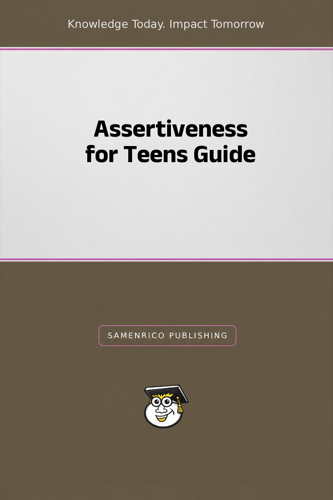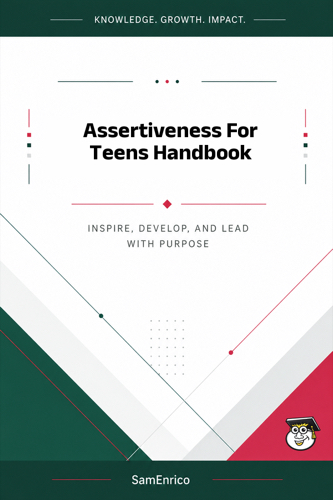
The Assertiveness for Teens Guide eBook
Helps adolescents resist peer pressure and speak t
Helps adolescents resist peer pressure and speak to adults.
Formats
Free sample
Chapter 1: The Silent Agreement--You have already signed a contract you never saw, never read, and never agreed to out loud. It was signed the first time you laughed at a joke you didn't find funny. It was stamped the first time you said "I don't care" when you actually cared a lot. It was notarized every time you nodded along while your brain screamed the opposite.This is the Silent Agreement. And it is the reason you cannot say no.Every teen on the planet has signed this agreement.
It is not your fault. It is not a character flaw. It is a survival strategy that your brain adopted because, evolutionarily speaking, being kicked out of the tribe meant death. Your ancient ancestors who got rejected by the group did not pass on their genes. So your brain is wired to avoid rejection the way your hand is wired to pull back from a flame.
The problem is that the flame is no longer a literal fire. The flame is now a group chat going quiet when you say something. The flame is a lunch table that shifts slightly away from you. The flame is the terrifying silence after you voice an opinion that goes against the crowd.And because your brain cannot tell the difference between being exiled from a prehistoric tribe and being left on read, it floods your body with stress chemicals every single time you face potential social rejection. This is not weakness.
This is biology. But biology can be rewired. And the first step to rewiring it is recognizing that you have been living under the Silent Agreement without ever knowing it existed.The Silent Agreement says this: I will say yes to keep the peace. I will hide my true opinion to stay liked. I will laugh when I don't want to laugh.
I will go along when I want to go along. And in exchange, the group will not reject me.It is a terrible deal. You give up your voice, your preferences, your boundaries, and sometimes your safety. In return, you get a temporary, fragile version of belonging that could shatter at any moment. But because the alternative—standing alone—feels so terrifying, most teens never even consider breaking the agreement.
They just keep signing it, day after day, until they no longer know what they actually want versus what they have been trained to want.This chapter is about reading that invisible contract for the first time. Then deciding whether you want to tear it up.The Neurochemistry of Yes: Why You Can't Stop People-Pleasing Before we talk about fixing the problem, you need to understand how deeply it is wired into you. This is not a lecture about having low self-esteem or being weak. This is neuroscience.When you receive social approval—a like on a post, an invite to a party, a friend laughing at your joke—your brain releases dopamine. Dopamine is the same chemical released by cocaine, gambling, and video game victories.
It feels good. Really good. And your brain wants more of it.Here is the cruel trick: dopamine is not released when you have approval. It is released when you anticipate approval. The chase is the high.
This is why you can scroll social media for an hour waiting for notifications. This is why you check your phone seventeen times after posting a story. You are not checking for the likes themselves. You are chasing the dopamine hit that comes right before you see the likes.Now add peer pressure to this neurochemical equation. When a friend suggests something that makes you uncomfortable—skipping class, trying a substance, lying to your parents—your brain does a split-second calculation.
It asks: If I say no, will I lose approval? And because losing approval means losing the dopamine supply, your brain screams YES. Say yes. Go along. Keep the approval coming.This is not a moral failure.
This is your amygdala (the brain's alarm system) and your nucleus accumbens (the reward center) colluding against you. They do not care about your long-term happiness, your values, or your safety. They care about avoiding rejection right now.The teens who successfully resist peer pressure are not "stronger" or "better" than you. They have simply trained their brains to respond differently. They have built what neuroscientists call "cognitive friction"—a tiny pause between the impulse to say yes and the actual decision.
That pause is what this entire book is designed to build.But before you can build the pause, you have to understand what you are up against. And what you are up against is not just your friends. It is the most powerful chemical reward system in your teenage brain.The Two Kinds of Belonging: Popularity vs. Acceptance Here is a distinction that will change how you see every single one of your friendships. It is the difference between popularity and acceptance.
They sound similar. They feel similar. But they are opposites in every way that matters.Popularity is a measure of social dominance. It is about visibility, status, and hierarchy. Popular teens are known.
They are talked about. They have followers. But here is the secret that no one tells you: popularity is not the same as being liked. In fact, research shows that popular teens are often actively disliked by a large number of their peers. They are famous, not loved.Popularity operates on a scarcity model.
There is only room at the top. To stay popular, you must constantly perform, compete, and guard your status. One mistake—one wrong outfit, one awkward moment, one public failure—and the hierarchy shifts. Popularity requires you to sacrifice parts of yourself to maintain a position that was never stable to begin with.Acceptance, on the other hand, is about authentic connection. Acceptance is being known and liked for who you actually are.
When you are accepted, you do not have to perform. You do not have to laugh at jokes that are not funny. You do not have to pretend to like things you hate. Acceptance operates on an abundance model. There is no limit to how many people can genuinely like you.Here is the brutal truth that most teens learn too late: popularity does not protect you from loneliness.
Some of the most popular teens in any school are also the most anxious. They are terrified of falling. They cannot tell who their real friends are because everyone wants something from them. They are surrounded by people and completely alone.Acceptance, by contrast, is quiet. It does not come with a thousand followers.
It comes with two or three people who have seen you cry, who know your weird opinions, who still want to sit next to you after you embarrassed yourself. Acceptance is not flashy. But acceptance is real.The Silent Agreement tricks you into chasing popularity because popularity provides visible, measurable proof of belonging—likes, invites, shout-outs. Acceptance provides none of that. You cannot screenshot acceptance.
You cannot post it on your story. But acceptance is the only kind of belonging that actually makes you feel safe.So here is the question you need to…
This is the end of the free sample. Get the eBook to keep going. Buy now
About this book
Details
- Author
- Bankston Gonzalo
- Publisher
- SamEnrico
- Language
- English
- Genre
- Non-Fiction, Self-Help, Teen Skills
- Released
- 2026-06-05
- Pages (approx.)
- 150
- Available as
- eBook, Audiobook

Read better in the ZLOADR app
Your eBooks on your phone or tablet. Sign in with your SamEnrico account and start reading.
More by Bankston Gonzalo
 Pomodoro for Photography EditingBankston Gonzalo$11.99
 Affirmations For ResilienceBankston Gonzalo$11.99
 The Shipwreck Decay StudyBankston Gonzalo$11.99
 Cooperative Legal ComplianceBankston Gonzalo$11.99
 The London Mob: How the American Mafia Infiltrated Post-War BritainBankston Gonzalo$11.99
 Understanding Ophthalmoplegia Myalgia Tubular AggregatesBankston Gonzalo$17.99
 Manufacturing Pricing Cost Pass ThroughBankston Gonzalo$12.99
 Career Changer Developer RoadmapBankston Gonzalo$12.99
 How to Become a Shade-cloth FinisherBankston Gonzalo$11.99
 Iron MiningBankston Gonzalo$11.99