
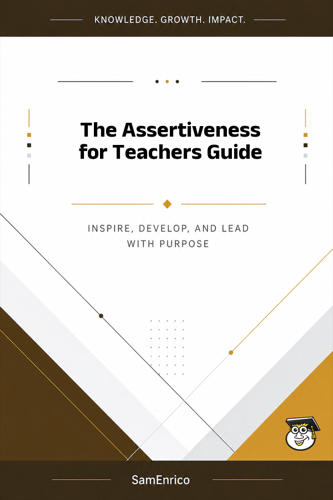
The Assertiveness for Teachers Guide eBook
Manage classroom behavior, parent meetings, and ad
Manage classroom behavior, parent meetings, and administrator demands assertively.
Formats
Free sample
Chapter 1: The Glass Door...-- At 7:43 on a Tuesday morning, Sarah closed her classroom door, leaned her forehead against the cool cinderblock wall, and cried. Not the silent, dignified tear—the kind that comes with a heaving chest and the desperate hope that no one walks in. She had been teaching for six years. She had won a "Rising Star" award in year three. Her students' test scores were above the district average.
By every external metric, Sarah was a good teacher. And she was drowning.The reason was not that she couldn't manage a classroom. It was that she couldn't manage the invisible flood of demands that had nothing to do with instruction. The parent who emailed at 10:17 PM demanding a grade explanation. The principal who added a "quick" duty to her already full lunch period.
The colleague who "just needed five minutes" of her planning time, which became thirty. The student who argued every direction into a ten-minute negotiation. Sarah had said yes to all of it. She had been trained, like most teachers, to believe that "yes" was the sound of a dedicated professional. She had learned the hard way that "yes" was also the sound of her own disappearance.This chapter is not a pep talk.
It is not a collection of gentle suggestions about self-care. It is a fundamental reorientation of what it means to be a teacher in a system that has learned to exploit the goodwill of its most dedicated people. Before you can assert yourself with students, parents, or administrators, you must first assert yourself to yourself. You must recognize that the cultural script of the "good teacher"—the martyr, the saint, the one who never says no—is not a recipe for success. It is a recipe for burnout, resentment, and eventual departure from the profession you once loved.This chapter introduces the central metaphor that will guide every page of this book: the Glass Door.
It will help you diagnose your current communication posture. It will give you the language to understand why "nice" is not working. And it will offer the first concrete steps toward a different way of being—one that protects your ability to teach without walling you off from the humanity of the work.The Cultural Conspiracy of "Nice"There is an unspoken agreement in American education that teachers should be endlessly accommodating. This agreement is rarely written into contracts. It never appears in evaluation rubrics.
But it saturates the air in every teachers' lounge, every professional development day, every conversation about what makes a teacher "great."Consider what happens when a teacher leaves exactly at their contracted time. The whispers start. "Must be nice." "Some of us have work to do." Consider what happens when a teacher says no to covering a colleague's class. "Not a team player." Consider what happens when a teacher refuses an extra duty. "Doesn't care about the school community." The message is clear: the good teacher gives.
The good teacher gives until there is nothing left. And then the good teacher gives more.This cultural conspiracy has deep roots. Teaching has historically been feminized labor, and feminized labor has always been expected to operate on an economy of love rather than an economy of exchange. Nurses, social workers, early childhood educators, and teachers share a common burden: they are told that their work is a "calling" and that callings do not come with boundaries. You do not clock out of a calling.
You do not say no to a calling. You serve.The research is unambiguous about the consequences. In a longitudinal study of teacher attrition, researchers found that "agreeableness"—the personality trait associated with being cooperative, trusting, and conflict-avoidant—was the single strongest predictor of burnout among early-career teachers. The teachers most likely to leave the profession within five years were not the ones with the most challenging students or the least administrative support. They were the ones who could not say no.
They were the ones who absorbed every request, every demand, every expectation, until the weight of invisible labor crushed their capacity to do the actual work of teaching.The tragedy is that these teachers are not failing. They are succeeding at the wrong thing. They are succeeding at being nice. And being nice, in a system designed to consume niceness, is a survival strategy that guarantees unsustainability.The Four Postures of a Teacher To understand why "nice" fails, we need a clearer language for describing how teachers position themselves in relation to the demands they face. This book uses a framework of four postures.
Every teacher shifts among them depending on the situation, but most teachers have a default posture—the one they fall back on when tired, stressed, or uncertain.The Doormat (Passive)The Doormat teacher prioritizes others' needs above their own, almost always, almost automatically. When a parent makes an unreasonable request, the Doormat says "of course" while feeling resentment bloom in their chest. When an administrator adds a duty, the Doormat says "no problem" while internally calculating how many hours of sleep they will lose. When a student argues, the Doormat explains, justifies, and negotiates—turning every boundary into a debate.The Doormat's internal experience is a constant low-grade resentment. They feel taken advantage of, but they believe that asserting themselves would be rude, unprofessional, or unkind.
They mistake compliance for generosity. Over time, the resentment crystallizes into burnout. The Doormat does not leave the classroom in a dramatic explosion. They leave quietly, midway through a semester, having gradually lost the ability to care.The cost of the Doormat posture is not just personal. It is pedagogical.
Students learn that this teacher's boundaries are suggestions, not rules. Parents learn that this teacher will answer emails at any hour. Administrators learn that this teacher is a reliable absorber of unwanted tasks. The Doormat trains everyone around them to take more than is offered.The Bulldozer (Aggressive)At the opposite extreme is the Bulldozer teacher. The Bulldozer prioritizes their own needs above others' needs, often loudly and publicly.
When a student talks out of turn, the Bulldozer yells. When a parent questions a grade, the Bulldozer becomes defensive and dismissive. When an administrator offers feedback, the Bulldozer argues or sulks.The Bulldozer's internal experience is a mix of momentary power and long-term isolation. They feel in control during the confrontation, but they notice that colleagues avoid them, that students comply out of fear rather than respect, and that administrators handle them with kid gloves rather than genuine collaboration. The Bulldozer mistakes intimidation for authority.The cost of the Bulldozer posture is relational.
Fear is not respect. Compliance is not engagement. The Bulldozer may have fewer overt behavior problems, but they also have fewer students who feel safe enough to take academic risks. Parents may stop complaining, but they also stop partnering. The Bulldozer wins battles and loses the war of trust.The Velvet Rope (Passive-Aggressive)The Velvet Rope teacher is the most confusing posture because it looks like kindness on the surface.
The Velvet Rope says yes to your face and no behind your back. They agree to the committee assignment in the meeting and…
This is the end of the free sample. Get the eBook to keep going. Buy now
About this book
Details
- Author
- Ritchey Danuta
- Publisher
- SamEnrico
- Language
- English
- Genre
- Non-Fiction, Self-Help, Education
- Released
- 2026-06-07
- Pages (approx.)
- 139
- Available as
- eBook, Audiobook

Read better in the ZLOADR app
Your eBooks on your phone or tablet. Sign in with your SamEnrico account and start reading.
More by Ritchey Danuta
 TM and Psychotherapy GuideRitchey Danuta$11.99
 The Limitless BoxRitchey Danuta$11.99
 Calm Response to CriticismRitchey Danuta$11.99
 The First Forty Days Postpartum GuideRitchey Danuta$11.99
 The Pendle Witchcraft Panic: England's Forgotten Witch Hunts of 1923Ritchey Danuta$11.99
 Grocery Retail PositioningRitchey Danuta$12.99
 One Page Plan for EcommerceRitchey Danuta$12.99
 How to Start a Cable Made of Textile Materials Business (Beginners Guide)Ritchey Danuta$11.99
 Understanding Pfeiffer–singer–zschiesche SyndromeRitchey Danuta$17.99
 Kim Jong Un: The Nuclear Family DynastyRitchey Danuta$11.99
You may also like
 Hong Kong Handover 1997Dunn Johnnie$11.99
 Zumba For Postnatal Recovery CourseNeal Christian$11.99
 Zumba for BeginnersLadner Nikia$11.99
 YouTube Comment Mining GuideHumes Pandora$12.99
 Worry Box MeditationCarlin Rudy$11.99
 Workplace Stress MeditationNguyen Lynn$11.99
 Workplace Stress and Sleep RepairHawley Ivory$11.99
 Workplace Perfectionism CureDelaney Jeffry$11.99
 Workplace Injustice Anger GuideWallen Isabelle$11.99
 Work Addiction and Burnout LinkGreenwood Ester$11.99
 Women in Yoga and WellnessBeattie Galina$11.99
 Women in Stand Up ComedyChun Evangeline$11.99