
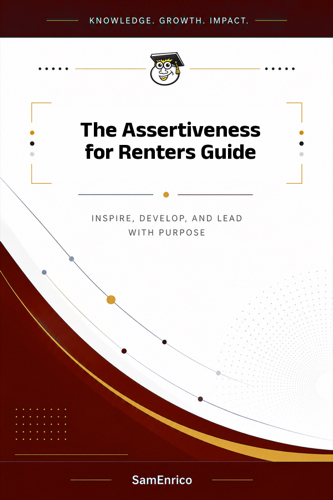
The Assertiveness for Renters Guide eBook
Request repairs and address landlord issues with f
by Holden Kory
Request repairs and address landlord issues with firm professionalism.
Formats
Free sample
Chapter 1: The Beggar’s Trap--–- You are not a beggar. You have never been a beggar. But somewhere along the way—perhaps the first time your landlord sighed when you mentioned the leak, or the first time a friend told you “just be grateful you have a roof”—you started acting like one.You started phrasing requests as questions. “Is there any chance you could look at the heater?” You started apologizing for things that weren’t your fault. “I’m so sorry to bother you, but the ceiling is collapsing.” You started waiting.
Waiting for permission. Waiting for a good time. Waiting until the problem became an emergency because you didn’t want to be “difficult.”This chapter is called The Beggar’s Trap, and it is the single most important concept in this entire book. Because until you see the trap for what it is, none of the scripts, letters, or legal tactics that follow will work. You can memorize every template in the Appendix.
You can cite the warranty of habitability backward and forward. But if you still believe, deep down, that asking for repairs is a favor you are requesting rather than a service you are owed, your voice will crack. Your letters will hedge. Your deadlines will be “whenever you get a chance.”And your landlord will smell it.Landlords are not mind readers, but they are pattern recognizers. They manage dozens or hundreds of tenants over the years, and they develop an intuitive sense for who will push back and who will fold.
The tenant who says “I’m so sorry to ask” gets put at the bottom of the list. The tenant who says “Per our lease and state law, I need a repair date within 72 hours” gets moved to the top. Not because the landlord loves the second tenant more, but because the second tenant has signaled something unmistakable: I know my rights, and I will use them.This chapter will rewire how you see your relationship with your landlord. It will take you from a mindset of scarcity and gratitude to a mindset of contract and professionalism. You will learn why rent is not charity, why your landlord is not doing you a favor, and why the most powerful word in your new vocabulary is not “please” but “per.” By the end of this chapter, you will be able to look at your apartment, your lease, and your landlord with new eyes—and you will never apologize for requesting a habitable home again.The Psychology of Passivity: Where It Comes From Let us be honest about something most self-help books dance around.
The passivity that renters feel is not irrational. It is not a character flaw. It is a learned response to a power imbalance that is very, very real.When you rent a home, you are entering a relationship with someone who has more money than you (typically), more legal resources than you (usually), and the ability to make you homeless with thirty days’ notice in some jurisdictions. That is terrifying. And the terror is not imaginary.
In most states, landlords can non-renew a lease for any reason or no reason at all. Even in states with “just cause” eviction laws, the process of defending yourself in court is expensive, exhausting, and humiliating.So your brain does something clever and profoundly self-defeating. It decides that the safest path is to be small. To not make waves. To trade your rights for the illusion of security.
You tell yourself: If I just don’t complain, maybe they will like me. Maybe they will renew my lease. Maybe they will ignore me for another year.This is what we call The Beggar’s Trap. You are not actually safer when you are passive. You are simply deferring the pain.
The leaky ceiling does not stop leaking because you are nice. The mold does not stop spreading because you are afraid to mention it. The only thing passivity buys you is time—time during which the problem gets worse, your health may decline, and your landlord learns exactly how much they can ignore you.Consider the research on tenant-landlord power dynamics. Studies consistently show that tenants who assert their rights in writing, with specific deadlines and citations of law, receive repairs 40-60 percent faster than tenants who make verbal requests or “polite” inquiries. Landlords prioritize based on perceived risk.
A tenant who knows the law and documents everything is a risk. A tenant who apologizes is not.The passivity you feel is understandable. But it is also a trap. And the first step out of the trap is to recognize that your landlord is not your parent, your benefactor, or your friend. Your landlord is a vendor.
You are a client. And the transaction between you is governed by a contract called a lease.Rent Is Not Charity: The Transaction Model Let us perform a simple mental experiment. Imagine you walk into a coffee shop and pay seven dollars for a latte. The barista takes your money, nods, and then does nothing. Thirty minutes pass.
An hour. You approach the counter and say, “Excuse me, I paid for a latte.” The barista sighs and says, “I’ll get to it when I can. You’re being very demanding.”Would you accept this? Of course not. You would ask for a manager.
You would demand a refund. You might even leave a one-star review. You would never, for one second, think: Maybe I should be more grateful. Maybe the barista has a lot on their plate. Maybe I’m being difficult.Now replace the latte with a habitable apartment.
Replace the seven dollars with fifteen hundred dollars. Replace the barista with your landlord. Why does the same logic feel different?It feels different because housing is emotional. Your apartment is not just a transaction; it is where you sleep, raise your children, store your belongings, and try to feel safe. When someone has power over your home, it feels personal.
And when it feels personal, you start acting like a supplicant rather than a client.But the lease is a contract. Contracts are not personal. They are agreements exchanging money for goods or services. In your case, you exchange rent for a habitable dwelling. That is the deal.
Not a “pretty good” dwelling. Not a dwelling that your landlord will fix “when they get around to it.” A habitable dwelling, as defined by your state’s housing code and the implied warranty of habitability, which we will explore in Chapter 3.When you pay rent, you have fulfilled your side of the contract. You are not asking for a favor when you request a repair. You are demanding performance of the other side of the bargain. This is not aggression.
This is not rudeness. This is contract enforcement.Repeat that to yourself until it sticks: Requesting a repair is not asking for a favor. It is enforcing a contract.The moment you internalize this, your entire tone will shift. You will stop saying “I was hoping you could…” and start saying “Per our lease, I need…” You will stop apologizing and start documenting. You will stop…
This is the end of the free sample. Get the eBook to keep going. Buy now
About this book
Details
- Author
- Holden Kory
- Publisher
- SamEnrico
- Language
- English
- Genre
- Non-Fiction, Self-Help, Housing
- Released
- 2026-06-08
- Pages (approx.)
- 145
- Available as
- eBook, Audiobook

Read better in the ZLOADR app
Your eBooks on your phone or tablet. Sign in with your SamEnrico account and start reading.
More by Holden Kory
 The Angry Parent Recovery PlanHolden Kory$11.99
 Portuguese Colonial WarsHolden Kory$11.99
 Empty Nest Relationship GuideHolden Kory$11.99
 From Immigrant To Ceo Success GuideHolden Kory$11.99
 Partner Emotion MirrorHolden Kory$11.99
 Money Illusion ExplainedHolden Kory$11.99
 Heidi Roizen TCVHolden Kory$11.99
 Government of India Act 1858Holden Kory$11.99
 The Last Telegram: The Secret War of the CodebreakersHolden Kory$11.99
 Black Gold & Blood: The Untold Story of the First Coffee HeistHolden Kory$11.99
 The Marble Phantoms: Canova’s Ghostly PerfectionHolden Kory$11.99
 Growing LiatrisHolden Kory$11.99
You may also like
 Hong Kong Handover 1997Dunn Johnnie$11.99
 Zumba For Postnatal Recovery CourseNeal Christian$11.99
 Zumba for BeginnersLadner Nikia$11.99
 YouTube Comment Mining GuideHumes Pandora$12.99
 Worry Box MeditationCarlin Rudy$11.99
 Workplace Stress MeditationNguyen Lynn$11.99
 Workplace Stress and Sleep RepairHawley Ivory$11.99
 Workplace Perfectionism CureDelaney Jeffry$11.99
 Workplace Injustice Anger GuideWallen Isabelle$11.99
 Work Addiction and Burnout LinkGreenwood Ester$11.99
 Women in Yoga and WellnessBeattie Galina$11.99
 Women in Stand Up ComedyChun Evangeline$11.99