

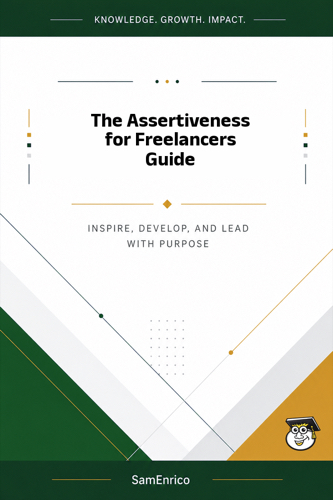
Non-FictionSelf-HelpFreelancing
The Assertiveness for Freelancers Guide eBook
Set rates, enforce contracts, and say no to scope
Set rates, enforce contracts, and say no to scope creep.
Formats
Free sample
Chapter 1: The Order Taker’s Graveyard--–- The email arrived at 11:47 PM on a Tuesday. Three words: “One more thing.” The client wanted a complete redesign of the logo they had already approved twice. The deadline was tomorrow morning. There was no budget for extra hours. And the freelancer—let’s call her Sarah—typed back four words that would change everything: “Of course.
No problem.” Then she closed her laptop, sat in the dark, and cried.Sarah is not lazy. She is not untalented. She is not naive. Sarah is a highly skilled graphic designer with a degree from a good school and five years of experience. She has worked with recognizable brands.
She pays her taxes on time. She has a website, a portfolio, and a steady stream of clients. By any external measure, Sarah is a successful freelancer.But Sarah is also broke.Not “I can’t afford a new car” broke. Not “I need to watch my spending this month” broke. Sarah is “I ate ramen for six consecutive days” broke.
She is “I missed my best friend’s wedding because I couldn’t afford the plane ticket” broke. She is “I have $14,000 in credit card debt and I add to it every month” broke. And she cannot figure out why.The math, on paper, makes no sense. Sarah charges $50 per hour. She works forty to fifty hours per week.
Fifty dollars times forty hours equals two thousand dollars per week, which is more than one hundred thousand dollars per year. That is solidly middle class. That is a life without ramen. That is a plane ticket to a wedding.But Sarah does not make one hundred thousand dollars. She made thirty-seven thousand dollars last year.
And she is exhausted.What happened to the missing sixty-three thousand dollars? The answer is not theft or fraud or bad luck. The answer is the subject of this entire book, and it begins with a single, devastating psychological trap that destroys more freelance careers than lack of skill, lack of work, or lack of talent combined.Sarah is an Order Taker. And this is her graveyard.The Scarcity Loop Let us rewind to the beginning of Sarah’s freelancing career. She quit her full-time agency job because she was tired of the commute, the open-plan office, and the creative director who took credit for her work.
She had saved six months of expenses. She had three clients lined up. She was ready.The first month was glorious. She worked from coffee shops. She slept until nine.
She felt alive.The second month, one client delayed their project. Another client paid two weeks late. The third client finished their work and had nothing else. Suddenly, Sarah’s pipeline was empty. She stared at her bank account.
She stared at her calendar. She stared at the ceiling at three in the morning.And then she heard about a potential client through a friend. A local restaurant needed a new menu design. The budget was small—two hundred dollars—but the work was easy. Sarah thought: “Something is better than nothing.” She took the job.That was the beginning of the loop.Here is how the Scarcity Loop works.
Step one: You fear that saying no will leave you with no work. Step two: You say yes to a job that pays poorly, has vague requirements, or comes from a difficult client. Step three: That job consumes your time, energy, and mental bandwidth—leaving you no room to market yourself, network, or pursue better opportunities. Step four: Your pipeline remains empty. Step five: The next low-quality job arrives.
And because you have no other options, you say yes again.The loop tightens with every rotation. The more bad jobs you accept, the less time you have to find good jobs. The less time you have to find good jobs, the more you depend on bad jobs. The more you depend on bad jobs, the more desperate you become. The more desperate you become, the lower your standards drop.
And the lower your standards drop, the more bad jobs you attract.Sarah did not start as a bargain-basement designer. She started as a professional with a degree and a portfolio. But after six months of the Scarcity Loop, her reputation had shifted. The clients who found her online saw her low prices, her rushed portfolios, and her availability for “quick projects.” The clients who could afford her never found her at all. She had been sorted into the algorithmic basement of the freelance economy, and she could not see the stairs.The Scarcity Loop is not a failure of character.
It is not laziness or stupidity or lack of ambition. It is a cognitive trap, wired into the human brain by millions of years of evolution. Our ancestors who said “no” to uncertain opportunities did not survive. Our ancestors who said “yes” to anything that might contain calories, shelter, or safety passed on their genes. The fear of scarcity—real or imagined—triggers the same neural circuits as the fear of physical danger.
When you say yes to a bad project because you are afraid of having no project at all, you are not being weak. You are being human.But being human does not pay the rent. And the Scarcity Loop, left unchecked, will drive you into the ground.The “Nice” Tax Sarah’s second trap is more subtle, and in some ways more destructive, than the Scarcity Loop. It is a trap that wears a friendly face. It is a trap that makes you feel virtuous while it picks your pocket.
It is the “Nice” Tax.The “Nice” Tax is the difference between what you earn and what you would earn if you stopped working for free. And if you think you do not work for free, think again. Every time you answer a “quick” client email that turns into a thirty-minute phone call, you are working for free. Every time you attend a “discovery meeting” that goes over by twenty minutes, you are working for free. Every time you deliver a revision beyond your agreed limit because you “don’t want to seem difficult,” you are working for free.
Every time you rush a deadline because the client changed their requirements at the last minute and you did not charge a rush fee, you are working for free.Sarah, by her own estimation, spent twenty hours per month on unpaid work. Twenty hours. That is half of a full-time workweek. Every month. At her stated rate of fifty dollars per hour, those twenty hours represented one thousand dollars in lost income.
Over the course of a year, that was twelve thousand dollars. That alone would have paid off most of her credit card debt.But Sarah’s “Nice” Tax was actually much higher, because her stated rate of fifty dollars per hour was fictional. After accounting for the unpaid hours, she was earning closer to twenty-five dollars per hour. And after accounting for taxes, health insurance, software subscriptions, and the other costs of running a business, her real take-home pay was closer to fifteen dollars per hour. That is below minimum wage…
This is the end of the free sample. Get the eBook to keep going. Buy now
About this book
Details
- Author
- Shook Santina
- Publisher
- SamEnrico
- Language
- English
- Genre
- Non-Fiction, Self-Help, Freelancing
- Released
- 2026-06-10
- Pages (approx.)
- 157
- Available as
- eBook, Audiobook

Read better in the ZLOADR app
Your eBooks on your phone or tablet. Sign in with your SamEnrico account and start reading.
More by Shook Santina
 Autism Partner Relationship GuideShook Santina$11.99
 Eisenhower For Side HustlesShook Santina$11.99
 Campbell's Winter CampaignShook Santina$11.99
 Immigrant Women Entrepreneurs Success GuideShook Santina$11.99
 Hospitality Emotion GuideShook Santina$11.99
 Anger And Child Anxiety TransferShook Santina$11.99
 Doctor Weight Bias NavigationShook Santina$11.99
 Reparenting Your Self EsteemShook Santina$11.99
 Fentanyl’s Shadow: The Silent Killer in Your Medicine CabinetShook Santina$11.99
 The Silk Road Tycoon: The Rise of Biyaa the Great of the SahelShook Santina$11.99
 The Clockmaker of Strasbourg: The Timekeeper Who Defied the UniverseShook Santina$11.99
 Machine Learning for UAV ApplicationsShook Santina$11.99
You may also like
 Hong Kong Handover 1997Dunn Johnnie$11.99
 Zumba For Postnatal Recovery CourseNeal Christian$11.99
 Zumba for BeginnersLadner Nikia$11.99
 YouTube Comment Mining GuideHumes Pandora$12.99
 Worry Box MeditationCarlin Rudy$11.99
 Workplace Stress MeditationNguyen Lynn$11.99
 Workplace Stress and Sleep RepairHawley Ivory$11.99
 Workplace Perfectionism CureDelaney Jeffry$11.99
 Workplace Injustice Anger GuideWallen Isabelle$11.99
 Work Addiction and Burnout LinkGreenwood Ester$11.99
 Women in Yoga and WellnessBeattie Galina$11.99
 Women in Stand Up ComedyChun Evangeline$11.99