
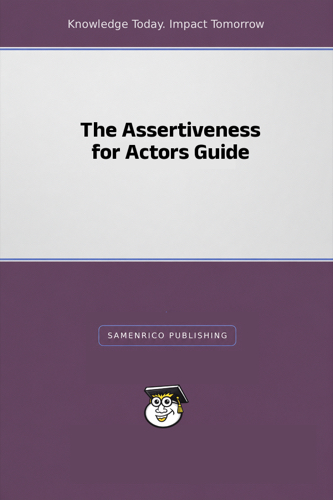
The Assertiveness for Actors Guide eBook
Audition confidently, handle rejection, and negoti
by Cline Tracey
Audition confidently, handle rejection, and negotiate contracts in entertainment industry.
Formats
Free sample
Chapter 1: The Waiting Trap--There is a specific flavor of silence that haunts every actor’s life. It is not the silence of an empty theater before a performance, which hums with possibility. It is not the silence of deep concentration before a monologue, which crackles with tension. No, this silence is the one that follows the words “we’ll be in touch.” It lives in the days between an audition and a callback, between a submission and a response, between a “we loved you” and a “we went another direction.” In that silence, most actors slowly drown.You know this silence. You have sat by your phone, willing it to ring.
You have refreshed your email four hundred times in a single afternoon. You have replayed every word you said in the room, analyzing each inflection, each gesture, each breath, searching for the exact moment you lost the part you never actually had. You have told yourself that if you just wait patiently enough, if you are just nice enough, if you just stay ready, someone will finally discover you.That belief – that waiting is the same as working, that passivity is professionalism, that discovery is a thing that happens to the deserving – is the most dangerous lie in the entertainment industry. And it is the first thing this book will ask you to unlearn.The Myth of Being Found Every acting class, every headshot photographer, every well-meaning mentor has fed you some version of the same fantasy. They tell you to “stay ready.” They tell you to “be patient.” They tell you that “your time will come.” And none of them are lying, exactly.
But they are omitting the crucial truth that separates working actors from struggling ones: no one is coming to save you.Casting directors are not talent scouts. They do not sit in their offices, rubbing their hands together, hoping to stumble upon greatness. They wake up every morning with a headache. The headache has a name: an unfilled role in a production that starts shooting in six weeks. The producer is calling them.
The director is calling them. The network is calling them. They need to solve a problem, and they need to solve it yesterday.You are not being evaluated as a human being when you walk into that room. You are being evaluated as a potential solution to a very specific, very urgent problem. The casting director is thinking: does this person look like the character?
Can they deliver the emotional range required? Will they be easy to work with? Will they show up on time? Do they fit the budget? That is it.
That is the entire list.When you understand this – truly understand it, bone-deep – your entire relationship to auditions changes. You stop begging. You start offering. You stop hoping they like you. You start solving their problem.The Difference Between Passivity and Professionalism Here is a question that will determine the trajectory of your career: when you walk into an audition room, what are you thinking?If you are thinking “I hope they like me,” you are already at a disadvantage.
That thought leaks out of your body in a thousand tiny ways. It softens your posture. It hurries your speech. It makes you smile when you should not smile, nod when you should question, agree when you should clarify. The casting director may not be able to articulate what feels different about you, but they feel it.
Neediness has a smell.If you are thinking “I am solving their problem,” you radiate a completely different energy. You stand differently. You speak more slowly. You take up space. You make choices that are clear and specific because you are not trying to please everyone – you are trying to be useful to one specific person with one specific need.This is not about being arrogant.
It is not about pretending you do not want the job. Of course you want the job. But wanting and needing are not the same thing. The actor who needs the job begs. The actor who wants the job offers.
The actor who offers gets hired.Professionalism, in this industry, is not about being quiet and flexible and endlessly agreeable. That is passivity dressed up in a blazer. Real professionalism is about knowing what you bring, knowing what you are worth, and knowing that the room needs you as much as you need them.The Small Business Owner Mindset Let me say something that will sound harsh but is actually liberating: you are not an artist waiting for a patron. You are a small business owner. Your product is your unique combination of skills, appearance, energy, and reputation.
Your customers are casting directors, producers, and directors. Your sales pipeline is your audition process. Your profit margin is your rate minus your expenses.Most actors recoil from this framing. They say things like “acting is art, not commerce” or “I don’t want to think of myself as a product.” I understand the instinct. But here is the truth: the people hiring you think of you as a product.
They have a role to fill. They are comparing you to other options. They have a budget. They have a schedule. If you refuse to think in these terms, you are not protecting your artistry – you are surrendering your agency.Every successful business owner knows three things about their product: what it is, who needs it, and what it is worth.
You need to know the same three things.What is your product? Not “I’m an actor who can do anything.” That is not a product. That is a wish. A product is specific: “I am the actress in her thirties who plays exhausted but competent mothers.” “I am the actor in his twenties who plays charming liars you almost trust.” “I am the character actor in their forties who plays quiet villains.” Specificity is not limiting. Specificity is how you get remembered.Who needs your product?
Which casting directors regularly cast roles like yours? Which production companies make the kind of projects you fit into? Which agents specialize in your type? These are not rhetorical questions. You should be able to name names.What is your product worth?
This is the hardest question for most actors, because the industry has trained you to believe that you should be grateful for anything. But gratitude without a floor is exploitation. You need a number. We will calculate it together in Chapter Eight. For now, just know that you need one.Your Unique Selling Proposition In marketing, there is a concept called the Unique Selling Proposition, or USP.
It is the one thing that makes your product different from every other product on the market. For actors, your USP is not “I’m versatile” or “I take direction well” or “I’m easy to work with.” Every actor says those things. They are table stakes, not differentiators.Your USP is the specific intersection of your look, your energy, your skills, your life experience, and your instincts that no one else can replicate. It is the thing that makes a casting director say, “Ah, that’s our person” instead of “Well, they’ll do.”Here is…
This is the end of the free sample. Get the eBook to keep going. Buy now
About this book
Details
- Author
- Cline Tracey
- Publisher
- SamEnrico
- Language
- English
- Genre
- Non-Fiction, Self-Help, Acting
- Released
- 2026-06-06
- Pages (approx.)
- 145
- Available as
- eBook, Audiobook

Read better in the ZLOADR app
Your eBooks on your phone or tablet. Sign in with your SamEnrico account and start reading.
More by Cline Tracey
 Metta For Disabled PersonsCline Tracey$11.99
 Road Rage In Carpool LanesCline Tracey$11.99
 The Spanish Inquisition ManualCline Tracey$11.99
 Slack Message Rage GuideCline Tracey$11.99
 The Pillars of Heaven: The Gothic Cathedral BuildersCline Tracey$11.99
 Understanding PhthiriophobiaCline Tracey$17.99
 AI-Driven Marketing AutomationCline Tracey$11.99
 Quantum Computing MapCline Tracey$12.99
 VA Training Manual TemplatesCline Tracey$12.99
 How to Start a Buttons Made of Glass Business (Beginners Guide)Cline Tracey$11.99
You may also like
 Hong Kong Handover 1997Dunn Johnnie$11.99
 Zumba For Postnatal Recovery CourseNeal Christian$11.99
 Zumba for BeginnersLadner Nikia$11.99
 YouTube Comment Mining GuideHumes Pandora$12.99
 Worry Box MeditationCarlin Rudy$11.99
 Workplace Stress MeditationNguyen Lynn$11.99
 Workplace Stress and Sleep RepairHawley Ivory$11.99
 Workplace Perfectionism CureDelaney Jeffry$11.99
 Workplace Injustice Anger GuideWallen Isabelle$11.99
 Work Addiction and Burnout LinkGreenwood Ester$11.99
 Women in Yoga and WellnessBeattie Galina$11.99
 Women in Stand Up ComedyChun Evangeline$11.99