
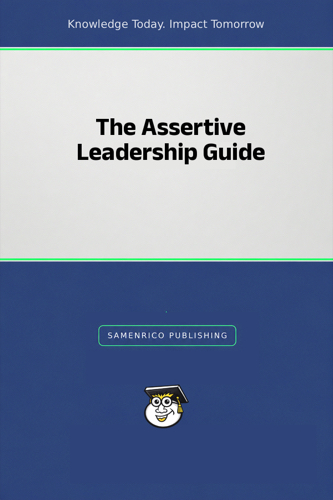
Non-FictionSelf-HelpLeadership
The Assertive Leadership Guide eBook
Lead teams with clear direction not intimidation o
Lead teams with clear direction not intimidation or bullying.
Formats
Free sample
Chapter 1: The Obedience Trap--–- Every Monday morning, Jordan sat in her car for exactly seven minutes before walking into the office. Not because she was checking emails. Not because she was preparing her thoughts. She was bracing herself. The pit in her stomach had become so familiar over eighteen months as a senior product manager that she had stopped wondering whether it was normal.
She assumed leadership just felt this way.Her boss, Marcus, was not a screamer. He never threw things, never cursed in meetings, never made personal insults that crossed an obvious line. Marcus was worse than a screamer. He was a master of the strategic silence—the long pause after someone spoke, followed by a quiet "Interesting" that said everything. He was the king of the public correction delivered as a question: "Jordan, did you really think that dashboard was ready for the client?" He never yelled.
He just made sure everyone in the room knew who was in charge and that stepping out of line would be remembered.Jordan had learned to adapt. She stopped bringing creative ideas to meetings—too risky. She started sending Marcus drafts of everything at least two days early so he could "suggest improvements" that she would then implement verbatim. She stopped pushing back on impossible deadlines. She stopped telling him when her team was struggling.
She just worked harder, longer, quieter.Her team noticed. The junior designers stopped asking questions. The engineers stopped proposing alternative solutions. Everyone just waited for Marcus's stamp of approval, then executed. On paper, they were hitting targets.
But Jordan knew something was wrong. No one laughed anymore. No one debated ideas. Meetings were monologues punctuated by nervous nods.Then Jordan got a new boss. Marcus was promoted sideways—someone else's problem now—and in walked Priya, a leader from a different division.
Priya did not scream either. But she also did not do the strategic silence. In her first week, she asked Jordan directly: "What would you do differently if there were no consequences?"Jordan froze. The question was so foreign that her brain took ten seconds to process it. Then she said something she had never said to Marcus: "Our development timeline is unrealistic.
We're going to burn out the engineers before launch. We need to push the deadline by two weeks or cut three features."Priya nodded. "Okay. Show me the data. If you're right, we'll move the date."Jordan spent the next hour preparing a presentation she would never have dared show Marcus.
The next morning, Priya looked at the evidence, agreed, and announced the timeline change to the entire department. She gave Jordan full credit for raising the issue.Jordan's team was stunned. One engineer pulled her aside: "Wait, we're allowed to say no to deadlines now?" Another designer said, "I thought you were just the messenger. I didn't realize you actually agreed with us."That was the moment Jordan understood the difference between fear and clarity. Marcus had never intended to be cruel.
He thought he was being efficient—setting high standards, not tolerating mediocrity, keeping everyone sharp. But his version of "tough" had produced something far worse than low performance. It had produced compliance without commitment. His team did what he asked, but they stopped thinking, stopped caring, stopped bringing their full selves to work.This chapter is about the cost of that trade-off. It is about the leadership spectrum that runs from passivity to assertiveness to aggression—and why most leaders who think they are "assertive" are actually operating in the aggressive zone without realizing it.
It is about the data proving that fear-based leadership destroys psychological safety, which in turn destroys innovation, retention, and ultimately results. And it is about the first step out of the obedience trap: learning to distinguish clarity from control.The Spectrum You Were Never Taught Most leaders believe there are two ways to lead: nice or mean. Passive or aggressive. Pushover or jerk. This binary is false and dangerous.
Between passivity and aggression lies a third path—assertiveness—and it requires a completely different set of skills than either of the extremes.Passive Leadership The passive leader avoids conflict, tolerates underperformance, and prioritizes being liked over being effective. They say "yes" when they mean "no." They delay hard conversations until problems become crises. They give vague feedback like "good job" or "let's think about that" when what they really mean is "that won't work, and I'm frustrated you didn't see it."Passive leadership does not feel dangerous. It feels nice. But it is a form of neglect.
Teams under passive leaders flounder without direction, waste time on low-priority work, and eventually resent the leader for not protecting them from chaos. The passive leader is not kind. They are absent.Aggressive Leadership The aggressive leader uses fear as a tool. They may scream, threaten, humiliate, or simply deploy the kind of strategic silence Marcus mastered. They believe that intimidation drives accountability—that people work harder when they are afraid of the consequences of failure.Aggressive leadership produces short-term results.
People jump when you yell. They work late when you imply their jobs are at risk. But the costs are staggering and well-documented. Teams under aggressive leaders hide mistakes, stop innovating, and spend a significant portion of their cognitive energy on self-protection rather than problem-solving. The aggressive leader confuses compliance with commitment—and eventually, the best people leave.Assertive Leadership The assertive leader occupies the middle ground that most leaders never knew existed.
They are clear, direct, and firm without being personal, hostile, or intimidating. They set high standards and hold people accountable, but they do so with respect and transparency. They deliver hard feedback without making it about the person's worth. They say "no" to bad ideas without making the idea's advocate feel stupid.Assertive leadership is harder than either passivity or aggression. It requires emotional regulation, situational awareness, and a tolerance for discomfort that passive leaders avoid and aggressive leaders outsource to their targets.
But it produces the only sustainable form of high performance: teams that trust their leader, challenge each other productively, and bring their full intelligence to work every day.The problem is that most leaders who think they are assertive are actually aggressive. They have never seen assertiveness modeled. They have been told to be "tough" but never taught the difference between toughness and intimidation. They mistake volume for conviction, silence for respect, and fear for focus.Jordan had assumed Marcus was assertive. He was direct.
He had high standards. He didn't tolerate excuses. That sounded like assertiveness on paper. But in practice, his directness landed as intimidation because of one missing ingredient: trust.Psychological Safety: The Invisible Architecture of Performance In the late 1990s, a Harvard researcher named Amy Edmondson began studying medication errors in hospitals. She expected to find that the best teams—the most cohesive, the most experienced—made the fewest mistakes.
What she found was the opposite. The best teams reported more errors, not fewer.This paradox led to one of the most important discoveries in organizational psychology: psychological safety. The difference between high-performing teams and low-performing teams was not the frequency of errors. It…
This is the end of the free sample. Get the eBook to keep going. Buy now
About this book
Details
- Author
- Keating Margeret
- Publisher
- SamEnrico
- Language
- English
- Genre
- Non-Fiction, Self-Help, Leadership
- Released
- 2026-06-10
- Pages (approx.)
- 99
- Available as
- eBook, Audiobook

Read better in the ZLOADR app
Your eBooks on your phone or tablet. Sign in with your SamEnrico account and start reading.
More by Keating Margeret
 Sebastian Vettel Record BreakerKeating Margeret$11.99
 Metric System French Revolution Origins HandbookKeating Margeret$11.99
 Talent Acquisition WorkbookKeating Margeret$11.99
 The Divorce Anger Release GuideKeating Margeret$11.99
 The Nobel Code: Black Geniuses Who Rewrote ScienceKeating Margeret$11.99
 How to Start a Mussel Production, Marine Business (Beginners Guide)Keating Margeret$11.99
 Chinese Supplier Red FlagsKeating Margeret$12.99
 Preprint and Thesis SubstitutionKeating Margeret$12.99
 Understanding Syndactyly Cataract Mental RetardationKeating Margeret$17.99
 Firearms Sales OutfitterKeating Margeret$11.99
You may also like
 Hong Kong Handover 1997Dunn Johnnie$11.99
 Zumba For Postnatal Recovery CourseNeal Christian$11.99
 Zumba for BeginnersLadner Nikia$11.99
 YouTube Comment Mining GuideHumes Pandora$12.99
 Worry Box MeditationCarlin Rudy$11.99
 Workplace Stress MeditationNguyen Lynn$11.99
 Workplace Stress and Sleep RepairHawley Ivory$11.99
 Workplace Perfectionism CureDelaney Jeffry$11.99
 Workplace Injustice Anger GuideWallen Isabelle$11.99
 Work Addiction and Burnout LinkGreenwood Ester$11.99
 Women in Yoga and WellnessBeattie Galina$11.99
 Women in Stand Up ComedyChun Evangeline$11.99