
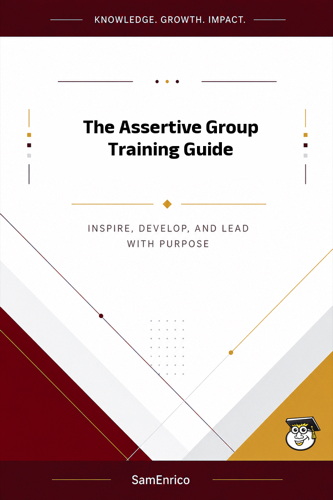
The Assertive Group Training Guide eBook
Lead assertiveness workshops teaching differences
by Vega Wilbert
Lead assertiveness workshops teaching differences from aggression.
Formats
Free sample
Chapter 1: The Behavioral Mirror--–- The first thing you must understand before you ever stand in front of a group is this: you cannot teach what you do not embody.Every facilitator of assertiveness training carries an invisible script. That script was written not in a textbook but in the hundreds of small interactions that shaped your default responses to conflict, requests, and pressure. If your default is to raise your voice when someone challenges you, you will teach aggression no matter how many "I" statements you put on a Power Point slide. If your default is to shrink, apologize, or over-explain when someone pushes back, you will teach passivity no matter how many times you say the word "boundaries." The group will not remember what you said. They will remember how you made them feel.
And they will mirror you.This chapter is not a gentle warm-up. It is the first and most difficult challenge you will face as an assertiveness facilitator: looking into the behavioral mirror and honestly naming what you see. Only after you have done that can you effectively teach others to do the same.The Hidden Truth About Assertiveness Training Most people come to assertiveness training because they want a set of techniques. They want scripts, phrases, and strategies they can deploy when someone cuts in line or a coworker takes credit for their work. These tools exist, and this book will give you many of them.
But techniques alone are like giving someone a map without teaching them how to read it. They may hold it correctly, but they will still get lost.The hidden truth is that assertiveness is not primarily a set of external behaviors. It is an internal orientation. It is the belief that you matter as much as everyone else—but not more. It is the ability to tolerate the discomfort of conflict without fleeing into passivity or fighting into aggression.
It is the practice of pausing when every instinct screams at you to react.If you do not hold this orientation yourself, your participants will sense it immediately. They may not be able to name what feels wrong, but they will feel it. They will experience you as inauthentic. They will test you. And, most damagingly, they will learn that assertiveness is just another performance—something you put on like a costume and take off when no one is watching.This is why Chapter 1 exists before any technique, any curriculum, any role-play.
You must become the change before you facilitate it.The Three-Personality Continuum: Where Do You Live?Before we can map the territory for your participants, you must map it for yourself. The behavioral continuum consists of three distinct positions: passivity, aggression, and assertiveness. Most people believe they know which one they are. Most people are wrong.Passivity: The Silence That Screams Passivity is the systematic violation of your own rights. It is the decision—often made in milliseconds, often unconsciously—to suppress your honest feelings, needs, or boundaries in order to avoid conflict, preserve a relationship, or maintain the illusion of being "nice." The passive person says "it's fine" when it is not fine.
They say "don't worry about it" while secretly building a ledger of resentments. They agree to projects they cannot complete, then stay up late seething. They apologize for having needs.The passive style is often mistaken for kindness. It is not kindness. It is fear dressed in politeness.The hidden costs of passivity:Passivity appears safe, but it is one of the most destructive behavioral patterns over time.
The passive person pays in ways that are not immediately visible:Physical health: Chronic suppression of emotions is linked to hypertension, weakened immune function, and increased inflammation. The body keeps the score, even when the mouth stays silent.Relationships: Passive people often experience one-sided relationships where their needs go unmet. They attract people who are happy to take, because the passive person never says no. Over time, this breeds contempt on both sides.Professional trajectory: Passive employees are passed over for promotions, given the worst assignments, and paid less. Research shows that people who cannot advocate for themselves earn significantly less over their lifetimes than equally skilled assertive peers.Internal damage: The most insidious cost is self-respect.
Every time a passive person betrays their own needs, they send a message to themselves: you don't matter. After thousands of repetitions, they believe it.Common passive statements and their hidden meanings:What they say What they actually mean What they are afraid of"Oh, it's fine, don't worry about it.""It's not fine, but I'm afraid you'll be angry if I say so."Conflict, rejection"I guess I could do that if you need me to.""I really don't want to, but I don't trust my no."Disappointing others"No, you go ahead.""I matter less than you."Being seen as selfish"It's probably my fault anyway.""I've learned to preemptively accept blame to avoid arguments."Punishment, abandonment The internal experience of passivity:A passive person feels a tightness in the chest when asked for something they do not want to give. They hear a small voice saying "I don't want to" and immediately override it with a louder voice saying "but you should." They leave the interaction feeling hollow, vaguely angry, and uncertain why. They replay the conversation in their head for hours, inventing the assertive responses they wish they had given. They never actually give them.The passive facilitator:A facilitator who defaults to passivity will lose the group.
Participants will interrupt them. They will go off-topic. They will refuse to do exercises. The passive facilitator will say "that's okay" when it is not okay. They will laugh nervously when challenged.
They will end sessions early because they cannot manage conflict. Their participants will learn that assertiveness is weak because the person teaching it appears weak.Aggression: The Domination Disguised as Honesty Aggression is the systematic violation of others' rights. It is the expression of feelings, needs, or opinions in a way that dominates, humiliates, threatens, or dismisses the other person. The aggressive person believes—often unconsciously—that their needs matter more, that their perspective is correct, and that the other person's job is to get out of the way.Aggression is frequently rewarded in corporate and social settings. The loudest voice in the meeting gets heard.
The person who talks over others gets their idea adopted. The manager who yells gets the report delivered. These short-term rewards create a powerful reinforcement loop: aggression produces results, so the aggressive person doubles down. What they do not see is the wreckage behind them: the silent employees who have checked out, the family members who have learned to lie, the slow erosion of trust that eventually collapses.The hidden costs of aggression:Aggression feels powerful in the moment, but it extracts a heavy toll:Relationships: Aggressive people have fewer close friendships, higher divorce rates, and children who distance themselves as adults. People comply with aggression but they do not trust it.Professional ceiling: While aggression can lead to short-term promotions, it creates a ceiling.
People who are promoted into leadership often fail when their aggressive style alienates the very teams they need to lead.…
This is the end of the free sample. Get the eBook to keep going. Buy now
About this book
Details
- Author
- Vega Wilbert
- Publisher
- SamEnrico
- Language
- English
- Genre
- Non-Fiction, Self-Help, Training
- Released
- 2026-06-06
- Pages (approx.)
- 131
- Available as
- eBook, Audiobook

Read better in the ZLOADR app
Your eBooks on your phone or tablet. Sign in with your SamEnrico account and start reading.
More by Vega Wilbert
 Emotion Exposure DBT WorkbookVega Wilbert$11.99
 Kevin Harvick Closer StoryVega Wilbert$11.99
 Dreams Of The Deceased In TraumaVega Wilbert$11.99
 The Grocery Store Memory PalaceVega Wilbert$11.99
 Flintlocks and Fire: The Birth of the Modern Infantry (1704)Vega Wilbert$11.99
 How to Start a Window Treatment Store BusinessVega Wilbert$11.99
 Chinese Supplier Success StoriesVega Wilbert$12.99
 Professional Doctorate Without PapersVega Wilbert$12.99
 Understanding SynovitisVega Wilbert$17.99
 Highway Design EngineerVega Wilbert$11.99
You may also like
 Priority Matrix TrainingDarby Johnie$11.99
 Remote Communication TrainingKurtz Linnea$11.99
 Anger De escalation TrainingIrvine Jeannine$11.99
 The Training Delivery HandbookGerber Arcelia$11.99
 NVC Trainer Certification GuideHadden Nannie$11.99
 Remote Lunch and Learn GuideBlunt Shizue$11.99
 Chunking Training MaterialsPeacock Dawna$11.99