

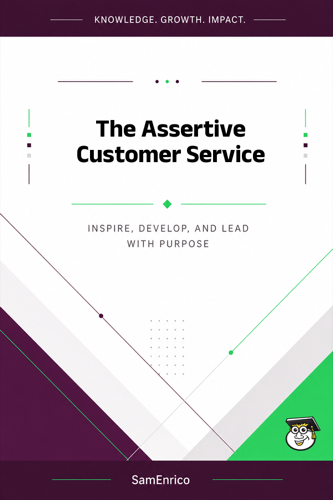
The Assertive Customer Service eBook
Set boundaries with abusive customers without esca
by Burk Ilse
Set boundaries with abusive customers without escalating conflict.
Formats
Free sample
Chapter 1: The Punching Bag Economy--–- The headset clicks. A deep breath. Then the voice comes through, sharp and raw: "You people are absolutely useless. I've been on hold for twenty minutes, and now I get you? I want your manager.
No—I want your CEO. And I hope your children die."The agent, let's call her Maya, has been in this call center for eleven months. She has heard variations of this before. The "you people." The threats to her job. The personal insults.
But this—the mention of her children—lands differently. Her youngest started kindergarten last week. For three seconds, Maya says nothing. Her trainer once told her that silence is a technique. But this silence is not strategic.
It is the silence of a human being trying not to cry.She does what she was trained to do. She apologizes. She does not hang up. She does not set a boundary. She says, "I'm so sorry you feel that way.
Let me see what I can do about your billing issue." She solves the problem in four minutes. The customer hangs up without a thank-you. Maya takes off her headset, stares at her screen, and wonders if she can afford to quit.This scene is not an outlier. It is not a worst-case scenario. It is Tuesday.Across the world, millions of customer service workers—in call centers, retail stores, hotels, airports, hospitals, and restaurants—are told a lie every single day.
The lie is this: the customer is always right. And because the customer is always right, you must absorb whatever they throw at you. The yelling. The insults. The threats.
The dehumanization. Your job, the lie says, is to smile, apologize, and fix the problem while your nervous system floods with cortisol and your sense of self erodes one call at a time.This book exists because that lie is destroying people.But there is another way. There is a path between the two poles that define most customer service jobs today: passive submission ("I'll take any abuse to keep my job") and aggressive confrontation ("You're an idiot, hang up"). That path is called assertiveness. And assertiveness is not rudeness.
It is not coldness. It is not defiance. Assertiveness is the professional, respectful, and powerful act of stating your needs clearly, protecting your emotional safety, and inviting cooperation—all while solving the customer's problem.This chapter will name the myth, draw the crucial line between difficult customers and abusive ones, quantify the hidden costs of silence, and define assertiveness once and for all. By the end of this chapter, you will understand why everything you were taught about customer service might have been exactly wrong—and why a different future is possible.The Origins of the Lie The phrase "the customer is always right" did not emerge from customer service research or employee wellness studies. It emerged from retail in the early 1900s, popularized by Harry Gordon Selfridge, Marshall Field, and John Wanamaker—department store magnates who wanted to differentiate their businesses in an era of increasing competition.
The logic was simple and, for its time, revolutionary: if you want people to spend money in your store, you should treat them like royalty. Refunds without questions. Smiles without limits. The customer's word as final.In a world where most retail transactions were adversarial—caveat emptor, let the buyer beware—this was genuine progress. It built loyalty.
It created repeat business. It made shopping feel safe.But somewhere along the way, the phrase metastasized. What began as a business strategy about returns and satisfaction became a moral commandment about hierarchy and deference. The customer is not just right about the product; the customer is right about everything. The customer is right to yell.
The customer is right to insult. The customer is right to threaten. And the employee's job is to take it.This distortion did not happen by accident. It happened because the phrase serves a convenient purpose for companies: it shifts all the emotional labor onto frontline workers while absolving management of the need to protect them. If the customer is always right, then any conflict is automatically the employee's fault.
If the employee is unhappy, the employee is the problem. The company does not need to change its policies, its training, or its support systems. It just needs to hire more resilient people.But resilience is not a bottomless well. And as we will see, the costs of this lie are staggering.The Crucial Distinction: Difficult vs. Abusive Before we go any further, we must draw a line.
This line is the foundation of everything that follows in this book. Not all angry customers are the same. And treating them as if they are is the first mistake that leads to burnout.A difficult customer is angry because of a legitimate problem. Their package arrived late. Their bill has an error.
Their hotel room was not ready at check-in. Their software crashed. Their food was cold. These are real problems, and the customer's frustration is understandable. The difficult customer may raise their voice.
They may use sharp language. They may demand to speak to a manager. But their anger is tethered to a solvable issue. And crucially, when that issue is resolved, the anger dissipates. The difficult customer wants a solution, not a surrender.An abusive customer, by contrast, uses yelling, personal insults, threats, or power plays to dominate the interaction.
Their goal is not resolution but domination. The abusive customer may start with a legitimate complaint—a late package, a billing error—but they quickly move beyond the facts into personal attacks. "You're useless." "You must be stupid to work there." "I hope you lose your job." "I know where your office is." These are not expressions of frustration. They are weapons.The difference is not in volume. A difficult customer can shout.
The difference is in target. The difficult customer shouts about the problem. The abusive customer attacks the person.Here is a simple test: If you solved the customer's problem right now, would they thank you and move on? If yes, they are difficult. If no—if they would find something else to be angry about, or if they continue the personal attacks even after the issue is resolved—they are abusive.This distinction matters because the strategies in this book are calibrated differently.
For the difficult customer, de-escalation and problem-solving are usually enough. For the abusive customer, you need boundaries, consequences, and sometimes termination of the interaction. One of the great failures of traditional customer service training is that it treats all anger as the same. It tells agents to "smile and apologize" whether the customer is frustrated about a late delivery or threatening violence. This is not just ineffective.
It is dangerous.The Hidden Cost of Silence For decades, companies have operated under a silent assumption: tolerating customer abuse is cheaper than preventing it. The logic goes like this: if we fire an abusive customer, we lose their revenue. If we let our agents hang up on rude customers, we might lose customer satisfaction scores. If we publicly announce a no-abuse policy, we might look "anti-customer." Better to…
This is the end of the free sample. Get the eBook to keep going. Buy now
About this book
Details
- Author
- Burk Ilse
- Publisher
- SamEnrico
- Language
- English
- Genre
- Non-Fiction, Self-Help, Customer
- Released
- 2026-06-07
- Pages (approx.)
- 151
- Available as
- eBook, Audiobook

Read better in the ZLOADR app
Your eBooks on your phone or tablet. Sign in with your SamEnrico account and start reading.
More by Burk Ilse
 Candidate Experience BenchmarksBurk Ilse$11.99Candidate Experience BenchmarksBurk Ilse$11.99
 Battle Of Leipzig Nations Battle CourseBurk Ilse$11.99
 The Child Circadian Rhythm GuideBurk Ilse$11.99
 Wise Mind Decision Making GuideBurk Ilse$11.99
 The Dragon Tamer of the Black ForestBurk Ilse$11.99
 How to Become a Staff ToxicologistBurk Ilse$11.99
 Extrusion Blow Molding TechnicianBurk Ilse$11.99
 Price Negotiation Chinese GuideBurk Ilse$12.99
 Data Asset Valuation GuideBurk Ilse$12.99
 Understanding Symphalangism BrachydactylyBurk Ilse$17.99
You may also like
 Hong Kong Handover 1997Dunn Johnnie$11.99
 Zumba For Postnatal Recovery CourseNeal Christian$11.99
 Zumba for BeginnersLadner Nikia$11.99
 YouTube Comment Mining GuideHumes Pandora$12.99
 Worry Box MeditationCarlin Rudy$11.99
 Workplace Stress MeditationNguyen Lynn$11.99
 Workplace Stress and Sleep RepairHawley Ivory$11.99
 Workplace Perfectionism CureDelaney Jeffry$11.99
 Workplace Injustice Anger GuideWallen Isabelle$11.99
 Work Addiction and Burnout LinkGreenwood Ester$11.99
 Women in Yoga and WellnessBeattie Galina$11.99
 Women in Stand Up ComedyChun Evangeline$11.99