
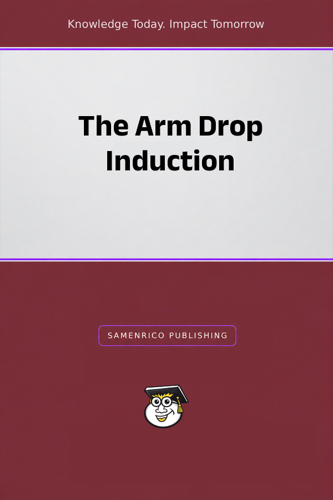
The Arm Drop Induction eBook
Suggest your arm is too heavy to hold up and will
Suggest your arm is too heavy to hold up and will drop as trance deepens.
Formats
Free sample
Chapter 1: The Silent Lever--–- You have already used the arm drop. Not as a hypnotist. Not as a practitioner. But as a human being. Think back to the last time you were exhausted—truly exhausted, after a long flight, a sleepless night, or a physical ordeal.
You sat down. You let your arms rest on the armrests or your thighs. And without any instruction, without any suggestion, they felt heavy. Dense. Pulled downward by an invisible force.
That feeling—that automatic, involuntary heaviness—is the seed of every arm drop induction in this book. You have already experienced it. You already know the mechanism from the inside. This chapter simply gives that mechanism a name, a map, and a method for turning it from a passive sensation into an active tool for trance.The ideodynamic principle, introduced briefly in the preface, deserves a deeper examination before we ever ask a subject to drop an arm. The term comes from the Greek idea (form or pattern) and dynamis (power or force).
An ideodynamic response is any physical movement or sensation that arises directly from an idea, without conscious effort or deliberate muscular action. When you imagine biting into a sour lemon, your mouth waters. That is ideodynamic. When you vividly recall a frightening moment, your heart rate increases. That is also ideodynamic.
And when you simply entertain the thought my arm is becoming heavy, the muscle spindles in your biceps and triceps begin to adjust their resting tension, and the arm genuinely, measurably, gains weight.Most people misunderstand this mechanism. They believe that hypnosis requires a special state, a ritual, a swinging watch, or a particular tone of voice. They believe that the arm drop is a trick or a表演. But the arm drop works before trance, during trance, and even in the complete absence of any formal induction. It works because the human nervous system is wired to translate expectation into action.
That is not mysticism. That is neurology.The Muscle Spindle Discovery To understand why the arm drop is so reliable, we must go inside the muscle. Every skeletal muscle in your body contains specialized sensory receptors called muscle spindles. These spindles run parallel to the main muscle fibers and measure two things: stretch and rate of stretch. When a muscle lengthens, the spindles fire signals to the spinal cord and brain, saying in effect, This muscle is being pulled longer.
We need to resist or adjust.Under normal voluntary movement, the brain sends commands to the muscle fibers to contract, and the spindles report back on how well that contraction is going. But under ideodynamic conditions—that is, when you simply hold an expectation of heaviness—the brain does something different. It sends inhibitory signals to the gamma motor neurons that control the spindles themselves. The spindles become less sensitive to stretch. They stop resisting gravity.
The muscle fibers relax without any conscious command to relax. The result is a slow, smooth, involuntary lengthening of the muscle as gravity pulls the limb downward.This is not muscle fatigue. Fatigue produces a jerky, uneven, sometimes trembling descent because the muscle fibers are exhausted and firing randomly. The ideodynamic drop is smooth, continuous, and eerily even. It looks like something is pulling the arm down from inside—which, in a sense, is exactly what is happening.
The expectation of heaviness has temporarily disabled the muscle’s natural anti-gravity reflex.Researchers have measured this effect using electromyography (EMG). When a subject is told to expect heaviness—without any hypnosis, without any trance induction—the EMG reading shows a measurable decrease in muscle spindle activity within seconds. The effect is small at first, then grows as the subject continues to hold the expectation. After about thirty seconds, the arm has typically dropped an inch or two. After ninety seconds, most subjects have dropped all the way to the armrest or thigh.This is the silent lever.
A thought changes a muscle. A muscle changes a position. A position changes a perception. And a perception changes the state of the nervous system. That is the chain of events we will exploit in every subsequent chapter.The Reticular Activating System as Gatekeeper The muscle spindle mechanism does not operate in a vacuum.
It is regulated by a structure deep in the brainstem called the reticular activating system, or RAS. The RAS is sometimes called the gateway to consciousness because it filters sensory information, deciding what reaches your awareness and what does not. But the RAS also filters motor intentions. It decides which internal signals are strong enough to become physical actions.When you think, my arm is heavy, that thought generates a neural signal. The RAS evaluates that signal against competing signals: the feeling of the chair against your back, the sound of the air conditioner, the memory of what you had for breakfast.
If the RAS judges the heaviness signal to be relevant and important, it amplifies that signal and sends it onward to the motor cortex. If the RAS judges the signal to be weak or unimportant, it attenuates it, and the arm does not move.This is why some subjects feel heaviness immediately while others require pacing. The RAS of a highly anxious person is already overloaded with threat signals. A new signal—heaviness—has to compete with a dozen other sensations. The RAS of a relaxed person, by contrast, has bandwidth to spare.
The heaviness signal gets through quickly and clearly.The clinical implication is profound. You do not need to fight the RAS. You need to work with it. You need to reduce competing signals before you introduce the heaviness suggestion. That is why pre-induction framing (Chapter 2) and calibration (Chapter 2) are not optional flourishes.
They are mechanical necessities. You are clearing the gateway so that a single signal—heaviness—can pass through unopposed.Expectation as the Active Ingredient The most important word in this chapter is expectation. Not belief. Not faith. Not trust.
Expectation.Belief is cognitive. It involves analysis, judgment, and often resistance. Do I believe this will work? That question activates the critical factor, the part of the mind that compares new information against old categories. When a subject says, I do not believe in hypnosis, they are not saying the arm drop will fail.
They are saying their belief system does not currently include hypnosis as a valid category. But expectation bypasses belief.Expectation is pre-cognitive. It is the raw, automatic prediction your nervous system makes about the next moment. When you sit in a chair, you do not believe it will hold you. You expect it to hold you.
That expectation is built into your posture, your muscle tone, your breathing. You do not decide to relax into the chair. You simply relax, because your nervous system has already predicted support.The arm drop works the same way. When you say to a subject, Your arm will become heavy and drop, you are not asking them to believe anything. You are inviting their nervous system to make a prediction.
What will happen next? Probably heaviness. Probably a drop. And that prediction, that expectation, triggers the ideodynamic response. The arm drops because the nervous system…
This is the end of the free sample. Get the eBook to keep going. Buy now
About this book
Details
- Author
- Tackett Argentina
- Publisher
- SamEnrico
- Language
- English
- Genre
- Non-Fiction, Self-Help, Catalepsy
- Released
- 2026-06-07
- Pages (approx.)
- 142
- Available as
- eBook, Audiobook

Read better in the ZLOADR app
Your eBooks on your phone or tablet. Sign in with your SamEnrico account and start reading.
More by Tackett Argentina
 Post Traumatic Growth GuideTackett Argentina$11.99Post Traumatic Growth GuideTackett Argentina$11.99
 Uber Night Shift Safety GuideTackett Argentina$11.99
 Public Speaking for NeurodivergentTackett Argentina$11.99
 Immigrant Entrepreneur ResilienceTackett Argentina$11.99
 The Rescripting Safety PlanTackett Argentina$11.99
 Pregnancy Master GuideTackett Argentina$11.99
 Doe Network Skeletal Trauma AnalysisTackett Argentina$11.99
 The Forgotten Champions: Africa's 19th-Century Track and Field PioneersTackett Argentina$11.99
 The African Diamond: How a Kenyan Pitcher Changed the World SeriesTackett Argentina$11.99
 How to Produce Nursing Pads and ShieldsTackett Argentina$11.99
 A Collector's Handbook to the Singer Super TenTackett Argentina$11.99
You may also like
 Hong Kong Handover 1997Dunn Johnnie$11.99
 Zumba For Postnatal Recovery CourseNeal Christian$11.99
 Zumba for BeginnersLadner Nikia$11.99
 YouTube Comment Mining GuideHumes Pandora$12.99
 Worry Box MeditationCarlin Rudy$11.99
 Workplace Stress MeditationNguyen Lynn$11.99
 Workplace Stress and Sleep RepairHawley Ivory$11.99
 Workplace Perfectionism CureDelaney Jeffry$11.99
 Workplace Injustice Anger GuideWallen Isabelle$11.99
 Work Addiction and Burnout LinkGreenwood Ester$11.99
 Women in Yoga and WellnessBeattie Galina$11.99
 Women in Stand Up ComedyChun Evangeline$11.99